

Summary
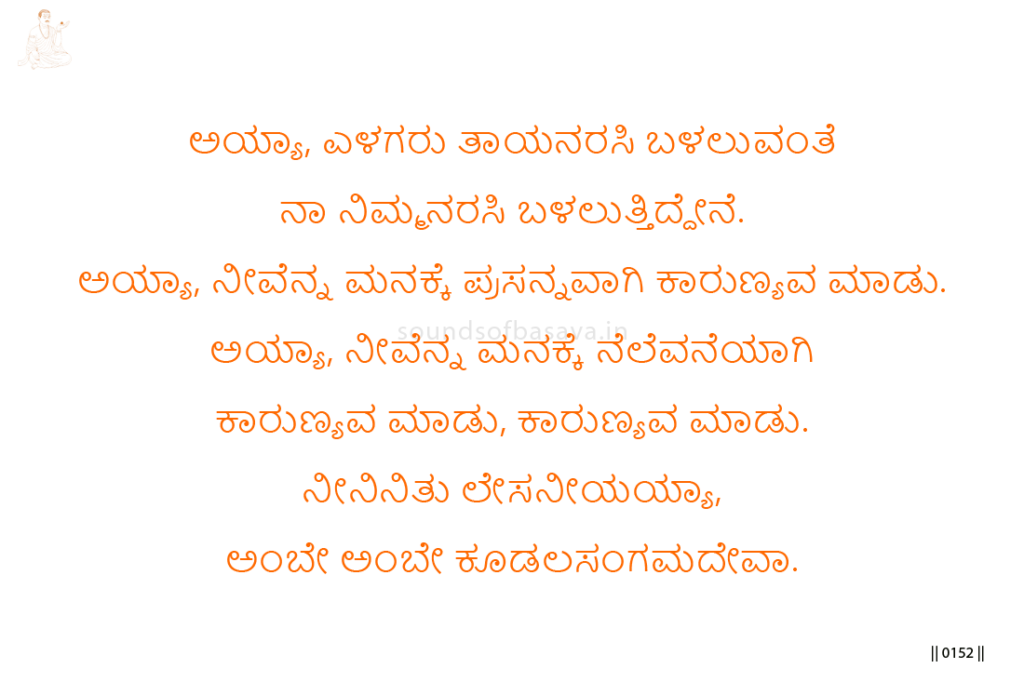
In this vachana, Basavanna cries to Kudalasangama Deva as an infant cries for its mother. The image is one of complete dependence, helplessness, and trust.
He asks the Lord to be gracious to his heart. He does not ask for power, honor, or attainment, but for compassion and inward nearness.
The repeated plea “show mercy, show mercy” gives the vachana its tenderness. Basavanna seeks Kudalasangama Deva as the One who must dwell in the heart and sustain it like a mother.
Imagery & Symbolic Relevance
The infant crying for the mother is the central image. An infant has no self-sufficient strength. It does not approach the mother through argument or merit. It cries because the mother alone is its refuge.
Basavanna takes this condition as his own. His cry is not formal prayer alone; it is need, trust, and surrender joined together.
The heart is the place where grace is sought. Basavanna asks Kudalasangama Deva to become gracious to his heart and to make the heart His dwelling.
The repeated request for mercy shows that grace is not secondary. The seeker depends on compassion at the deepest level.
The final cry, “Mother, Mother,” completes the image. Kudalasangama Deva is invoked not as distant authority, but as intimate refuge, nourishment, and protection.
The imagery therefore teaches that mature devotion does not become hard or self-sufficient. It becomes simple, dependent, and open before the Divine.
Lingayoga
In Lingayoga, the Anga must not stand before the Linga with pride or self-claim. It must become receptive.
This vachana shows the heart as the field of practice. The seeker asks not merely to see the Linga outwardly, but for Kudalasangama Deva to dwell inwardly.
The infant’s cry teaches the discipline of dependence. Practice does not mature through self-sufficiency alone; it requires grace.
When the heart becomes softened by longing and mercy, remembrance deepens. Lingayoga becomes not only effort, but inward shelter in Kudalasangama Deva.
Editorial Commentary
This vachana should be read as a prayer of childlike dependence. Basavanna’s cry is not weakness; it is surrender without disguise.
The teaching is direct: the heart must become the dwelling-place of Kudalasangama Deva through mercy.
Related Vachana
Supporting Vachana
Vachana 980 — The Single-Pointed Devotion
Vachana 980 teaches the unbroken vow of single-pointed devotion to Kudalasangama Deva. Vachana 987 continues this movement by showing that such fidelity must soften into complete dependence on Divine mercy.
Advancing Vachana
Maheshwara Vachana 1259 — The Collapse of Boastful Claims Before Māyā
Vachana 987 shows the devotee crying like a child for the mother, asking Kudalasangama Deva to dwell in the heart through mercy. Maheshwara Vachana 1259 advances this sacred exchange into the final seamless state, where dependence, grace, and indwelling presence are no longer separate movements but one continuous abidance.
