

Summary
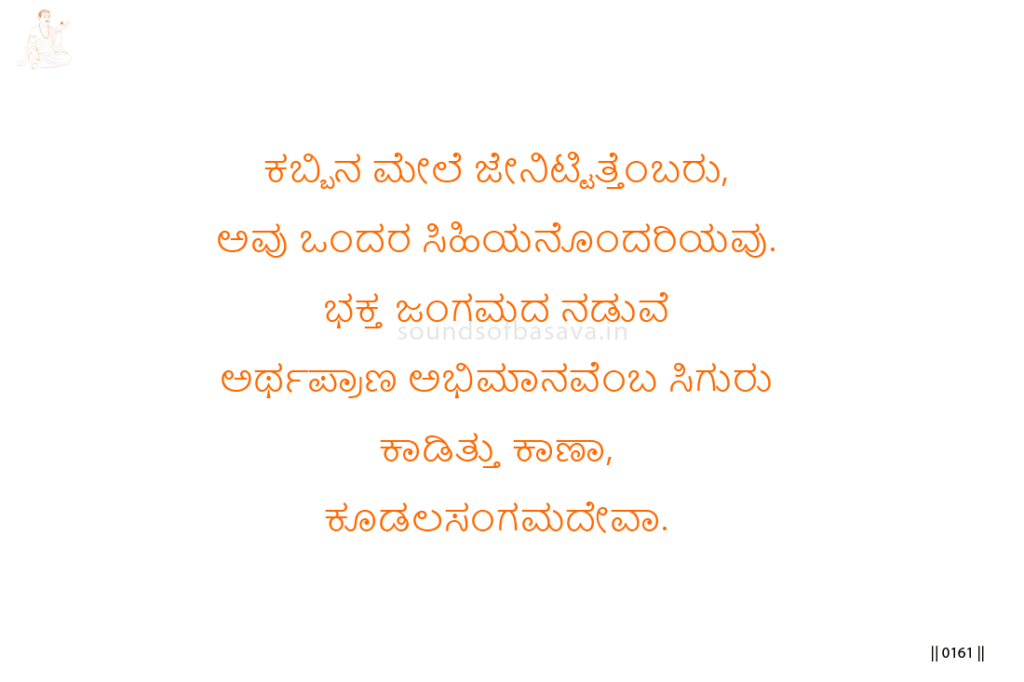
In this vachana, Basavanna gives the image of honey resting upon sugarcane. Both are sweet, yet one does not know the sweetness of the other.
He applies this image to the relation between Bhakta and Jangama. Although they belong to the same field of devotion, true recognition may still fail to arise between them.
The obstacle is the subtle covering called artha, prana, and abhimana: attachment to meaning, life, and self-regard. Basavanna shows that even where devotion is present, pride can grow as a thin veil between the Bhakta and the Jangama.
Imagery & Symbolic Relevance
Honey upon sugarcane is the central image. Honey is sweet, and sugarcane is sweet. Yet their sweetness does not automatically become known to one another.
Basavanna uses this delicate image to show that nearness is not the same as recognition. The Bhakta may be near the Jangama, and the Jangama may stand within the field of devotion, yet the living sweetness of the relation may remain untasted.
The siguru, the thin covering or membrane, is the decisive image. It is not a thick wall. It is subtle, but it is enough to prevent true contact.
Basavanna names this covering as artha, prana, and abhimana. Artha points to attachment to meaning, interpretation, or personal understanding. Prana points to attachment to life, identity, and self-preservation. Abhimana points to pride, self-regard, and the sense of “mine.”
These are not crude obstacles alone. They can survive inside devotional life itself. One may have devotion, but still cling to one’s own understanding, one’s own life-claim, and one’s own spiritual importance.
The imagery therefore teaches that sweetness must recognize sweetness. Bhakta and Jangama come into true relation only when the subtle veil of pride and self-claim is removed.
Lingayoga
In Lingayoga, the relation between Bhakta and Jangama must not remain external. The seeker must recognize living realization when it stands before him.
This vachana warns that even a thin covering can block that recognition. Attachment to one’s own interpretation, one’s own identity, or one’s own devotional standing prevents the flow between Bhakta and Jangama.
The honey and sugarcane image shows that spiritual nearness is not enough. The practitioner may live near sacred forms, teachings, and realized presence, yet still fail to taste their essence.
Lingayoga matures when the subtle veil is seen and removed. Then the Bhakta no longer stands protected by self-regard, and the sweetness of Jangama becomes directly known.
Editorial Commentary
This vachana should be read as a teaching on subtle obstruction. Basavanna does not describe an obvious hostility between Bhakta and Jangama, but a delicate covering that prevents recognition.
The teaching is direct: pride of meaning, life, and self-regard must fall away before sweetness can know sweetness.
Related Vachana
Supporting Vachana
Vachana 1129 — Can Good Sense Enter a Closed Mind?
Vachana 1129 teaches that right understanding cannot enter where the mind is closed by wrong understanding. Vachana 1132 continues this by showing a subtler form of closure: even between Bhakta and Jangama, pride and self-regard can become a veil.
Advancing Vachana
Maheshwara Vachana 972 — The Hero Born of Divine Fire
Vachana 1132 shows that a subtle veil of artha, prana, and abhimana can stand between Bhakta and Jangama. Maheshwara Vachana 972 advances this into the burning at the root, where the coverings that obstruct recognition must be consumed at their source. What appears here as a thin membrane becomes, in the next movement, the root obstruction to be burned before Kudalasangama Deva.
