

Summary
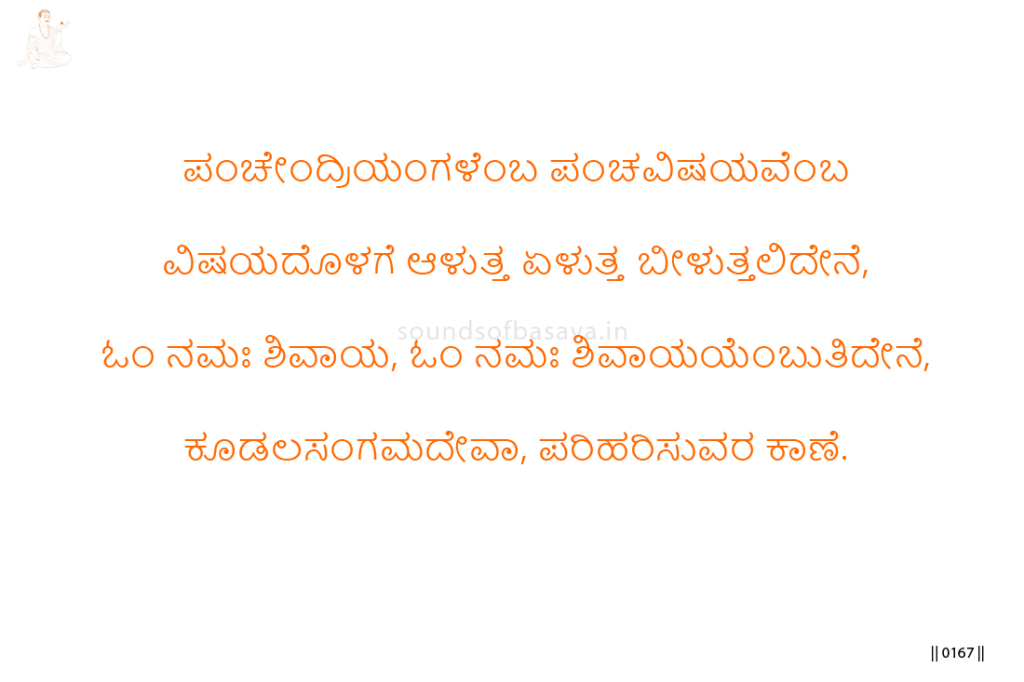
In this vachana, Basavanna confesses that he remains caught within the five senses and their five objects. He sinks, rises, and falls again and again.
At the same time, he continues repeating “Om Namah Shivaya.” The mantra is sacred, but its repetition has not yet freed him from sensory entanglement.
The teaching is direct: Basavanna does not reject the mantra. He rejects mantra that remains only on the tongue while the senses continue to rule the seeker. True release requires the mantra to become lived awareness before Kudalasangama Deva.
Imagery & Symbolic Relevance
The five senses and the five objects form the first image. The senses move outward, and their objects draw the mind into attraction, habit, and desire.
Basavanna says he is within this field. He is not describing the senses from a distance. He confesses that he is caught inside their movement.
The phrase “sinking, rising, and falling” gives the vachana its rhythm. The seeker rises through remembrance or effort, sinks again into the senses, and falls back into old patterns.
This is spiritual instability. There is aspiration, but there is not yet freedom.
Against this movement, Basavanna repeats “Om Namah Shivaya.” The sacred name is present, but the inner bondage remains.
The contrast is central. The tongue chants the mantra, but the senses still pull the mind. Sound is present, but transformation is incomplete.
The final cry, “I find none who can free me,” shows honest helplessness. Basavanna sees that mechanical repetition alone cannot bring release. He turns to Kudalasangama Deva for true removal of bondage.
The imagery therefore teaches that mantra must move from sound into consciousness. Until then, the seeker continues to rise and fall within the senses.
Lingayoga
In Lingayoga, mantra is not meant to remain verbal alone. It must enter awareness, conduct, and the whole relation between Anga and Linga.
This vachana warns against separating chanting from inner transformation. The seeker may repeat “Om Namah Shivaya,” yet still be governed by sight, sound, smell, taste, touch, and their objects.
The practice matures when the mantra begins to restrain, purify, and redirect the senses. It must become remembrance, not only repetition.
The five senses need not be hated, but they must no longer rule the Anga. When the mantra becomes living awareness, the outward pull weakens and the seeker stands more steadily before Kudalasangama Deva.
Editorial Commentary
This vachana should be read as a correction of mechanical repetition. Basavanna does not diminish “Om Namah Shivaya”; he asks that it become real within the seeker.
The teaching is direct: mantra must be embodied, not merely repeated.
Related Vachana
Supporting Vachana
Vachana 1241 — The Exposure of Hollow Devotion
Vachana 1241 shows Kudalasangama Deva revealing that devotion may be hollow within, even when outward form remains. Vachana 1264 continues this exposure by showing that mantra too may remain outward if it does not free the seeker from the pull of the senses.
Advancing Vachana
Maheshwara Vachana 1259 — The Collapse of Boastful Claims Before Māyā
Vachana 1264 teaches that repeating “Om Namah Shivaya” is not enough if the seeker continues to sink and fall within the senses and their objects. Maheshwara Vachana 1259 advances this into the final seamless state, where mantra, awareness, and being are no longer divided. What is exposed here as repetition without release becomes, in the next movement, seamless abidance before Kudalasangama Deva.
