

Summary
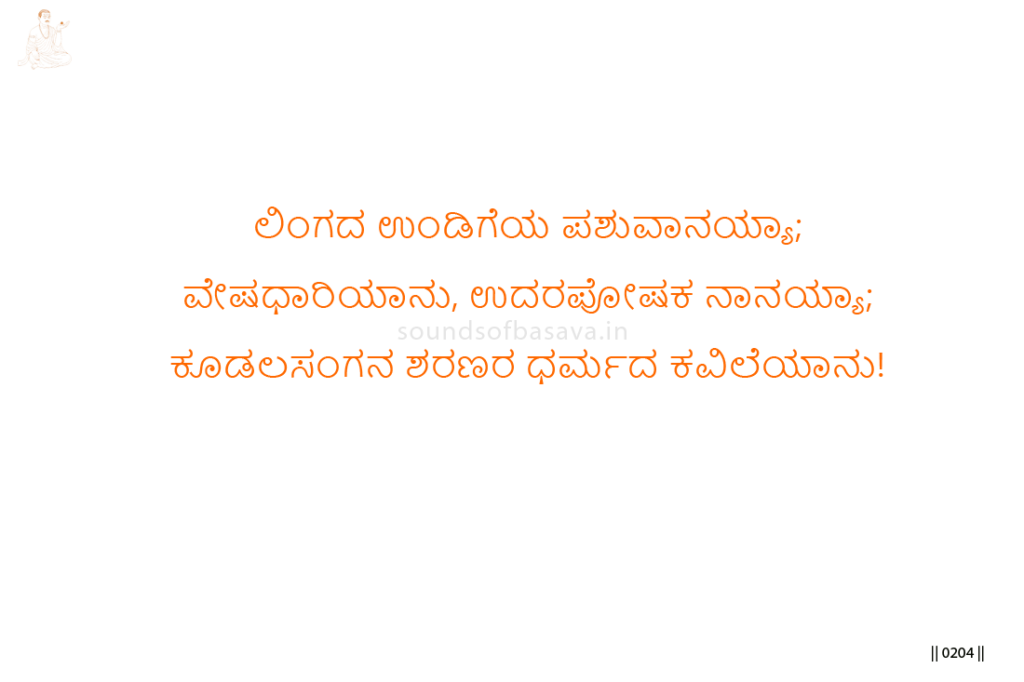
In this vachana, Basavanna confesses the difference between carrying the Linga and becoming inwardly transformed by it. The Linga is borne in its vessel upon the body, yet he calls himself animal-like.
He also calls himself a wearer of appearance and one who feeds the belly. Sacred bearing and devotional form are therefore not enough if life remains governed by bodily hunger.
Basavanna places this confession before the dharma of Kudalasangama Deva’s Sharanas. Their way becomes the measure before which his own outwardness is exposed.
Imagery & Symbolic Relevance
The first image is the Linga-vessel carried on the body. The Linga is physically borne near the chest, but Basavanna does not allow this outward bearing to become a claim of realization.
The second image is the animal carrying it. This is the sharp force of the vachana. The sacred vessel may be carried, yet the bearer may remain governed by instinct.
The third image is the wearer of appearance. Sacred form is visible, but visibility alone does not prove inward change.
The fourth image is feeding the belly. This shows life centered on bodily maintenance and need.
The final image is the dharma of the Sharanas. Basavanna measures himself not by what he carries or wears, but by the living way of Kudalasangama Deva’s Sharanas.
Together, these images expose spiritual appearance without transformation. The Linga may be carried, the marks may be worn, and the belly may be fed, yet the self may remain animal-like unless it lives the dharma of the Sharanas.
Lingayoga
In Lingayoga, this vachana warns that carrying the Linga must become inward transformation. The Linga-vessel on the body is not the completion of practice.
The body’s hunger must not govern the path. If practice remains at the level of bearing, appearance, and belly-feeding, the seeker remains outwardly marked but inwardly unchanged.
The practical movement here is honest self-measure. Basavanna places himself before the dharma of Kudalasangama Deva’s Sharanas and allows that measure to expose him.
Editorial Commentary
This vachana should be read as a confession against spiritual appearance. Basavanna does not reject the carrying of the Linga. He rejects the condition in which one carries the Linga outwardly, wears devotional appearance, and still lives from bodily hunger rather than Sharana-dharma.
Related Vachana
Supporting Vachana
Bhakta Sthala Vachana 108 — The Futility of the Unlived Truth
Bhakta Sthala Vachana 108 supports this vachana by asking what use the Linga has in the hands of one who does not know Kudalasangama Deva’s Sharanas or the Shiva-path. Vachana 85 carries that concern into confession: the Linga may be carried on the body, yet the bearer may remain animal-like if the truth is not lived.
Advancing Vachana
Prasadi Sthala Vachana 509 — Through Your Anubhava.
Prasadi Sthala Vachana 509 advances this movement by showing what true transformation looks like. Vachana 85 confesses a self still ruled by appearance and bodily hunger. Vachana 509 carries this into Prasadi Sthala, where Kudalasangama Deva’s experience causes body-identification and mind-identification to fall away, karma is cut, and the Sharanas refine devotion like gold made pure.
