

Summary
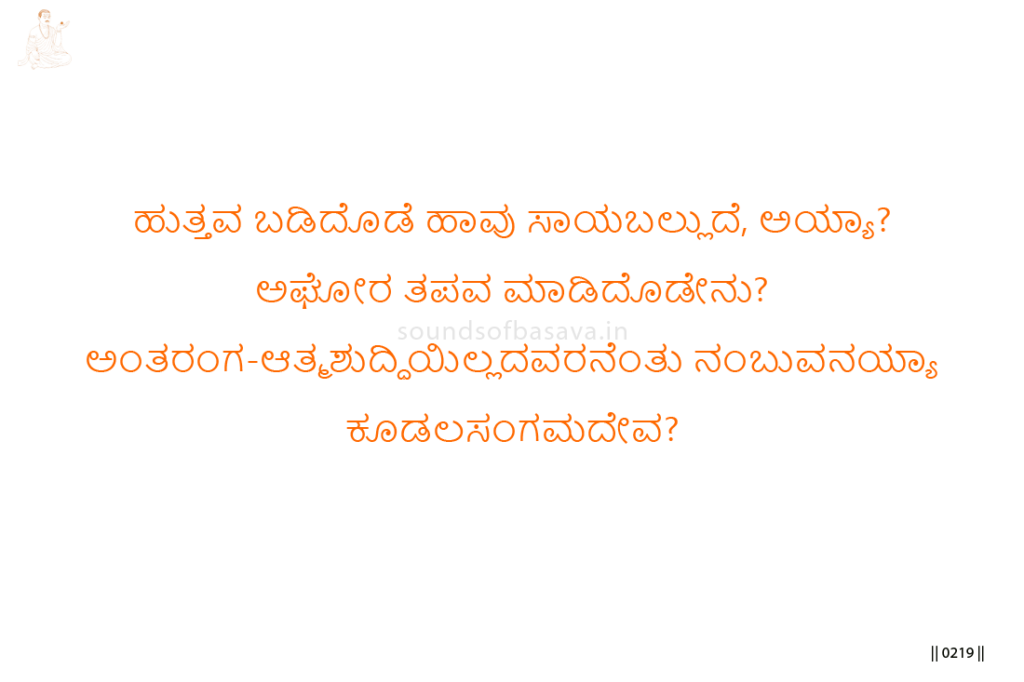
In this vachana, Basavanna asks whether a serpent can be killed by striking around its hole. The question shows the futility of effort that does not reach the hidden source.
He then asks what use fierce austerity has when inner self-purity is absent. Practice may be intense, but if the inner condition remains untouched, it cannot be trusted.
Basavanna brings the question before Kudalasangama Deva: how can one trust those who lack inner self-purity? The concern is not the appearance of effort, but whether the effort reaches within.
Imagery & Symbolic Relevance
The first image is the serpent. It represents the hidden danger that must be directly addressed.
The second image is the serpent’s hole. The source of the danger lies within, not on the surface around it.
The third image is striking around the hole. This shows misdirected effort. Noise and force may be present, but the serpent remains untouched.
The fourth image is fierce austerity. Basavanna does not deny austerity as effort; he questions its fruit when it does not produce inner purity.
The final image is inner self-purity. This is the true measure of trust. Without it, outward discipline cannot prove spiritual worth.
Together, these images show that effort must reach the root. Striking around the hole does not kill the serpent; austerity without inner purity does not establish truth.
Lingayoga
In Lingayoga, this vachana tests whether practice has entered the inner condition. Outer effort alone is not enough.
The serpent-hole image warns against circling the problem without touching its source. Discipline must not remain at the surface.
The practical movement here is inward purification. Basavanna asks the seeker to measure practice not by severity, but by whether inner self-purity has arisen before Kudalasangama Deva.
Editorial Commentary
This vachana should be read as a warning against misdirected spiritual effort. Basavanna does not reject discipline. He rejects discipline that strikes around the source while leaving the inner serpent alive.
Related Vachana
Supporting Vachana
Bhakta Sthala Vachana 125 — The Barren Field of the Heart
Bhakta Sthala Vachana 125 supports this vachana by showing that outward action, contact, and repetition do not become realization by themselves. The ox may bend its head, the tongs may hold fire, and the parrot may recite, yet inward awakening may still be absent. Vachana 117 carries the same concern into austerity: effort has no true fruit if it does not reach inner self-purity.
Advancing Vachana
Prasadi Sthala Vachana 511 — Practice Goes On, Yet Devotion Is Not Attained
Prasadi Sthala Vachana 511 advances this movement by showing that practice may continue again and again while devotion still does not arise. Vachana 117 asks what use fierce austerity has without inner self-purity. Vachana 511 carries this into Prasadi Sthala, where the seeker admits that inward turning, gathered mind, and removal of bodily qualities depend upon Kudalasangama Deva’s grace.
