

Summary
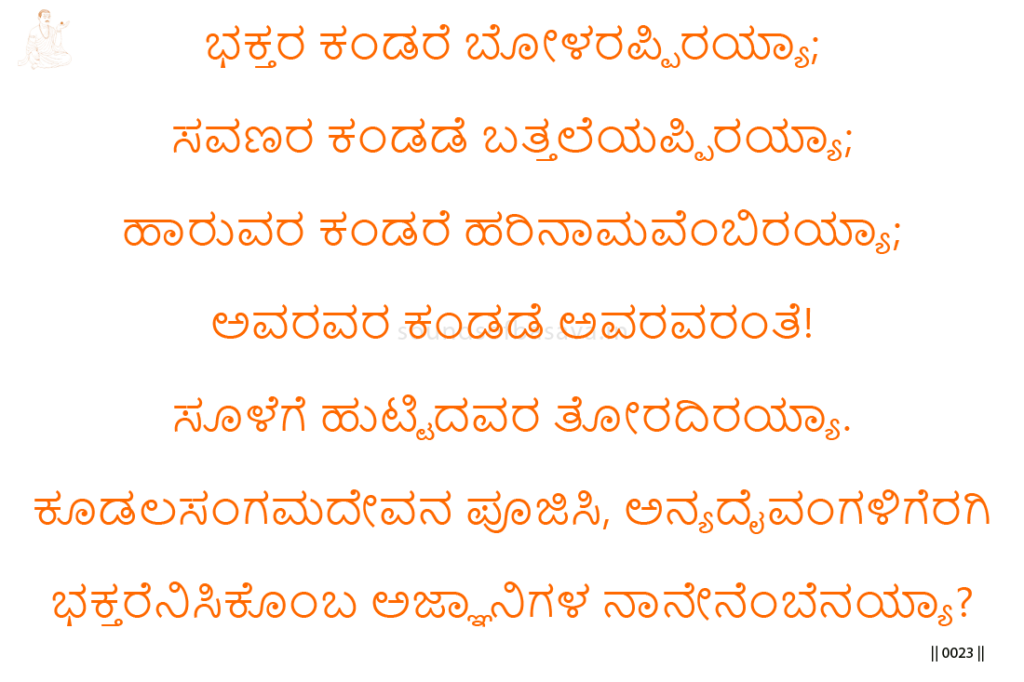
In this vachana, Basavanna criticizes those who identify people only by outward appearance. They see a bhakta, an ascetic, or another religious figure, and immediately name each according to visible marks.
Such seeing remains shallow. It recognizes form, but not inner truth.
The final lines sharpen the criticism. One may worship Kudalasangama Deva, yet still bow before other deities and claim to be a bhakta. Basavanna calls this ignorance, because devotion has not become undivided.
Imagery & Symbolic Relevance
The repeated act of seeing is central to the vachana. People see different religious figures and assign names to them according to outward signs.
Basavanna exposes the inadequacy of such recognition. A person is not known truly by appearance, clothing, mark, or name.
The line “each one as each appears” shows perception limited to surface. The viewer sees categories, not spiritual reality.
The final turn concerns divided worship. After worshipping Kudalasangama Deva, one still turns elsewhere for refuge or reverence.
This is the deeper blindness. The eyes may see religious forms, but the heart has not recognized the meaning of exclusive devotion.
Lingayoga
In Lingayoga, the practitioner must move from outer seeing to inner recognition.
The Anga cannot remain satisfied with labels, forms, and visible signs. It must discern whether devotion has become steady before Linga.
Divided worship weakens this steadiness. When the mind bows in many directions, its inward relation to Kudalasangama Deva remains unsettled.
Practice matures when seeing becomes clear and devotion becomes single-pointed.
Editorial Commentary
This vachana distinguishes religious recognition from spiritual discernment.
Basavanna’s concern is not the variety of appearances, but the failure to see what devotion truly demands.
Related Vachana
Supporting Vachana
Vachana 99 — The Unsoftened Stone
Vachana 99 shows worship without inward softening. Vachana 103 continues the examination by showing worship without undivided recognition.
Advancing Vachana
Maheshwara Vachana 59 — The Prayer for Sacred Sensory Gates
The surface-seeing of Vachana 103 advances into the blind eye of Maheshwara Vachana 59. What appears here as labeling without recognition becomes, in the next movement, the deeper incapacity to see truth before Kudalasangama Deva.
