

Summary
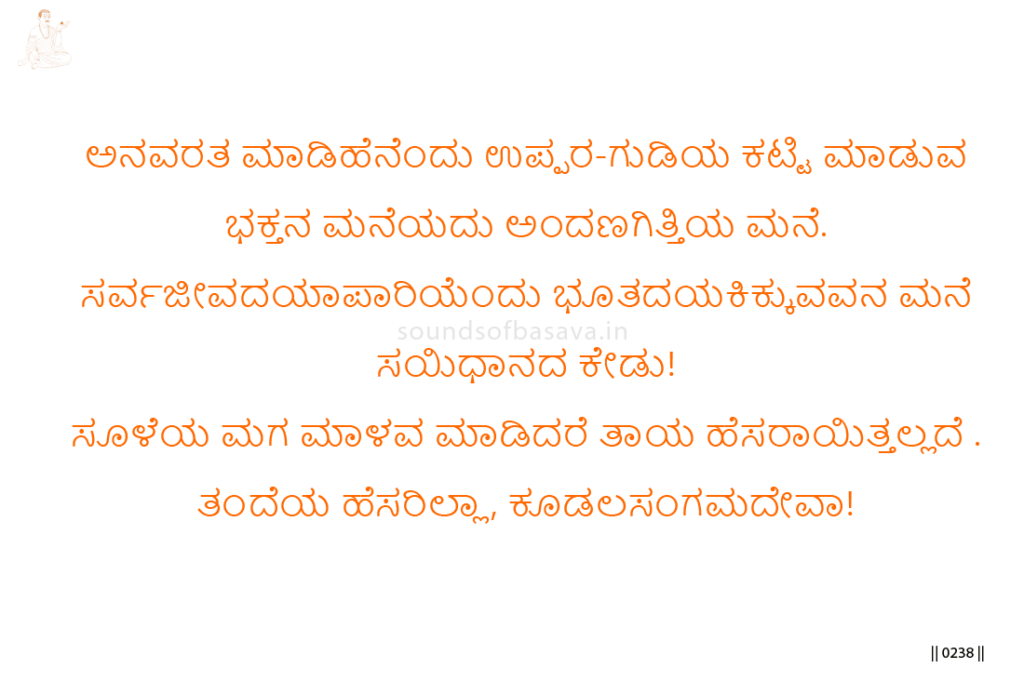
In this vachana, Basavanna exposes religious activity that remains outward. The devotee says, “I have done much,” and builds lofty shrines, yet his own house is like a cook’s kitchen.
He then turns to the claim of compassion. One may call oneself compassionate toward all beings, yet remain occupied with care for the body of elements. The claim is large, but the inward measure is small.
The final image is the courtesan’s son. If he builds a house, it bears the mother’s name, not the father’s. Basavanna uses this image to show a life with visible identity but without true source before Kudalasangama Deva.
Imagery & Symbolic Relevance
The first image is repeated religious building. The devotee claims much action and constructs visible sacred forms.
The second image is the lofty shrine. It appears elevated, but Basavanna does not accept height or visibility as proof of inner truth.
The third image is the cook’s kitchen. The house remains centered on preparation, maintenance, and bodily need. This image reduces outward religious greatness to ordinary bodily occupation.
The fourth image is compassion for all beings. The claim is broad and noble, but Basavanna tests whether it is true in lived condition.
The fifth image is care for the body of elements. What is called universal compassion may still remain bound to bodily concern.
The final image is the courtesan’s son. The house may stand, but the name of the father is absent. In the same way, outward identity may be present while true rootedness is lacking.
Together, these images expose activity without source. Shrines may be built, compassion may be claimed, and a house may stand, but without inward truth the life remains ungrounded.
Lingayoga
In Lingayoga, this vachana tests whether action has become inwardly truthful. Religious construction, service, and claims of compassion cannot replace inner rootedness.
The cook’s kitchen shows that activity may remain tied to bodily maintenance. The courtesan’s son shows identity without clear source.
The practical movement here is source-bound devotion. Basavanna asks the seeker to examine whether action arises from truth before Kudalasangama Deva, or whether it remains outward activity and bodily concern.
Editorial Commentary
This vachana should be read as a warning against religious productivity without inner source. Basavanna does not reject building, service, or compassion. He rejects the condition in which these are claimed outwardly while the house of the seeker remains centered on bodily maintenance and lacks true rootedness.
Related Vachana
Supporting Vachana
Bhakta Sthala Vachana 233 — Spiritual Automation
Bhakta Sthala Vachana 233 supports this vachana by teaching that repeated doing and repeated giving do not become sacred by quantity alone. They require nijaguna, the true quality within the act. Vachana 226 carries this concern into Maheshwara Sthala: one may build much and claim compassion, yet without inward truth the action remains hollow.
Advancing Vachana
Prasadi Sthala Vachana 741 — The Depth Within
Prasadi Sthala Vachana 741 advances this movement by showing that Kudalasangama Deva responds to inner depth, not outward greatness. Vachana 226 exposes visible religious activity without true source. Vachana 741 carries this into Prasadi Sthala, where royal abundance and great offering do not compel acceptance, while humble depth becomes the true measure before Kudalasangama Deva.
