

Summary
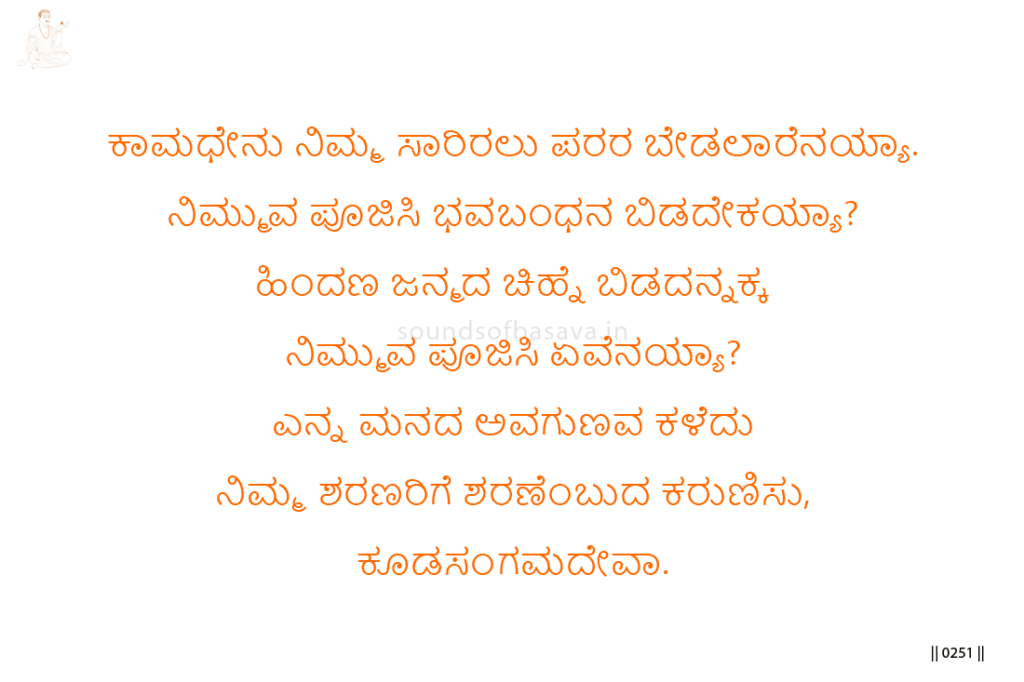
In this vachana, Basavanna asks why one should beg from others when Kamadhenu stands near. The source of fulfilment is present, yet the habit of seeking elsewhere continues.
He then asks what use worship is if the bondage of becoming has not been released. If the marks of former birth remain, worship has not yet touched the root of bondage.
Basavanna therefore prays to Kudalasangama Deva: remove the faults of my mind and grant me refuge in your Sharanas. The teaching is clear: worship must become inward release, not merely outward act.
Imagery & Symbolic Relevance
The first image is Kamadhenu standing near. Kamadhenu represents the all-giving source already present before the seeker.
The second image is begging from others. This shows the contradiction of seeking elsewhere while the source is near.
The third image is worship that has not released bondage. Basavanna does not reject worship. He asks whether worship has become effective if bhava-bandhana remains.
The fourth image is the mark of former birth. Old traces continue to cling. The seeker sees that previous conditioning has not yet fallen away.
The fifth image is the fault of the mind. The obstacle is not outside alone; it remains within the mind’s own defects.
The final image is refuge in the Sharanas. Basavanna asks not for worldly fulfilment, but for shelter in the living company of Kudalasangama’s Sharanas.
Together, these images show the persistence of bondage despite nearness and worship. Kamadhenu is near, worship is performed, yet old marks remain. The prayer therefore turns toward removal of the mind’s faults and refuge in the Sharanas.
Lingayoga
In Lingayoga, this vachana tests whether worship has entered the mind deeply enough to release bondage.
The seeker must not remain near the source and still beg elsewhere. Worship must not remain external while old marks and mental defects continue.
The practical movement here is inward correction. Basavanna asks Kudalasangama Deva to remove the mind’s faults and place him under the refuge of the Sharanas.
Editorial Commentary
This vachana should be read as a confession against incomplete worship. Basavanna does not deny the nearness of the Divine. He asks why, despite that nearness, the seeker still seeks elsewhere and remains bound. The prayer is not for more gain, but for the removal of what keeps bondage alive.
Related Vachana
Supporting Vachana
Bhakta Sthala Vachana 212 — The Double-Edged Blade
Bhakta Sthala Vachana 212 supports this vachana by showing how ignorance gives rise to ego, restlessness, body-attachment, desire, impurity, samsara, attraction, aversion, and sorrow. Vachana 261 carries that concern into Maheshwara Sthala: even after worship, the marks of former birth and the faults of the mind remain unless Kudalasangama Deva removes them.
Advancing Vachana
Prasadi Sthala Vachana 943 — The Grace Beyond All Division
Prasadi Sthala Vachana 943 advances this movement by showing the state in which illusion, stain, sorrow, temporality, and division have been left behind. Vachana 261 prays for the mind’s faults and old marks to be removed. Vachana 943 carries this into Prasadi Sthala, where the seeker becomes Prasadi in Kudalasangama Deva after such residues no longer remain.
