

Summary
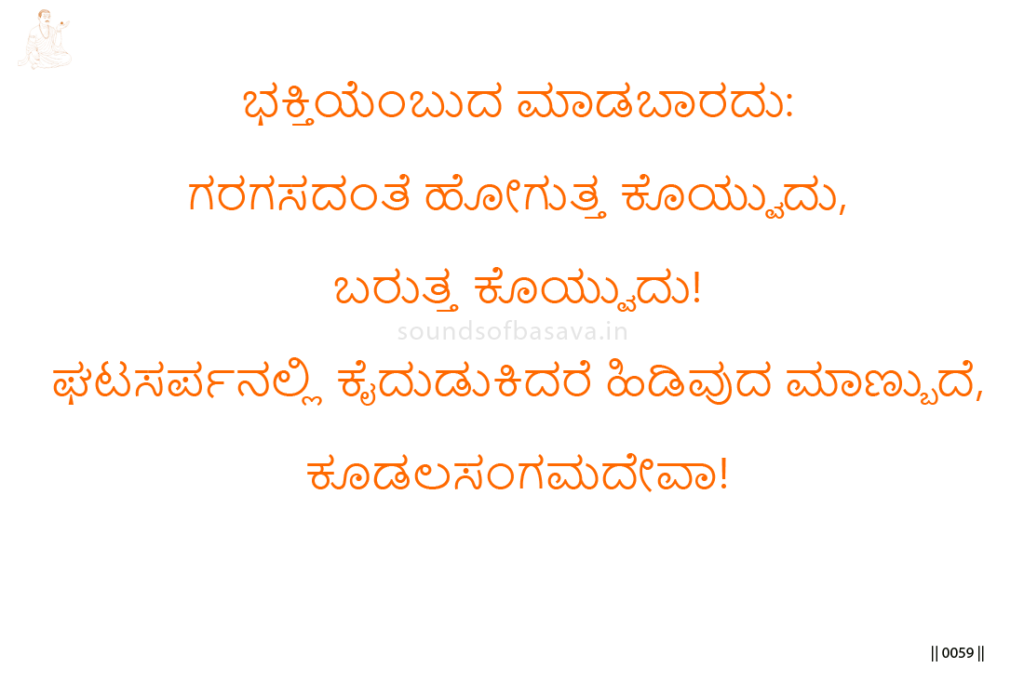
In this vachana, Basavanna warns that bhakti must not be taken up carelessly.
It is like a cutting instrument that cuts while going and cuts while returning. Once entered, it does not allow careless movement.
He then gives the image of a cobra hidden in a pot. If one thrusts the hand inside without steadiness, can it be safely held? Bhakti before Kudalasangama Deva requires alertness, reverence, and truth.
Imagery & Symbolic Relevance
The first image is the cutting blade. It cuts in both directions, showing that bhakti is not a harmless ornament.
Every movement within devotion exposes the seeker. Falsehood, pride, and divided intention cannot pass through it untouched.
The second image is the cobra in the pot. The danger is hidden, living, and immediate.
To place the hand inside without care is to invite harm. In the same way, one cannot enter bhakti with an unsteady mind and expect safety.
Basavanna’s question gives the vachana its force. Can such a thing be held casually? The answer is no. Bhakti must be approached with disciplined awareness before Kudalasangama Deva.
Lingayoga
In Lingayoga, bhakti is a force that cuts and awakens.
The Anga cannot treat devotion as occasional feeling. Once it turns toward Linga, its movements are tested.
The blade image shows the purifying sharpness of practice. The cobra image shows the need for inward vigilance.
Practice matures when the seeker does not merely admire bhakti, but becomes fit to hold it.
Editorial Commentary
This vachana removes sentimentality from devotion.
Basavanna presents bhakti as powerful, exacting, and unsafe for the careless.
Related Vachana
Supporting Vachana
Vachana 207 — The Substance of Devotion
Vachana 207 teaches that dance, song, and recitation are empty without threefold dāsoha and bhakti. Vachana 212 continues by showing that bhakti itself is not casual expression, but a sharp and demanding path.
Advancing Vachana
Maheshwara Vachana 219 — The Two Suns of Devotion
Vachana 212 presents bhakti as a force that cuts through carelessness. Maheshwara Vachana 219 advances this into the fuller demand of Linga-bhakti and Jangama-bhakti, where devotion must stand active both inwardly and in living service before Kudalasangama Deva.
