

Summary
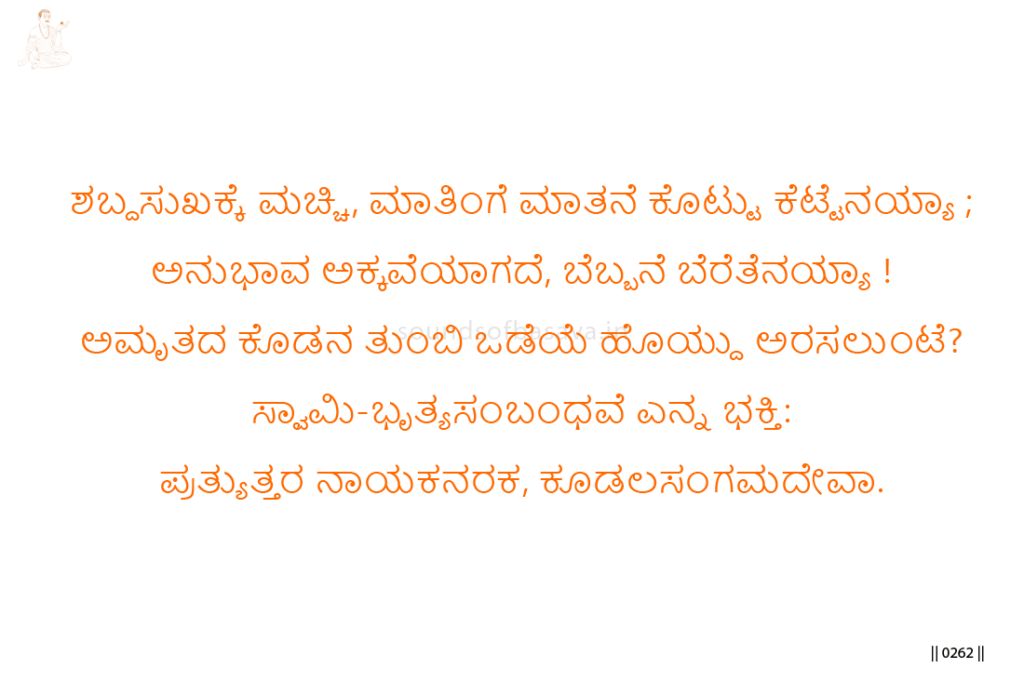
In this vachana, Basavanna confesses that he became attached to the sound of words. He answered word with word and was ruined.
Without anubhava becoming established, speech scattered him. Words continued, but they did not arise from lived realization.
He then gives the image of a vessel filled with nectar being spilled. Once such nectar is lost, can it be gathered again? Basavanna concludes that his bhakti is the Lord–servant relation. To answer back in self-assertion is the path to ruin before Kudalasangama Deva.
Imagery & Symbolic Relevance
The first image is attachment to sound. Speech becomes attractive in itself, and the seeker becomes caught in the taste of words.
The second image is answering word with word. This shows speech becoming reaction, reply, and contention rather than realization.
The third image is anubhava not becoming established. Without lived experience, speech has no true ground. It moves outward but does not become inner truth.
The fourth image is being scattered. Speech without anubhava does not steady the seeker; it disperses him.
The fifth image is the nectar-filled vessel. Nectar represents what is precious and life-giving. But if the vessel is spilled, the loss is serious.
The final image is the Lord–servant relation. Basavanna identifies this relation as his bhakti. The servant does not stand in self-asserting reply before the Lord; he stands in humility and obedience.
Together, these images show the danger of word-centered devotion. Sound, reply, and argument can ruin the seeker when anubhava is absent. True bhakti must become the humble relation of servant to Lord.
Lingayoga
In Lingayoga, this vachana tests speech at its root. The spoken word must arise from anubhava, not from attraction to sound or the impulse to answer back.
The seeker must not allow words to replace lived realization. Speech must become grounded, humble, and answerable to Kudalasangama Deva.
The practical movement here is from verbal reaction to servant-conduct. Basavanna asks the seeker to leave word-pride and enter the Lord–servant relation as bhakti.
Editorial Commentary
This vachana should be read as a warning against speech without lived experience. Basavanna does not reject speech. He rejects word-reply, verbal attachment, and speech that stands apart from anubhava. Bhakti becomes true when the speaker no longer argues from self-claim, but stands as servant before the Lord.
Related Vachana
Supporting Vachana
Bhakta Sthala Vachana 243 — The Collyrium of Divine Love
Bhakta Sthala Vachana 243 supports this vachana by teaching that the bhakta’s path requires Shiva-love and the anubhava of Kudalasangama’s Sharanas. Vachana 299 shows what happens when anubhava is absent: words become sound, reply, and scattering. Vachana 243 gives the earlier remedy, where Sharana-anubhava becomes the medicine that steadies and heals the seeker.
Advancing Vachana
Prasadi Sthala Vachana 509 — Through Your Anubhava
Prasadi Sthala Vachana 509 advances this movement by showing the realization that Vachana 299 lacks. Vachana 299 confesses speech without established anubhava and calls true bhakti the Lord–servant relation. Vachana 509 carries this into Prasadi Sthala, where through Kudalasangama Deva’s anubhava, body and mind fall away, karma is cut, and the Sharanas reveal bhakti like gold made pure.
