

Summary
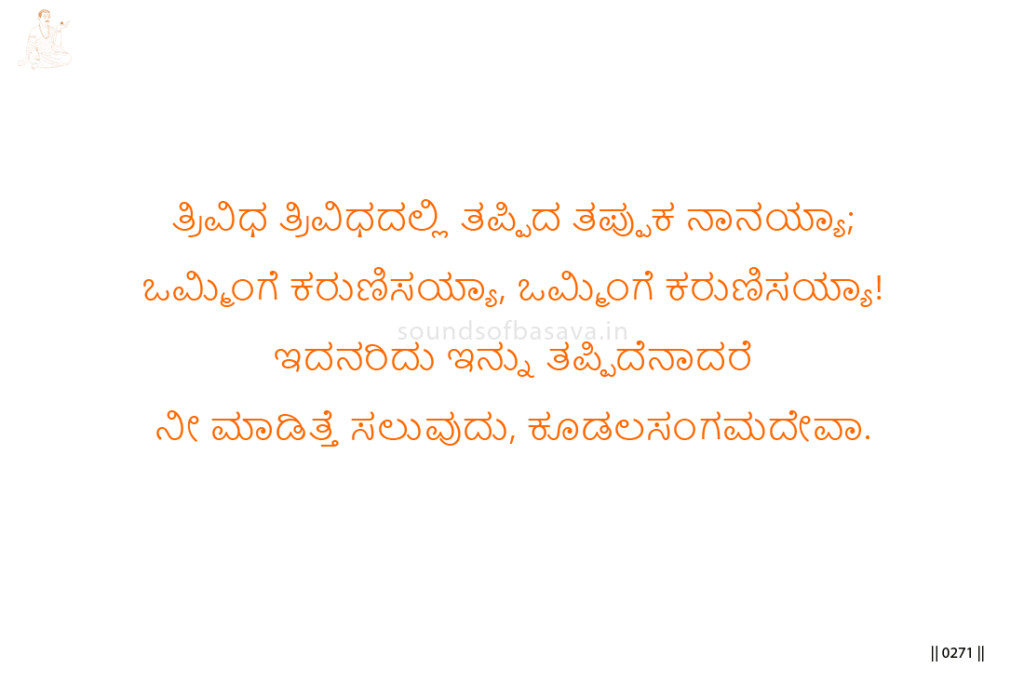
In this vachana, Basavanna confesses that he is a sinner who has failed in the threefold field. The failure is not limited to one action or one thought; it touches the whole field of body, mind, and wealth.
He asks Kudalasangama Deva to show mercy once. The plea is direct and humble.
He then says that if, after knowing this, he still falls again, Kudalasangama Deva must do what is needed and set him right. The teaching is clear: knowledge alone has not made him steady, so he turns to Divine correction.
Imagery & Symbolic Relevance
The first image is the threefold field. Body, mind, and wealth together form the practical field of human life.
The second image is failure within that field. Basavanna does not hide the fault in one corner of life. He admits that the failure reaches the whole person.
The third image is the plea for mercy. He does not claim strength, merit, or completion. He asks to be forgiven and corrected.
The fourth image is knowing and still failing. This is the sharpest point of the vachana. The seeker has understood, yet the possibility of falling again remains.
The final image is Kudalasangama Deva setting it right. Basavanna does not rely on self-power alone. He places the final correction in the hands of Kudalasangama Deva.
Together, these images show the difficulty of transformation after knowledge. The seeker knows, confesses, asks for mercy, and still recognizes that only Divine correction can make the path steady.
Lingayoga
In Lingayoga, this vachana tests whether knowledge has become lived steadiness. To know the fault is not yet to be free from the fault.
Body, mind, and wealth must all be brought into alignment. If any one of them remains unoffered, the seeker may fall again even after understanding.
The practical movement here is surrender after self-knowledge. Basavanna does not excuse repeated failure, but he also does not pretend that knowledge alone is enough. He turns to Kudalasangama Deva for correction.
Editorial Commentary
This vachana should be read as a confession after awareness has already begun. Basavanna is not speaking from simple ignorance. He says, in effect: “I know this, and yet if I fail again, You must set me right.”
That distinction is important for the reader. The problem is not only lack of knowledge; it is the weakness that remains after knowledge. A seeker may understand the need to offer body, mind, and wealth, yet old tendencies can still return.
The plea for mercy is therefore not an escape from responsibility. It is the recognition that responsibility itself must be supported by grace. Basavanna asks to be corrected, not merely comforted.
The threefold failure also gathers several earlier Maheshwara concerns. Body may act wrongly, mind may remain divided, and wealth may still carry possessiveness. In Vachana 322 these are brought together and placed under one plea: let Kudalasangama Deva do what the seeker cannot complete by self-effort alone.
Related Vachana
Supporting Vachana
Bhakta Sthala Vachana 300 — Forging the Unbreakable Vessel
Bhakta Sthala Vachana 300 supports this vachana by praying that there be no deceit in body, mind, and wealth. Vachana 322 shows the later confession of failure in that same threefold field. What Vachana 300 seeks as victory under testing, Vachana 322 brings before Kudalasangama Deva as failure requiring mercy and correction.
Advancing Vachana
Prasadi Sthala Vachana 936 — Dasoha at Every Stage
Prasadi Sthala Vachana 936 advances this movement by showing the mature correction of threefold failure. Vachana 322 confesses that the seeker fails even after knowing and asks Kudalasangama Deva to set him right. Vachana 936 carries this into Prasadi Sthala, where bhakti becomes Dasoha, yukti becomes Dasoha, and even the sense of “mine” in Aikya is surrendered before Kudalasangayya.
