

Summary
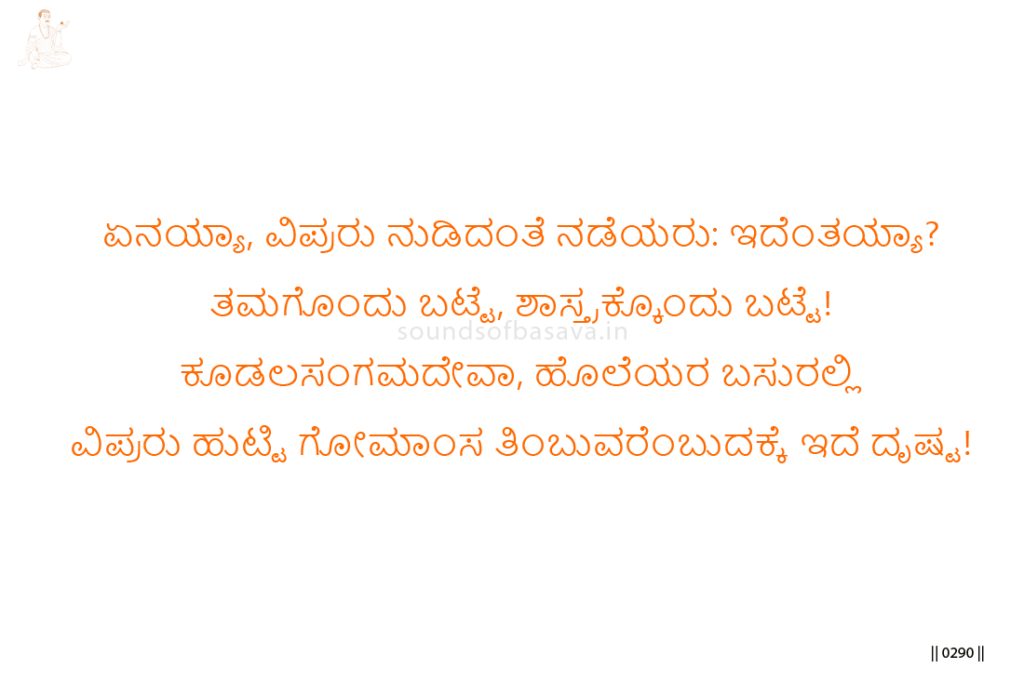
In this vachana, Basavanna asks why the learned do not live according to what they speak. Their words and conduct do not agree.
He gives the image of two garments: one for themselves and one for scripture. This shows a divided life, where teaching is held one way and living moves another way.
He then gives a severe example before Kudalasangama Deva: if those who claim purity are born in the womb of those they call impure and eat what they condemn, this is the proof. The teaching is clear: speech without lived truth becomes contradiction.
Imagery & Symbolic Relevance
The first image is the learned speaking but not living. Basavanna exposes the gap between instruction and conduct.
The second image is one garment for themselves and one garment for scripture. A garment covers and presents. Two garments show two standards: one for doctrine and another for life.
The third image is birth in the womb of those called impure. This overturns claims of superiority by showing dependence on the very life that is despised.
The fourth image is eating what is condemned. What is rejected in speech is consumed in conduct.
Together, these images reveal divided living. Basavanna does not reject learning or scripture. He rejects the separation of spoken doctrine from lived truth.
Lingayoga
In Lingayoga, this vachana tests integrity. The seeker must not allow speech and conduct to move in different directions.
Scripture cannot become a garment for public use while private life follows another measure. The path requires one standard.
The practical movement here is sincerity. What is spoken must be lived, and what is condemned outwardly must not be secretly consumed inwardly.
Editorial Commentary
This vachana should be read as a warning against double conduct. Basavanna’s question is simple: why do the learned not walk as they speak?
The two-garment image gives the teaching its force. One garment is worn before scripture; another is worn for oneself. This is not merely inconsistency, but a divided way of living.
The closing example is intentionally harsh. It exposes contradiction at the root of purity-claims. Before Kudalasangama Deva, the life one lives becomes the proof, not the doctrine one speaks.
Related Vachana
Supporting Vachana
Bhakta Sthala Vachana 803 — Words Become the Mirror of the Soul
Bhakta Sthala Vachana 803 supports this vachana by teaching that speech must be pure, transparent, and joined to conduct. If one’s conduct does not move within the word spoken, Kudalasangama Deva is not pleased. Vachana 575 carries this into Maheshwara Sthala by exposing those who speak scripture but do not live according to what they speak.
Advancing Vachana
Prasadi Sthala Vachana 905 — Grace Without Distinction
Prasadi Sthala Vachana 905 advances this movement by showing the correction to divided standards. Vachana 575 exposes a life split between scriptural claim and actual conduct. Vachana 905 carries this into Prasadi Sthala, where Guru’s grace and Chennayya’s grace stand within one shared conduct before Kudalasangama Deva.
