

Summary
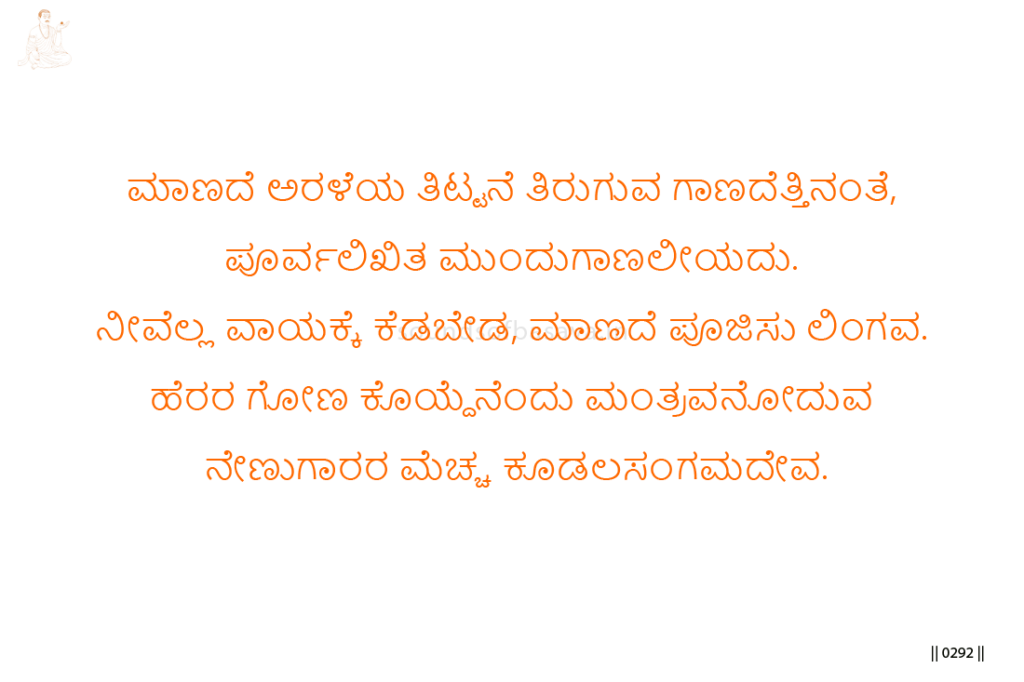
In this vachana, Basavanna compares blind action to a bull with covered eyes circling the oil-press. It moves continuously, but it does not know what it is doing.
He warns the listener not to be spoiled by others’ words. Instead, worship the Linga directly.
The final image is severe: one cuts another’s throat through false ritual recitation and mantra, like those who wear the sacred thread and claim religious authority. Kudalasangama Deva does not accept such people. The teaching is clear: blind movement, borrowed words, and ritualized harm cannot become true worship.
Imagery & Symbolic Relevance
The first image is the blindfolded bull. It has strength and movement, but no seeing. Its labor continues without awareness.
The second image is the oil-press. The bull goes round and round in one fixed pattern. This shows repetitive action without awakening.
The third image is what has been written before moving into what comes after. Blind action does not disappear. It carries its consequence forward.
The fourth image is others’ words. Basavanna warns the seeker not to fall under borrowed authority, inherited speech, or ritual claims that lack truth.
The fifth image is Linga worship. This is the correction. The seeker must turn directly toward Linga, not remain trapped in mechanical movement or false instruction.
The final image is the ritual throat-cutter. One harms another and covers the act with mantra and ritual recitation. Such false sacredness is not accepted by Kudalasangama Deva.
Together, these images show the danger of action without awareness. The bull moves but does not see. The ritualist chants but does not become truthful. Both reveal motion without realization.
Lingayoga
In Lingayoga, this vachana tests whether practice is conscious or mechanical. Repetition alone is not realization.
The seeker must not move like the blindfolded bull, circling through inherited patterns without seeing their meaning or consequence.
The practical movement here is direct Linga-orientation. Worship must awaken seeing and truthfulness. It must not become ritual language used to cover harm.
Editorial Commentary
This vachana should be read as a warning against blind religious motion. Basavanna does not condemn action itself; he condemns action without seeing.
The blindfolded bull shows movement without awareness. The ritual throat-cutter shows something worse: harm covered by mantra. In both cases, activity continues, but truth is absent.
The closing judgment is decisive. Kudalasangama Deva does not accept false ritual authority when it is joined to harm. Linga worship must become awakened responsibility, not sacred cover for violence.
Related Vachana
Supporting Vachana
Bhakta Sthala Vachana 125 — The Barren Field of the Heart
Bhakta Sthala Vachana 125 supports this vachana by showing outward resemblance without realization. An ox may bend its head, tongs may hold fire, and a parrot may recite, yet none of these becomes true devotion or Linga-knowledge. Vachana 579 carries the same concern into Maheshwara Sthala: movement, recitation, and ritual signs do not become worship when awareness is blind.
Advancing Vachana
Prasadi Sthala Vachana 777 — The Offering That Is Not Giving
Prasadi Sthala Vachana 777 advances this movement by correcting false ritual claim. Vachana 579 exposes harmful action covered by mantra and sacred-thread authority. Vachana 777 carries this into Prasadi Sthala, where true offering is not external claim or ritual cover, but the dissolution of separate selfhood before Kudalasangama Deva.
