

Summary
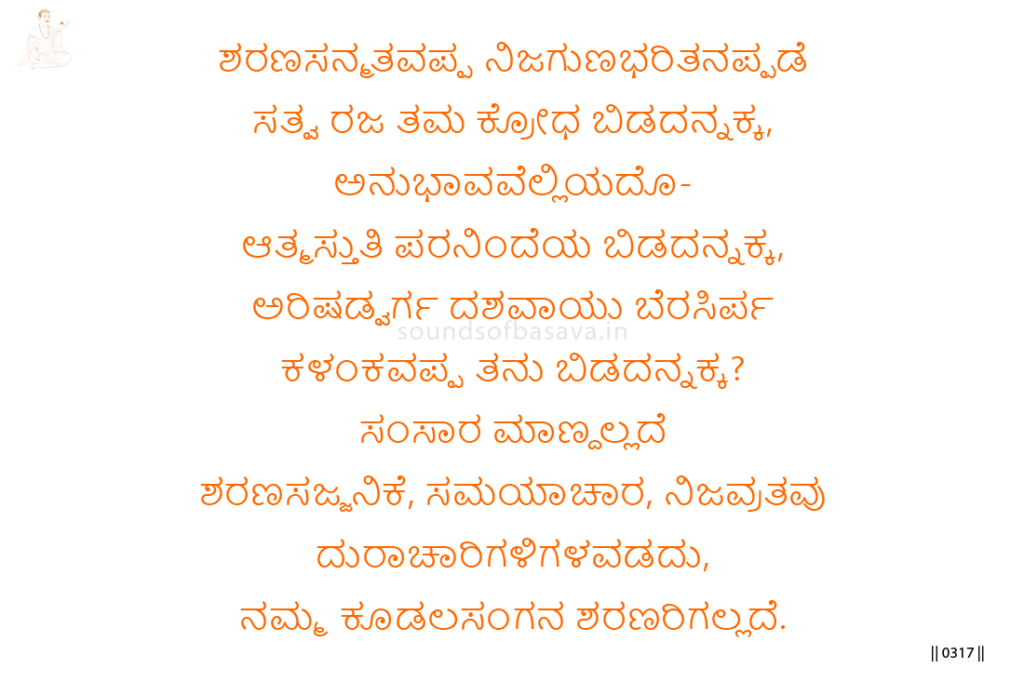
In this vachana, Basavanna defines true Sharana-life by inner transformation. If sattva, rajas, tamas, and anger are not relinquished, where is anubhava?
He then names subtler impurities: self-praise, criticism of others, the six inner enemies, the ten vital movements, and the stained body. If these remain, realization cannot be claimed.
Before Kudalasangama Deva, the conclusion is clear: Sharana-sajjanike, Samayachara, and Nija-vrata do not belong to the durachari. They belong only to the Sharanas of Kudalasangama.
Imagery & Symbolic Relevance
The first movement concerns true Sharana-hood. Basavanna does not accept name, praise, or appearance as proof. The Sharana must be inwardly changed.
The three gunas and anger show the conditioned movements that bind the person. Sattva, rajas, and tamas still belong to the field of nature. Anger shows that this conditioning has not been overcome.
Self-praise and criticism of others reveal divided consciousness. One who raises himself and lowers others still lives through comparison and separation.
The arishadvarga names the six inner enemies: desire, anger, greed, delusion, pride, and envy. These are not outer stains alone; they are forces that disturb the inner field of practice.
The ten vital movements and the stained body extend the warning to embodied life. Basavanna does not leave impurity as an idea. He places it in the body, mind, speech, conduct, and life-force of the seeker.
The final contrast is between true conduct and misconduct. Samayachara and Nija-vrata cannot dwell where durachara remains. True vow and true conduct require a purified inner condition before Kudalasangama Deva.
Lingayoga
In Lingayoga, this vachana teaches purification before realization. The seeker must not mistake religious identity for anubhava.
Anger, self-praise, criticism, and the inner enemies divide the seeker from true practice. They make the body and mind unfit to carry Sharana-life.
Practice matures when these impurities are not merely covered, but relinquished. Before Kudalasangama Deva, Sharana-life begins only where conduct, vow, and inward state become truthful.
Editorial Commentary
The question “where is anubhava?” controls the vachana. Basavanna is not asking whether a person has spiritual appearance, learning, or discipline. He is asking whether living realization has actually arisen.
“Samayachara” and “Nija-vrata” should be read as true conduct and true vow. They cannot belong to the durachari because misconduct and realization cannot stand together.
Related Vachana
Supporting Vachana
Bhakta Sthala Vachana 93 — The Stench and the Clay
Vachana 93 supports this teaching by showing that outer religious contact does not remove inner impurity. A dung-formed image does not lose its stench by being adorned, and a clay image does not change its nature by being washed. Vachana 856 carries the same principle into Maheshwara Sthala: one does not become a true Sharana while anger, self-praise, criticism, and inner enemies remain before Kudalasangama Deva.
Advancing Vachana
Prasadi Sthala Vachana 990 — Transformed Through the Touch of Grace
Vachana 990 advances this teaching by showing the corrective movement beyond impurity. There, through the company of Kudalasangama Deva’s Mahānubhāvas, the body becomes pure, the mind becomes pure, wealth becomes pure, and the whole being becomes pure.
Vachana 856 asks where anubhava can arise while impurity remains. Vachana 990 carries this into Prasadi Sthala by showing purification through realized company and grace. The movement is from the diagnosis of remaining impurity to the transformation of the whole person before Kudalasangama Deva.
