

Summary
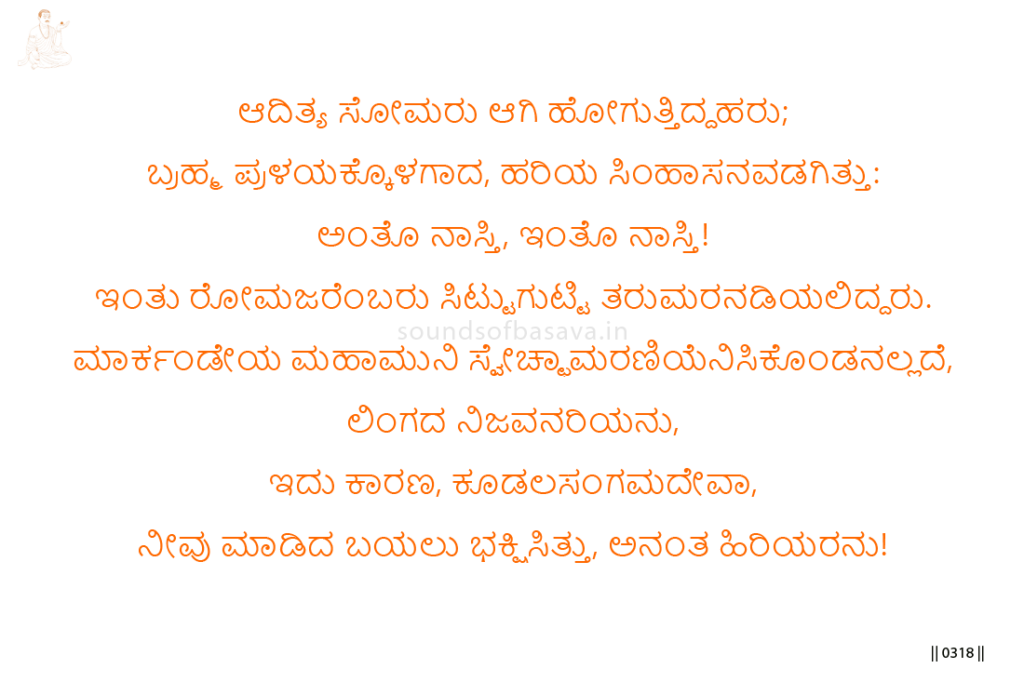
In this vachana, Basavanna places before us a series of exalted attainments: becoming sun and moon, remaining through Brahma’s dissolution, sitting upon Hari’s throne, and gaining the distinction associated with Markandeya Mahamuni.
Yet none of these equals knowledge of the truth of Linga. Even one who has gone beyond ordinary fear of death remains incomplete if the true nature of Linga is not known.
Before Kudalasangama Deva, the teaching is severe: cosmic status, endurance, authority, and victory over death are not final realization. The open expanse made by Kudalasangama Deva consumes even countless great ones who do not know the truth of Linga.
Imagery & Symbolic Relevance
The sun and moon are the first images. They suggest exalted cosmic position and movement. Basavanna begins with attainments that appear far beyond ordinary human life.
Brahma’s dissolution is the second image. To remain through such dissolution suggests immense endurance, but even this does not become knowledge of Linga.
Hari’s throne gives the image of high authority. A throne signifies position and sovereignty, but Basavanna places even this below the truth of Linga.
Markandeya Mahamuni is the strongest individual example. He is presented as one known for an extraordinary relation to death. Yet Basavanna says that even this does not mean he knew the true nature of Linga.
The final image is the open expanse made by Kudalasangama Deva. It consumes countless great ones. This completes the teaching: greatness that does not know Linga’s truth is still swallowed by what exceeds it.
Together, the images overturn the pride of attainment. Radiance, endurance, sovereignty, and death-conquest all remain incomplete without the true knowledge of Linga.
Lingayoga
In Lingayoga, this vachana teaches that attainment must not be confused with realization. Power, endurance, position, and even victory over death may still leave the seeker outside the truth of Linga.
The seeker must therefore move beyond fascination with greatness. The measure is not cosmic status or extraordinary ability, but whether the truth of Linga is known.
Before Kudalasangama Deva, realization is deeper than every form of achievement.
Editorial Commentary
The key phrase is “did not know the truth of Linga.” Basavanna uses it to overturn every preceding example. The greatness of sun, moon, Brahma’s dissolution, Hari’s throne, and Markandeya’s death-conquest all become secondary before this one question.
This vachana should not be expanded into contempt for these figures. Basavanna’s purpose is to set the measure correctly. Whatever does not arrive at Linga’s truth remains incomplete before Kudalasangama Deva.
Related Vachana
Supporting Vachana
Bhakta Sthala Vachana 108 — The Futility of the Unlived Truth
Vachana 108 supports this teaching by asking what use the Linga has in the hands of one who does not know or live its truth. It gives images of precious things becoming fruitless when held by one who cannot receive their purpose. Vachana 858 carries the same principle into Maheshwara Sthala: even cosmic attainment, sovereignty, endurance, and conquest of death do not suffice if the truth of Linga is not known.
Advancing Vachana
Prasadi Sthala Vachana 1002 — How Can I Claim to Have Conquered Māyā?
Vachana 1002 advances this teaching by removing the pride of conquest. There, Basavanna says that world, samsara, forgetfulness, sorrow, and the falling away of tamas all stand within Kudalasangama Deva’s power. The seeker should not claim, “I have conquered Māyā.”
Vachana 858 shows that even exalted attainment and death-conquest do not equal knowledge of Linga’s truth. Vachana 1002 carries this into Prasadi Sthala by showing that no conquest should become personal pride. What remains necessary is grace before Kudalasangama Deva.
