
Summary
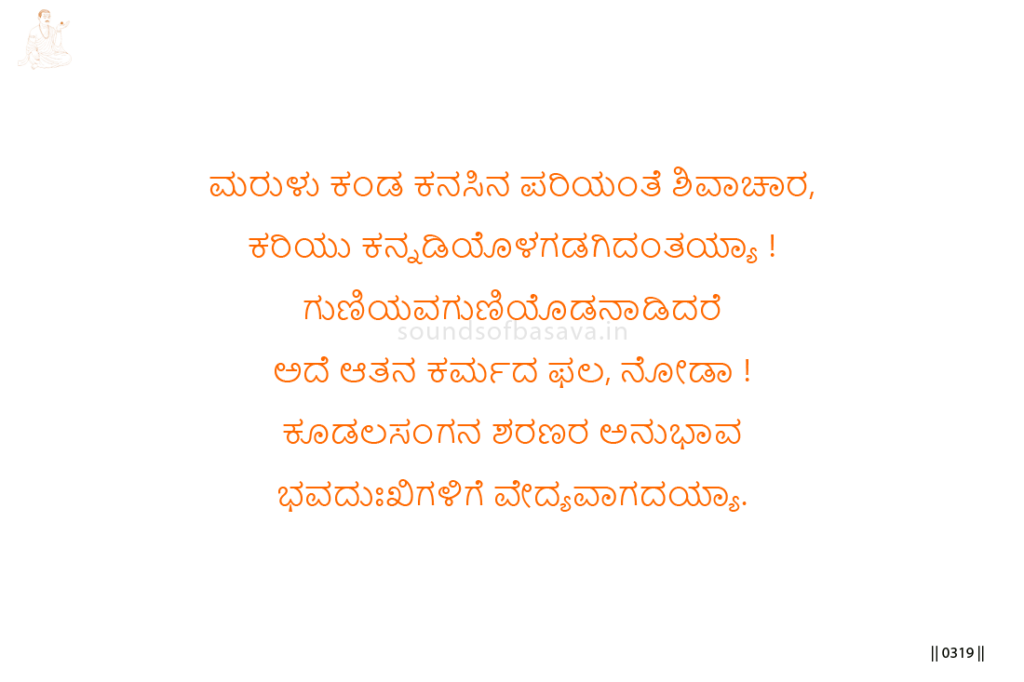
In this vachana, Basavanna compares deluded Shivachara to a dream. While the dream lasts, it appears real, but it does not become true realization.
He then gives the image of a dark appearance in a mirror. It has form as reflection, but not living substance. In the same way, conduct held within delusion may resemble Shivachara without becoming realized conduct.
Basavanna also says that when guṇa and avaguṇa are mixed, the result remains the fruit of karma. Before Kudalasangama Deva, the Anubhava of the Sharanas cannot be known by those still bound in bhava.
Imagery & Symbolic Relevance
The dream is the central image. A dream appears convincing while one is inside it, but it loses authority when awakening comes. Basavanna uses this to show how religious conduct can appear valid while the seeker remains deluded.
The mirror image deepens the warning. A mirror may show an appearance, but the reflected form is not the thing itself. Deluded Shivachara may reflect the shape of sacred conduct without carrying living realization.
The joining of guṇa and avaguṇa points to a mixed inner condition. Virtue and fault remain entangled, and the result still belongs to karma. Such mixture cannot be mistaken for freedom.
The final contrast is between bhava-bound persons and the Sharanas’ Anubhava. Those tied to becoming cannot know the lived realization of Kudalasangama Deva’s Sharanas through imitation, belief, or outward conduct alone.
Together, the images distinguish appearance from awakening. Dream, reflection, mixture, and karmic fruit all show a condition that appears meaningful but has not yet entered living Anubhava.
Lingayoga
In Lingayoga, this vachana teaches the difference between appearance and lived realization. Shivachara must not remain dream-like conduct or reflected form.
The seeker must examine whether conduct has become Anubhava or still remains within mixed karma and bhava. Outer correctness is not enough if the inner condition continues in delusion. Before Kudalasangama Deva, the path is fulfilled only when the seeker awakens into the lived truth known by the Sharanas.
Editorial Commentary
The phrase “like a dream seen by the deluded” controls the vachana. Basavanna is not rejecting Shivachara itself; he is rejecting Shivachara held inside delusion.
The final phrase is equally important. The Anubhava of Kudalasangama Deva’s Sharanas is not available to those still bound in bhava. The issue is not merely lack of outer practice, but the inability of the bhava-bound state to know living realization.
Related Vachana
Supporting Vachana
Bhakta Sthala Vachana 243 — The Collyrium of Divine Love
Vachana 243 supports this teaching by presenting the Anubhava of Kudalasangama Deva’s Sharanas as the healing force that steadies and transforms the seeker. It teaches that bhakti must be seen through the collyrium of Shiva-love and healed by Sharana-Anubhava. Vachana 860 shows the opposite condition: those bound in bhava cannot know that Anubhava while their Shivachara remains dream-like and mixed with karmic fruit.
Advancing Vachana
Prasadi Sthala Vachana 842 — Transformative Antidote
Vachana 842 advances this teaching by showing the force that destroys the condition named in Vachana 860. Knowledge destroys ignorance, light destroys darkness, truth destroys falsehood, and the touchstone transforms base metal. In the same way, Basavanna asks that his bhava be destroyed by the strength of the Anubhava of Kudalasangama’s Sharanas.
Vachana 860 warns that the bhava-bound cannot know the Sharanas’ Anubhava. Vachana 842 carries this into Prasadi Sthala by showing that the same Anubhava becomes the transforming antidote that removes bhava itself before Kudalasangama Deva.
