

Summary
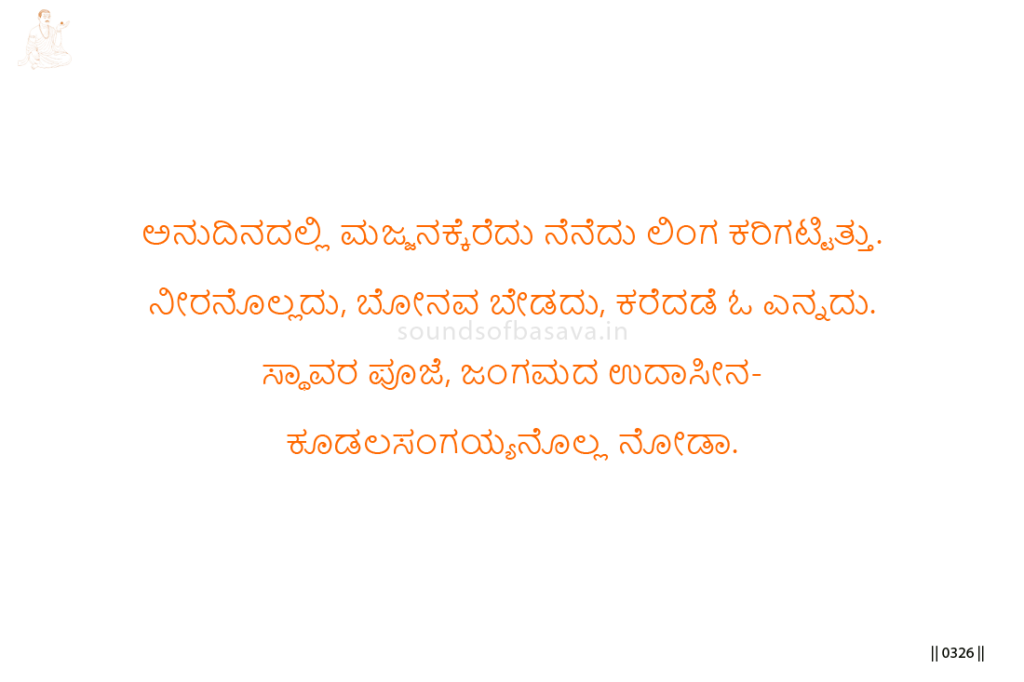
In this vachana, Basavanna warns that daily ritual attention to the Linga does not by itself become living worship. Day after day, the Linga is bathed, anointed, and remembered, yet it darkens.
He then shows the limitation of treating the Linga only as a fixed object. It does not desire water, ask for food, or answer when called.
Before Kudalasangama Deva, the teaching is direct: worship of the fixed form, while remaining indifferent to the Jangama, does not reach Kudalasangama. The issue is not lack of ritual, but lack of living recognition.
Imagery & Symbolic Relevance
Daily bathing and anointing form the first image. Basavanna does not reject worship itself. He questions worship that continues as repetition while its living meaning is missed.
The darkening of the Linga gives the vachana its sharp turn. What should be illumined through worship appears darkened because the practice has not become living awareness.
Water, food, and calling form the next movement. The fixed form does not drink, eat, or respond to a call. Basavanna uses this to expose the limit of worship confined to object-treatment alone.
The contrast between Sthavara and Jangama is the center of the vachana. Sthavara is the fixed form; Jangama is the living moving presence. Worship becomes incomplete when the fixed form is attended but the living Jangama is neglected.
The final warning is decisive. Such worship does not reach Kudalasangama Deva because devotion has been divided from living recognition.
Lingayoga
In Lingayoga, this vachana teaches that worship must become living responsiveness. The seeker must not separate Linga worship from reverence toward Jangama.
Practice becomes whole only when the fixed and the living are not divided. If ritual attention remains strong but living recognition is absent, worship remains incomplete.
Before Kudalasangama Deva, true practice must move from repeated act to awakened response.
Editorial Commentary
This vachana should not be read as a rejection of Linga worship. Basavanna rejects worship that remains fixed, mechanical, and indifferent to Jangama.
The words “Sthavara worship, indifference to Jangama” control the meaning. The fixed form must not become an excuse for ignoring living presence. Devotion reaches Kudalasangama Deva only when worship and living recognition are joined.
Related Vachana
Supporting Vachana
Bhakta Sthala Vachana 193 — The Living Altar
Vachana 193 supports this teaching by showing that one may sing, dance, and offer bhakti to the Linga, since the Linga does not come asking in hunger. But when the Jangama arrives hungry and asking, the devotee must not withhold. Vachana 978 carries this into Maheshwara Sthala: repeated worship of the fixed Linga remains incomplete when the living Jangama is neglected before Kudalasangama Deva.
Advancing Vachana
Prasadi Sthala Vachana 900 — Divine Paradox
Vachana 900 advances this teaching by exposing ritual action that misses living awareness. A flower is taken from the tree and offered back to the tree; river water is taken and returned to the river; a calf is made to cry while the mother is made to grieve and her milk is taken for worship.
Vachana 978 warns that Sthavara worship without Jangama recognition does not reach Kudalasangama Deva. Vachana 900 carries this into Prasadi Sthala by showing that worship becomes Māyā when it ignores living need, compassion, and rightful relation. The movement is from neglect of Jangama to the deeper Prasadi correction: sacred action must remain joined to living awareness before Kudalasangama Deva.
