

Summary
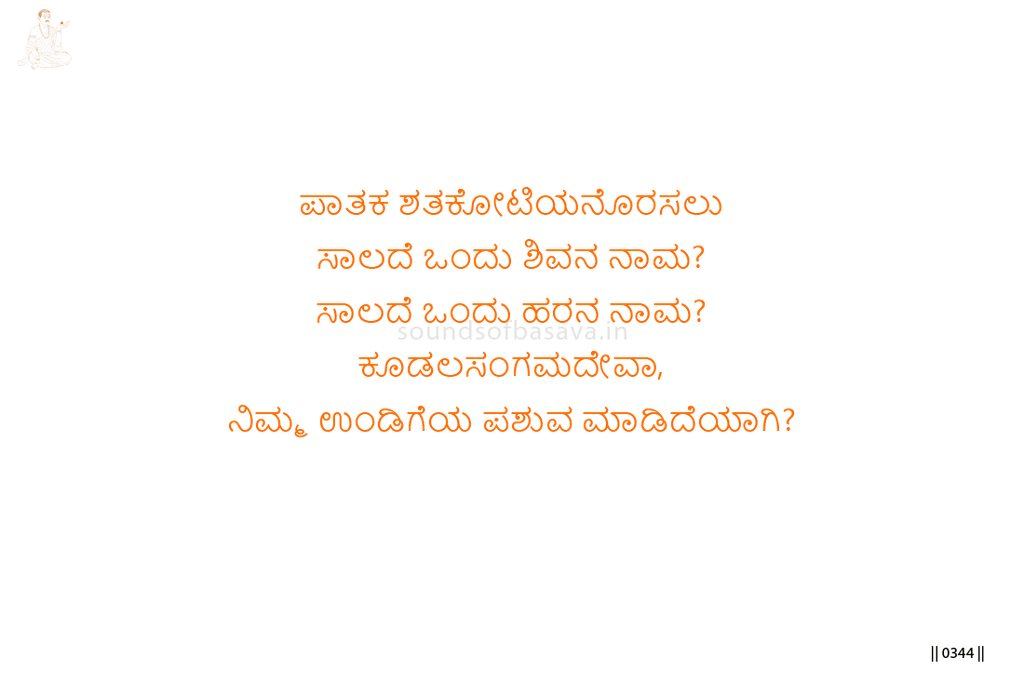
In this vachana, Basavanna asks whether one utterance of Shiva’s Name is not enough to erase countless sins. He repeats the question through the Name of Hara, making the force of the teaching clear: the Divine Name has power over what appears vast, accumulated, and difficult to remove.
The speaker then turns to Kudalasangama Deva and admits his own bound condition. He has lived under delusion as a pashu, a being held in bondage. The question about the Name is therefore not abstract. It arises from one who recognizes the weight of sin and bondage, yet trusts the sufficiency of the Divine Name.
The teaching is direct: countless sins are not greater than one true remembrance of Shiva’s Name. The bound being is not released by self-claim, but by turning to Kudalasangama Deva through the Name.
Imagery & Symbolic Relevance
The first image is the vast number of sins. Basavanna speaks of sins in countless measure, suggesting accumulation beyond ordinary counting. The weight appears enormous, but the vachana immediately places it before the greater power of the Name.
The second image is “one Shiva Name” and “one Hara Name.” The repetition is important. Basavanna does not multiply practices here. He asks whether even one true utterance of the Divine Name is not enough. The image is one of concentrated sacred power rather than extended ritual effort.
The third image is delusion. The speaker does not describe himself as free or accomplished. He sees that he has lived under covering and confusion. This gives the vachana its humility.
The final image is the pashu, the bound being. The term points to a condition of bondage, not merely animal nature. Basavanna places this bound condition before Kudalasangama Deva and turns toward the Name as the means of release.
Lingayoga
In Lingayoga, this vachana shows the power of the Divine Name as direct turning. The speaker does not describe complex method, argument, or ritual sequence. He places countless sins and bound existence before the sufficiency of Shiva’s Name.
For Prasadi Sthala, the relevance lies in receiving the Name as grace. The seeker does not claim that he can erase his own accumulated bondage. He receives the Name of Kudalasangama Deva as the sacred power through which sin and delusion lose their hold.
Editorial Commentary
This vachana should not be reduced to casual repetition of a word. Basavanna’s question has force because the Name is invoked before Kudalasangama Deva from the speaker’s confessed condition of bondage. The Name is not treated as ornamented speech; it is the sacred remembrance that confronts sin and delusion.
The term pashu should be kept in view. The speaker is not merely saying, “I have done wrong.” He is saying that he has lived as one bound. The greatness of the Name is measured against that bondage.
Related Vachana
Supporting Vachana
Bhakta Sthala Vachana 75 — The Name That Conquers All
Bhakta Vachana 75 supports this vachana by presenting the Divine Name as the one power before which the great sins tremble. In Vachana 84, Basavanna asks whether one Shiva Name or one Hara Name is not enough to erase countless sins. In Vachana 75, the five great sins are said to fear only the Name of Kudalasangama Deva. The support is direct: sin is not conquered by ordinary force, but by the Name.
Advancing Vachana
Pranalingi Sthala Vachana 76 — The All-Sufficient Name
Pranalingi Vachana 76 advances this movement by showing the Name not only as the remover of sin, but as the complete path. In Vachana 84, one Name is enough to confront countless sins and the bound condition of the pashu. In Vachana 76, the Name of Kudalasangama Deva becomes mantra, tantra, and Kamadhenu — the all-sufficient source of spiritual fulfillment. Thus the Prasadi trust in the saving power of the Name advances into Pranalingi certainty that the Name itself contains the path.
