

Summary
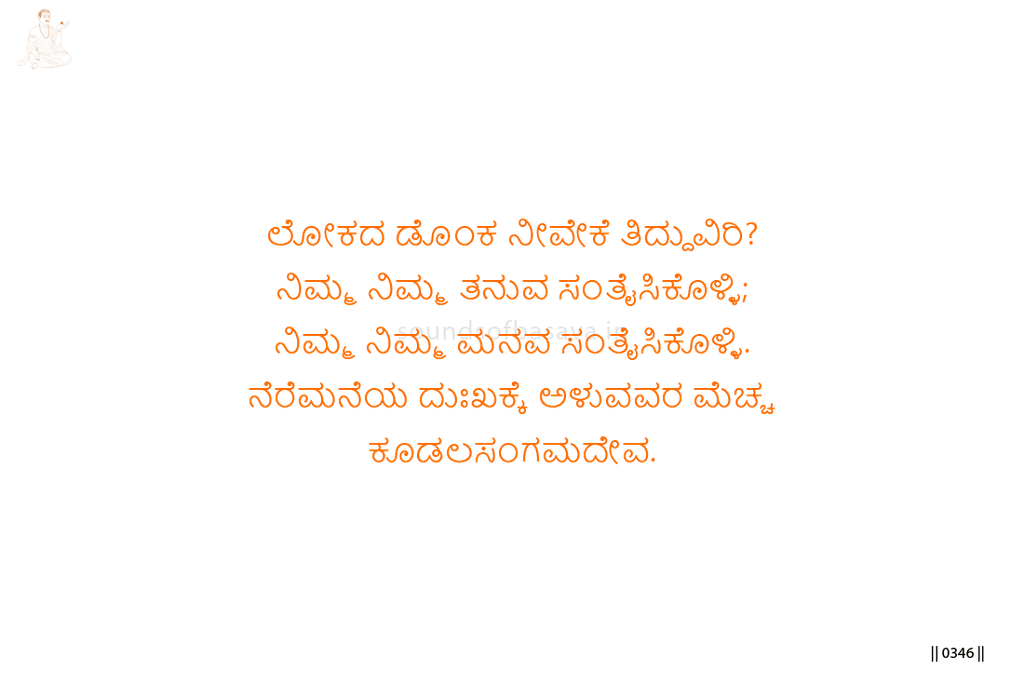
In this vachana, Basavanna asks why one should try to correct the crookedness of the world. The speaker redirects attention from others to oneself: steady your own body, steady your own mind. The instruction is plain and inward.
The vachana does not praise outward concern when the one who grieves has not first become settled. To weep over the neighbor’s sorrow while one’s own body and mind remain uncorrected does not please Kudalasangama Deva.
The teaching is direct: the seeker must not begin by correcting the world or becoming absorbed in another’s condition. The first responsibility is inward steadiness. Only when one’s own body and mind are brought into order can one stand rightly before Kudalasangama Deva.
Imagery & Symbolic Relevance
The first image is the crookedness of the world. Basavanna does not deny that the world appears crooked, disturbed, or difficult. His question is about the seeker’s impulse to correct it before correcting oneself.
The second image is one’s own body. The body is the immediate field in which conduct, restraint, steadiness, and discipline must be established. Basavanna brings attention back from the world to what is nearest.
The third image is one’s own mind. The mind is the deeper field of disturbance. If the mind is not settled, concern for others may become another form of agitation, judgment, or outward movement.
The neighbor’s sorrow is the final image. Basavanna does not treat another’s sorrow as meaningless. His concern is with the misplaced movement of one who turns outward before becoming inwardly steady. The grief shown toward another does not delight Kudalasangama Deva when the seeker has neglected his own correction.
Lingayoga
In Lingayoga, this vachana shows the discipline of inward return. The seeker must not begin by measuring, correcting, or lamenting the world. The body and mind must first be steadied.
For Prasadi Sthala, the relevance lies in receiving one’s own condition truthfully. The seeker receives the instruction not to perform outward concern while remaining inwardly unsettled. Prasadi requires clear reception; such reception begins with one’s own body and mind.
Editorial Commentary
This vachana should not be read as a rejection of compassion. Basavanna is not teaching indifference to others. He is warning against outward grief or correction that bypasses one’s own unsettled condition.
The order matters: first steady your own body; first steady your own mind. Without this, concern for another may become display, displacement, or confusion. Kudalasangama Deva is not pleased by such outward movement when inward correction has been neglected.
Related Vachana
Supporting Vachana
Maheshwara Sthala Vachana 105 — The Blindness of Self-Deception
Maheshwara Vachana 105 supports this vachana by exposing the blindness of judging another while failing to see one’s own condition. In Vachana 124, Basavanna asks why one tries to correct the crookedness of the world instead of steadying one’s own body and mind. In Vachana 105, the one who is marked by the same condition rejects another like herself, revealing self-deception. The support is direct: the path begins not with outward judgment, but with recognition of oneself.
Advancing Vachana
Pranalingi Sthala Vachana 946 — Beyond Assertion and Perception
Pranalingi Vachana 946 advances this movement by carrying inward correction into clarified perception. In Vachana 124, Basavanna tells the seeker not to begin by correcting the crookedness of the world, but to steady one’s own body and mind. In Vachana 946, the error is shown more deeply: what appears as a snake may be a rope wrongly perceived in darkness. Thus the Prasadi instruction to turn inward advances into Pranalingi insight, where correction occurs not through outward force, but through clear seeing before Kudalasangama Deva.
