

Summary
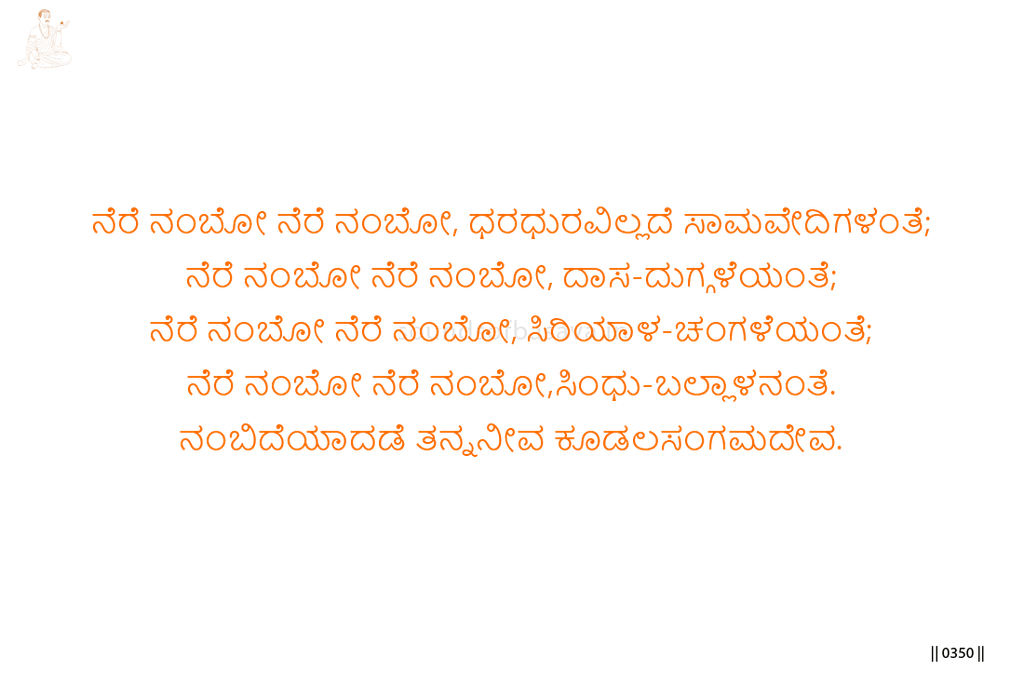
In this vachana, Basavanna calls for complete trust. The repeated phrase “trust fully, trust fully” gives the vachana its center. The trust he asks for is not tense, anxious, or self-measuring. It is steady like the Sharanas, who remain balanced without the strain of constantly proving their virtue.
Basavanna contrasts anxious religious effort with the simple fullness of trust. One should not stand in spiritual life as though virtue must be guarded by worry at every moment. Trust must become settled, like the trust seen in the lives of Dāsa-Duggale.
The final line gives the fruit of such trust: when one trusts fully, Kudalasangama Deva gives Himself. The vachana therefore teaches that full trust is not an ornament of devotion. It is the condition in which the Divine is received.
Imagery & Symbolic Relevance
The first image is repeated trust. Basavanna does not say “trust” once. He repeats it, making clear that the movement must be complete. Partial trust still leaves room for anxiety, calculation, and inward division.
The phrase “without anxiety” is important. It points to a state where virtue is not maintained as a burden of fear. The seeker does not stand trembling over whether he is virtuous enough. True trust steadies the heart and removes such strain.
The comparison with the Sharanas shows the measure. The Sharanas are not restless moral performers. They stand in balance because their trust has become settled. Their steadiness is not anxiety; it is groundedness.
Dāsa-Duggale stand here as exemplars of trust that is full, simple, and free from anxious self-measurement.
The final image is Kudalasangama Deva giving Himself. This is the highest point of the vachana. The result of full trust is not merely comfort, merit, or reputation. The Divine Himself is received.
Lingayoga
In Lingayoga, this vachana shows that trust must become steady and free from anxious self-measurement. The seeker should not live in constant inner tension, trying to secure virtue through worry. Such anxiety keeps the mind divided.
For Prasadi Sthala, the relevance lies in receiving through trust. Prasadi does not seize or prove. It receives. When trust becomes full and steady, the seeker becomes capable of receiving Kudalasangama Deva Himself.
Editorial Commentary
The main word of this vachana is trust. Basavanna calls the seeker into complete reliance, free from anxious calculation.
The phrase “without anxiety” clarifies the teaching. Virtue that must constantly fear its own collapse has not yet become settled. The Sharanas stand differently: their balance comes from trust. Basavanna asks for that kind of trust, and says that when it is present, Kudalasangama Deva gives Himself.
Related Vachana
Supporting Vachana
Maheshwara Sthala Vachana 258 — The Mind’s Refusal
Maheshwara Vachana 258 supports this vachana by showing the opposite condition: the mind does not rejoice in the Linga, does not trust the Jangama, and turns away even from love alive in others. In Vachana 149, Basavanna calls for full trust without anxiety, like the steadiness of the Sharanas. In Maheshwara Vachana 258, the mind’s refusal to trust must be broken through refuge at the feet of the Sharanas. The support is direct: what Maheshwara exposes as refusal, Prasadi receives as full trust.
Advancing Vachana
Pranalingi Sthala Vachana 988 — When the Linga Returned as Living Presence
Pranalingi Vachana 988 advances this movement by showing what full trust becomes when doubt falls away. In Vachana 149, Basavanna says that when one trusts fully, Kudalasangama Deva gives Himself. In Vachana 988, the old doubt falls away, the small anxieties are asked to rest, and Kudalasangama Deva becomes the seeker’s breath. Thus the full trust of Prasadi advances into Pranalingi as living inward presence, where trust is no longer effort but life itself.
