

Summary
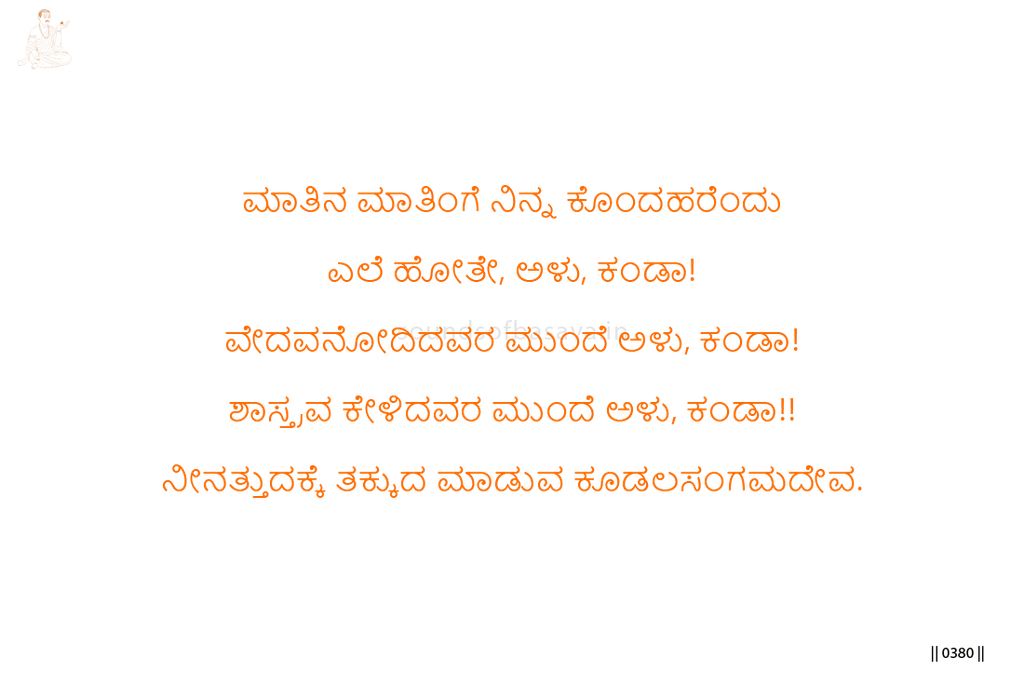
In this vachana, Basavanna warns that words themselves can become harmful when they are not joined with realization. Hearing words, the small goat is killed; seeing this, it must cry.
He then says to cry before those who merely read the Veda, and before those who merely hear the Shastra. Reading and hearing alone do not complete the path.
The final measure is Kudalasangama Deva. What is spoken, read, or heard must become fit for the state one has reached. Word alone is not enough.
Imagery & Symbolic Relevance
The first image is the small goat being killed by words. The goat represents helplessness before speech that has not become lived truth.
The killing is not by a physical knife, but by words. This shows the danger of word-bound learning when it remains unassimilated.
The reader of the Veda represents knowledge received through text.
The hearer of the Shastra represents knowledge received through instruction.
The repeated cry is important. Basavanna asks the seeker to weep before learning that remains only read, heard, or spoken, without becoming living truth.
Lingayoga
In Lingayoga, this vachana teaches that speech, reading, and hearing must become inward realization.
For Prasadi Sthala, the seeker must receive sacred words in such a way that they become lived clarity. Otherwise, even sacred speech remains external.
Editorial Commentary
The goat image should remain central. It shows the vulnerable seeker harmed by words that are not joined with realization.
Basavanna’s warning is not against Veda or Shastra as such. The warning is against being “killed” by words that remain external, argumentative, or merely inherited.
The vachana teaches that sacred words must not become a substitute for direct realization before Kudalasangama Deva.
Related Vachana
Supporting Vachana
Maheshwara Sthala Vachana 410 — The Sharanas as Mukhalingas
Maheshwara Vachana 410 supports this vachana by warning that speech without lived knowing becomes only sound without substance. In Vachana 573, Basavanna speaks of words killing the small goat, and of those who merely read the Veda or hear the Shastra. Both vachanas distinguish verbal familiarity from lived realization.
Advancing Vachana
Pranalingi Sthala Vachana 979 — Without Experience, Nothing Ripens
Pranalingi Vachana 979 advances this teaching by saying that devotion, Linga, Prasada, knowledge, and fellowship require Anubhava. In Vachana 573, Basavanna warns that reading, hearing, and speaking remain incomplete when they do not become lived truth. In Vachana 979, this requirement is stated through Anubhava.
