
Summary
In this vachana, Basavanna makes a complete vow of consecration.
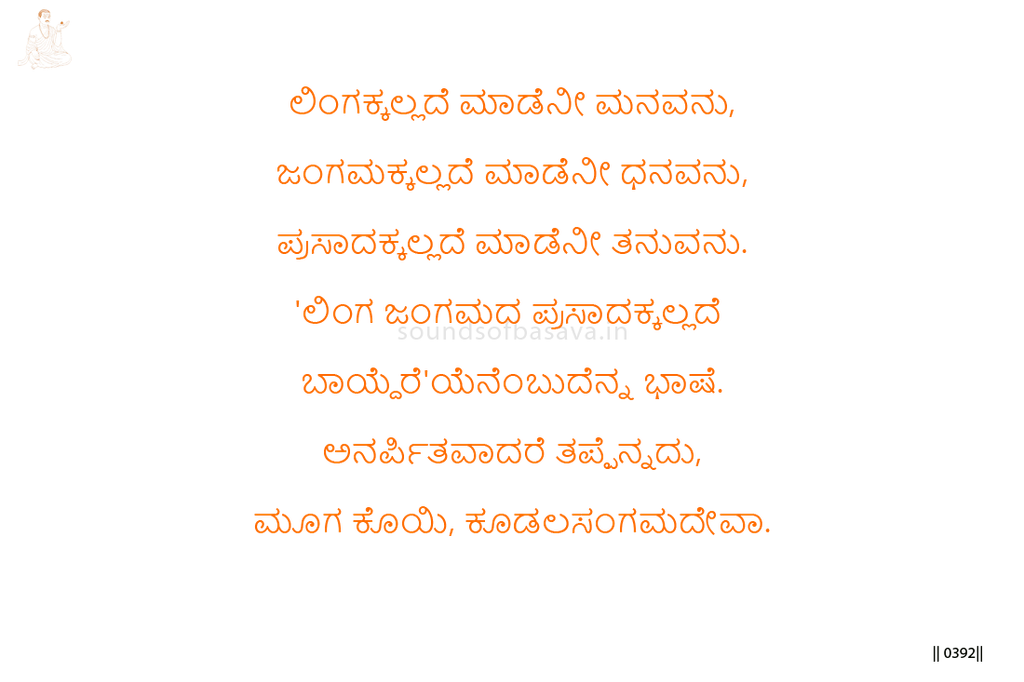
He says: I will not make my mind for anything other than Linga. I will not make my wealth for anything other than Jangama. I will not make my body for anything other than Prasada.
He then extends this vow to speech. His language is this: apart from Linga, Jangama, and Prasada, he will not open his mouth.
If anything remains unoffered, the fault is his own. Before Kudalasangama Deva, mind, wealth, body, and speech must not remain separate possessions. They must return to their proper sacred relation.
Imagery & Symbolic Relevance
The mind belongs to Linga. This means that thought, intention, remembrance, and inward awareness must be directed toward the Divine presence.
Wealth belongs to Jangama. Wealth is not rejected, but it must not be held as private possession. It must move toward the living presence of truth.
The body belongs to Prasada. The body is not meant for self-centered use alone. It becomes sacred when it is received, used, and offered as Prasada.
These three movements form the structure of the vachana: mind, wealth, and body are each given their rightful direction.
Speech is then brought under the same vow. Basavanna says that apart from Linga, Jangama, and Prasada, he will not open his mouth. Speech itself must remain consecrated.
The closing line is a severe self-correction. If anything remains unoffered, the blame is not elsewhere. The fault belongs to the seeker.
Lingayoga
In Lingayoga, this vachana teaches total consecration.
Arivu is purified when the mind belongs to Linga. Dasoha is purified when wealth belongs to Jangama. Kayaka is purified when the body becomes Prasada.
For Prasadi Sthala, the teaching is that grace must not remain only received. It must order the whole life. Mind, wealth, body, and speech must each find their proper place in Linga, Jangama, and Prasada.
When this happens, life itself becomes offering.
Editorial Commentary
The order of the vachana should be preserved: mind to Linga, wealth to Jangama, body to Prasada, and speech to Linga-Jangama-Prasada.
The line on speech should not be reduced to ordinary silence. Basavanna is not merely saying that he will speak less. He is saying that speech must not move outside sacred alignment.
The word “unoffered” is central. Anything not offered becomes the seeker’s own fault.
The vachana therefore teaches complete self-accountability. Nothing in the seeker’s life should remain outside Linga, Jangama, and Prasada.
Related Vachana
Supporting Vachana
Maheshwara Sthala Vachana 322 — The Threefold Failure and the Plea for Mercy
Maheshwara Vachana 322 supports this vachana by confessing failure in the threefold field of body, mind, and wealth. It shows the seeker who knows the truth but still falls short in consecrating these three dimensions.
In Vachana 728, Basavanna gives the corrected vow: mind must belong to Linga, wealth to Jangama, and body to Prasada. Thus Vachana 322 shows the failure of threefold consecration, while Vachana 728 gives its proper Prasadi ordering.
Advancing Vachana
Pranalingi Sthala Vachana 1096 — The Worship of the Inner Lotus
Pranalingi Vachana 1096 advances this teaching by interiorizing worship itself. In that vachana, the devotee offers bliss as water, the heart as lotus, yearning as light, illumination as incense, and direct experience as fragrance.
In Vachana 728, mind, wealth, body, and speech are consecrated to Linga, Jangama, and Prasada. In Vachana 1096, this consecration matures further: the devotee’s own inner states become the worship, and Prāṇa-Linga is beheld directly.
