

Summary
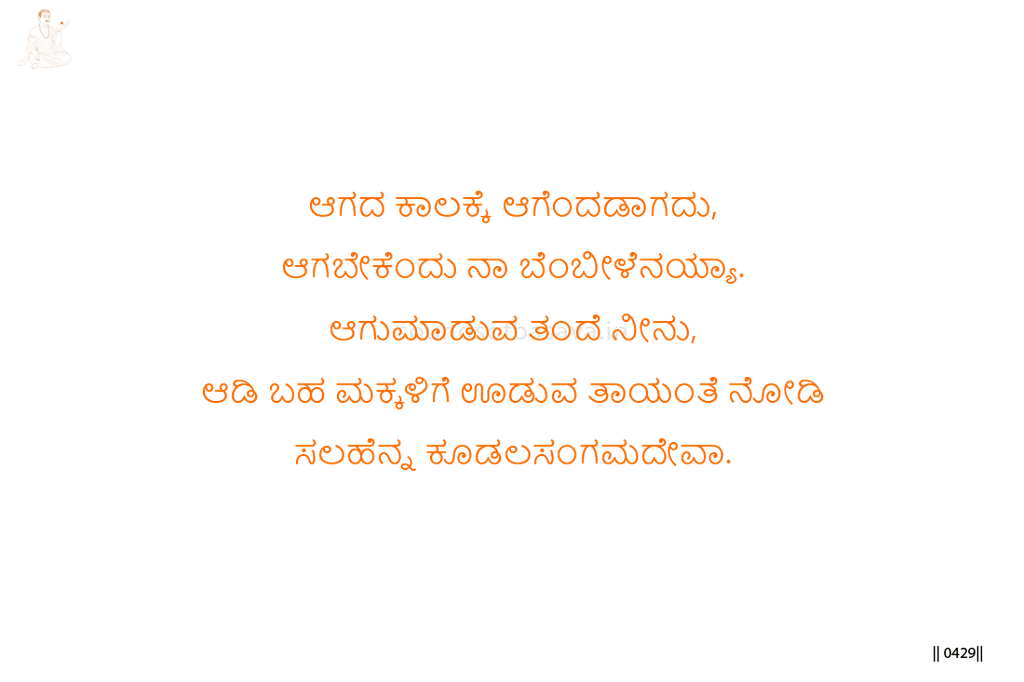
In this vachana, Basavanna says that what has not reached its proper time cannot be made to happen merely because one desires it. He does not exhaust himself by chasing the question of when it will come.
He turns instead to Kudalasangama Deva. The Lord is the Father who makes what must happen happen. He is also like a Mother who watches children at play and feeds them at the proper moment.
The teaching is direct: the seeker should not force the ripening of grace through impatience. What must unfold belongs to Kudalasangama Deva’s care. Basavanna asks to be watched, guided, and sustained by that Divine care.
Imagery & Symbolic Relevance
The first image is time. Basavanna does not treat realization or grace as something that can be forced by personal anxiety. If the proper time has not come, desire alone cannot make it arrive.
The second movement is the refusal to be exhausted. The speaker does not deny longing, but he will not waste himself in restless pursuit of “when.” This gives the vachana its discipline of trust.
The Father image shows Kudalasangama Deva as the one who causes what must happen to happen. The seeker does not hold that power in himself.
The Mother image gives the same trust a tender form. Children absorbed in play do not know when nourishment is needed. The mother watches and feeds at the right moment.
The final prayer gathers both images. Basavanna asks Kudalasangama Deva to watch over him, care for him, and sustain him in the proper way.
Lingayoga
In Lingayoga, this vachana teaches release from impatient self-effort. The seeker remains devoted, but does not try to compel the timing of grace.
For Prasadi Sthala, the point lies in right receiving. Grace is not seized by demand. It is received when Kudalasangama Deva makes the moment fruitful.
The practice-related meaning is therefore simple: remain under Divine care without anxiety. Let longing become trust, not exhaustion.
Editorial Commentary
The Father and Mother images should both be preserved. The Father causes the unfolding; the Mother watches and nourishes. Together they show that Kudalasangama Deva’s care is both ordering and sustaining.
The image of children at play should not be over-expanded. Its function is to show trust. The child does not control the time of feeding; the mother knows the need and the moment.
Related Vachana
Supporting Vachana
Maheshwara Sthala Vachana 322 — The Threefold Failure and the Plea for Mercy
Maheshwara Vachana 322 supports this vachana by showing the seeker’s dependence on Kudalasangama Deva even after knowing his own condition. There, Basavanna admits failure and says that if he falls again, the Lord must correct and restore him.
In Vachana 1033, the seeker does not force the moment of grace, but trusts the Father who makes it happen and the Mother who sustains. In Maheshwara Vachana 322, the same dependence appears as a plea for Divine correction. Both vachanas place the decisive movement in Kudalasangama Deva rather than in the seeker’s anxious control.
Advancing Vachana
Pranalingi Sthala Vachana 1240 — The Revelation of Ishtalinga
Pranalingi Vachana 1240 advances this teaching by showing grace becoming actual revelation. Basavanna says he did not remain in restless wandering; the Lord arose as Mahaprasadi, placed the Linga called Sanganatha in his hand, blessed him, and drew him toward Kudalasangama Deva through Chennabasavanna.
In Vachana 1033, Basavanna trusts that Kudalasangama Deva will make the right thing happen at the right time. In Vachana 1240, that trust matures into received grace: the Linga is given, the seeker is steadied, and the path is revealed. Thus the Prasadi surrender to Divine timing advances into Pranalingi as direct grace and Ishtalinga-revelation.
