

Summary
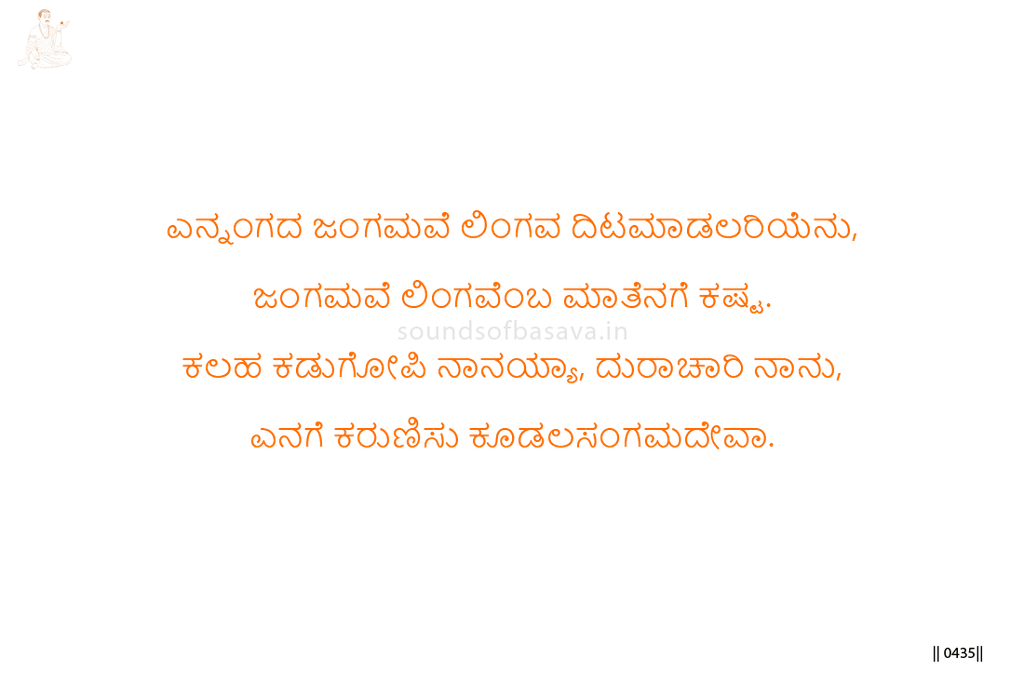
In this vachana, Basavanna confesses that he does not know how to make true the Linga resting upon his own Anga.
The Linga is not absent or distant. It is already borne on the body. Yet the difficulty lies in making that external bearing become inward truth.
He then says that the statement “Jangama itself is Linga” is difficult for him. Jangama is not merely a representative of Linga; Jangama himself is to be recognized as Linga.
Basavanna names the obstruction within himself. He is quarrelsome, quick to anger, and wrong in conduct. Therefore he asks Kudalasangama Deva for compassion.
The teaching is direct: wearing the Linga is not complete until its truth is lived, and saying “Jangama is Linga” is not complete until Jangama is directly recognized as Linga.
Imagery & Symbolic Relevance
The first image is the Linga resting upon the body. Basavanna already has the physical symbol. He bears it and worships it. Yet he says he does not know how to make it true.
“To make it true” means that the Linga worn outwardly must become inwardly realized. The gap is between bearing the Linga on the body and allowing its truth to shape perception, speech, and conduct.
This is not presented as a simple lack of effort. Basavanna recognizes that effort alone cannot produce realization. Therefore the confession moves toward grace.
The second image is Jangama as Linga. Basavanna does not say that Jangama merely points to Linga or represents Linga. He says that Jangama itself is Linga, and that this recognition is difficult for him.
This difficulty is not intellectual. It is not only a matter of understanding the statement. The difficulty lies in direct recognition. As long as anger, quarrel, and wrong conduct remain active, Jangama is seen as another person rather than as the living Linga.
Basavanna’s self-description is therefore central. “I am quarrelsome; I am quick to anger; I am of wrong conduct.” These are not decorative confessions. They name the very conditions that obstruct the recognition of Jangama as Linga.
The final prayer asks for compassion. Basavanna does not claim that he can close this gap by himself. He places the difficulty before Kudalasangama Deva.
Lingayoga
In Lingayoga, this vachana teaches that outer Linga-bearing must become inner truth.
The seeker may wear and worship the Linga, but the test is whether the same Linga is recognized in Jangama. Without that recognition, the practice remains incomplete.
For Prasadi Sthala, the point is honest receiving of one’s own limitation. Basavanna sees the obstruction within himself and asks for Kudalasangama Deva’s compassion.
Editorial Commentary
The phrase “make it true” should be kept central. It does not question the presence of the Linga. It questions whether the Linga borne on the body has become realized in life.
The phrase “Jangama itself is Linga” should also remain central. It is not a general respect for Jangama, but the direct recognition of Jangama as Linga.
The confession of quarrel, anger, and wrong conduct explains why this recognition is difficult. The final prayer shows that Basavanna seeks compassion, not self-justification.
Related Vachana
Supporting Vachana
Maheshwara Sthala Vachana 195 — The Serpent’s Shed Skin
Maheshwara Vachana 195 supports this vachana by showing that the word “Jangama-Linga” alone is not enough when the inner condition has not changed.
In Vachana 1077, Basavanna confesses that recognizing Jangama as Linga is difficult because anger, quarrel, and wrong conduct remain. Both vachanas insist that the truth of Jangama-Linga must be lived, not merely spoken.
Advancing Vachana
Pranalingi Sthala Vachana 403 — The Heart’s Hidden Truth
Pranalingi Vachana 403 advances this teaching by declaring clearly that Jangama is Linga and by warning against judging the Shiva-bhakta by outer appearance.
In Vachana 1077, Basavanna confesses the difficulty of this recognition. In Vachana 403, that recognition becomes clearer: Jangama must be approached as Linga before Kudalasangama Deva.
