

Summary
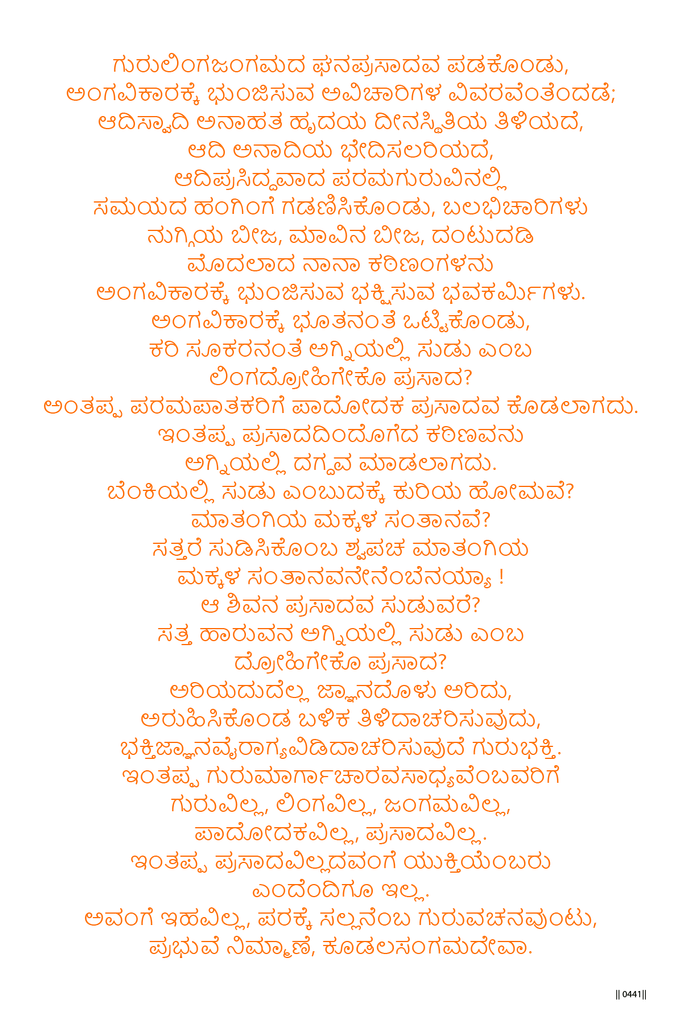
In this vachana, Basavanna warns against receiving the great Prasada of Guru, Linga, and Jangama while using it only to feed Angavikara, the distortions of the body and its cravings.
Such people do not know the primordial taste, the Anahata heart, or the inner condition. They cannot distinguish the Adi from the Anadi, and they do not understand the depth of the Supreme Guru’s path.
Basavanna then gives severe images of misuse: feeding bodily desire, clinging to bodily distortion, burning in craving, and betraying the Linga while still seeking Prasada.
He says that Padodaka and Prasada should not be given to such great offenders. Outer fire cannot burn away this misuse, and the Prasada of Shiva itself cannot be treated as something to be burned or consumed carelessly.
The positive teaching comes near the end. To know what was unknown through Jnana, to receive instruction, and then to live accordingly — this is Bhakti, Jnana, Vairagya, and Guru-Bhakti.
Basavanna concludes that those who try to reach the Guru’s path without this living conduct have no Guru, no Linga, no Jangama, no Padodaka, and no Prasada. Without Prasada there is no Panchachara; without Panchachara there is no Prasada.
Imagery & Symbolic Relevance
The first image is the great Prasada of Guru, Linga, and Jangama. Basavanna is not speaking of ordinary food alone. He speaks of what has come through the sacred relation of Guru, Linga, and Jangama.
The danger is Angavikara. When the body’s craving and distortion rule the person, even Prasada is treated as something to consume for bodily desire. The sacred is reduced to appetite.
The images of primordial taste, Anahata heart, and inner condition show what such a person has failed to know. Prasada should open inward recognition, but the distorted mind remains at the level of consumption.
The fire images are important. Fire may burn outward things, but Basavanna says that the impurity caused by misuse of Prasada is not removed by outer burning. External fire cannot replace inner transformation.
The questions about burning are therefore warnings. One cannot make something fit merely by putting it into fire. In the same way, sacred misuse cannot be corrected by outward acts alone.
The turning point is the line on knowing, receiving instruction, and living accordingly. This gives the true measure. Knowledge must be followed by instructed conduct. Only then can Bhakti, Jnana (right understanding of truth), Vairagya (detachment from worldly cravings), and Guru-Bhakti be real.
The closing sequence joins Prasada and Panchachara. Prasada cannot stand apart from right conduct. Panchachara also cannot stand without Prasada. Each completes and guards the other.
Lingayoga
In Lingayoga, this vachana teaches that sacred receiving must become lived conduct.
Guru, Linga, Jangama, Padodaka, and Prasada are not to be handled as outer forms while the body’s craving remains unchanged. They must enter understanding, instruction, and practice.
For Prasadi Sthala, the teaching is strict: Prasada is not mere consumption. It is received rightly only where knowledge, conduct, Bhakti, Vairagya, and Guru-Bhakti are joined.
Editorial Commentary
“Angavikara” should be retained because it names the central distortion: the sacred is taken into a body-centered and craving-centered condition.
“Anahata Hridaya” refers to the inner, unstruck heart—the subtle center of awareness beyond physical sensation—while “Adi-Anadi” points to the distinction between the primal origin and that which has no beginning. These should be explained briefly, not expanded. They mark deeper realities that the distorted receiver fails to know.
The line “knowing what was unknown, receiving instruction, and then living accordingly” should remain central. It is the constructive teaching of the vachana.
The final relation between Prasada and Panchachara should be kept clear: without Prasada, the fivefold conduct of right practice does not stand; without Panchachara, Prasada is not rightly received.
Related Vachana
Supporting Vachana
Maheshwara Sthala Vachana 292 — The Distance Between Knowledge and Realization
Maheshwara Vachana 292 supports this vachana by showing that sacred nearness is not the same as realization. There, Basavanna says that he moves among devotees, speaks of Linga, and keeps sacred observances, yet the way to Kailasa has not opened within.
In Vachana 1173, one may receive Guru, Linga, Jangama, Padodaka, and Prasada outwardly, yet remain ruled by Angavikara. Both vachanas warn that sacred contact must become lived realization.
Advancing Vachana
Pranalingi Sthala Vachana 1016 — The Fulness of Pranalinga
Pranalingi Vachana 1016 advances this teaching by showing that Arivu is fulfilled only through Anubhava. Knowledge becomes complete when it becomes lived experience through Guru’s grace.
In Vachana 1173, Basavanna says that one must know, receive instruction, and live accordingly. In Vachana 1016, this advances into Pranalingi clarity: knowledge must become Anubhava, and Achara must rest as prana before the greatness of Pranalinga is revealed.
