

Summary
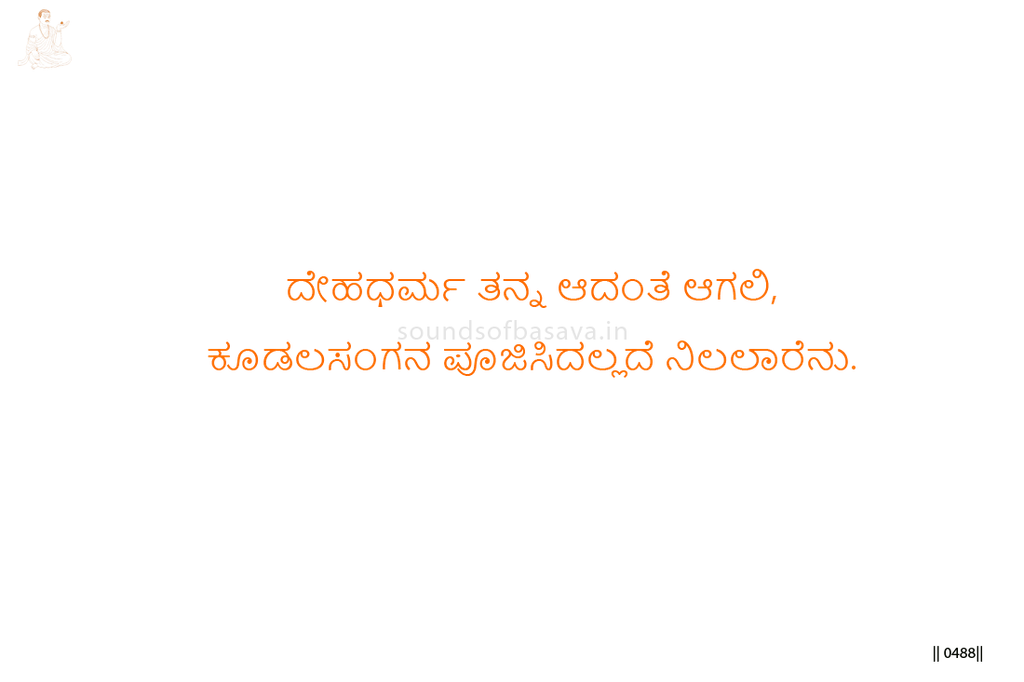
In this vachana, Basavanna allows the body to follow its own dharma. The body has its natural order, and he does not make bodily process the center of conflict.
The decisive turn is in the second line. Whatever may happen according to the body’s nature, Basavanna cannot remain without worshipping Kudalasangama Deva.
The teaching is one of right ordering. The body may move according to its condition, but the seeker’s life cannot stand apart from worship. Bodily nature is allowed its place; Divine orientation is made indispensable.
Imagery & Symbolic Relevance
The first image is deha-dharma, the law or nature of the body. Basavanna does not deny embodiment. He lets the body remain within its own field.
The phrase “let it be as it is” gives the tone of spiritual realism. The body is not made into the enemy, nor is it treated as the highest truth. It is given its proper measure.
The second image is worship of Kudalasangama Deva. This worship is not placed beside bodily life as an occasional addition. It is the condition without which Basavanna says he cannot remain.
The contrast is therefore precise: the body has its own dharma, but the seeker’s being depends on worship. Embodiment continues according to its nature, while awareness must remain turned toward Kudalasangama Deva.
Lingayoga
In Lingayoga, this vachana teaches integration without bodily domination. The seeker need not reject the body, but must not become ruled by the body’s nature.
For Pranalingi Sthala, the emphasis is on continuity of worship within embodied life. The relation to Linga must not break because the body follows its own law.
The practice-point is simple: let the body remain within its natural order, but let worship remain the sustaining center. Without Kudalasangama Deva, the seeker cannot truly stand.
Editorial Commentary
“Deha-dharma” should be read carefully. It does not authorize indulgence, and it does not require body-denial. It simply gives the body its proper place.
The force of the vachana lies in the contrast between allowing the body and refusing to live without worship. Basavanna’s concern is not bodily suppression, but unbroken Divine orientation.
Related Vachana
Supporting Vachana
Prasadi Sthala Vachana 728 — Breath of Being
Prasadi Vachana 728 supports this vachana by showing the proper sacred ordering of life. There, the mind belongs to Linga, wealth to Jangama, body to Prasada, and speech to Linga-Jangama-Prasada.
Vachana 495 allows the body to follow its nature, but refuses to remain without worshipping Kudalasangama Deva. Vachana 728 supports this by showing that the body must not remain self-owned; it must be placed in its proper sacred relation. Thus bodily life is not rejected, but ordered within worship, Prasada, and offering.
Advancing Vachana
Sharana Sthala Vachana 1072 — The Cry of Linga-Yoga
Sharana Vachana 1072 advances this teaching by showing how the seeker remains vigilant when instability appears. In Vachana 495, Basavanna says that the body may follow its nature, but he cannot remain without worship. In Vachana 1072, when one side falters, the seeker holds to the other and cries, “Protect me, protect me,” placing failure before Kudalasangama Deva’s compassion.
Thus the Pranalingi ordering of body and worship advances into Sharana Sthala as vigilant return. The body may have its nature, but the seeker must not remain fallen in that nature. He returns again and again to Kudalasangama Deva, the ground of compassion and refuge.
