

Summary
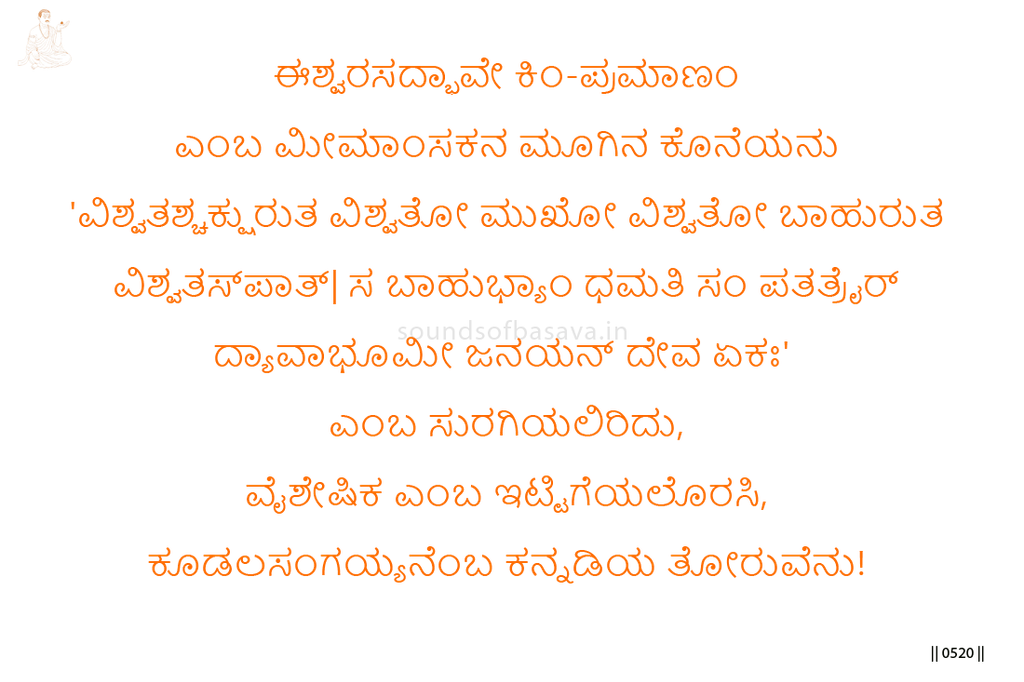
In this vachana, Basavanna brings three forms of knowing before Kudalasangama Deva: philosophical proof, scriptural declaration, and direct seeing. The Mīmāṃsaka asks, “Īśvara-sadbhāve kiṃ pramāṇam?”—“What is the proof, or valid means of knowing, for the existence of Īśvara?” This represents inquiry that seeks to establish God through argument and evidence.
Basavanna then refers to the sacred declaration, “Dyāvābhūmī janayan deva ekaḥ”—“The One God who created heaven and earth.” This represents scriptural testimony: the Divine is declared as the one source of heaven and earth. Yet even this remains a statement that must be understood and realized.
He then places the Vaisheshika system before us as a brick-like structure of reasoning. Philosophical systems may arrange categories, build arguments, and establish doctrines, but such construction is still not the same as direct realization.
The final turn is decisive. Basavanna says that he will show Kudalasangayya as a mirror. The teaching is that Kudalasangama Deva is not finally known by proof, quotation, or doctrinal structure alone. He is known when seeing becomes clear, direct, and mirror-like.
Imagery & Symbolic Relevance
The first image is the Mīmāṃsaka’s question: “Īśvara-sadbhāve kiṃ pramāṇam?” The phrase means, “What is the proof for the existence of Īśvara?” or more precisely, “What valid means of knowledge establishes the being of Īśvara?” It represents the mind that asks for logical or philosophical proof before accepting the Divine.
The second image is the scriptural declaration: “Dyāvābhūmī janayan deva ekaḥ.” The phrase means, “The One God who created heaven and earth.” It gives a sacred statement about the Divine as the creator and source. Basavanna does not dismiss such a declaration, but he places it within a larger movement. A statement about God is still not the same as seeing God.
The third image is the Vaisheshika as brick. A brick suggests construction, arrangement, and system. Basavanna uses this image to show that reasoning can build a structure, but a structure built by thought remains indirect. It may organize understanding, but it does not itself become realization.
The fourth and final image is the mirror. A mirror does not argue, infer, construct, or quote. It shows what stands before it. By saying that he will show Kudalasangayya as a mirror, Basavanna moves beyond mediated knowledge into direct seeing.
Kudalasangama Deva is the final measure. What philosophical proof seeks, what scripture declares, and what doctrinal reasoning constructs must become clear in direct realization.
Lingayoga
In Lingayoga, this vachana teaches that argument, scripture, and doctrine must ripen into direct seeing. The seeker should not remain only in debate, quotation, or system-building.
For Pranalingi Sthala, the emphasis is inward clarity. The Linga must become directly known, not merely proved, described, or placed within a philosophical category.
The practice-point is direct: do not stop at asking for proof, repeating sacred declaration, or constructing doctrinal explanation. Let the inner field become clear enough for Kudalasangama Deva to be seen as in a mirror.
Editorial Commentary
The two Sanskrit phrases should both be preserved. “Īśvara-sadbhāve kiṃ pramāṇam?” represents the philosophical demand for proof. “Dyāvābhūmī janayan deva ekaḥ” represents scriptural declaration of the one Creator of heaven and earth.
Basavanna does not simply reject either philosophy or scripture. His correction is more precise: proof, scripture, and system remain incomplete unless they become direct realization.
The Vaisheshika brick and the mirror form a striking contrast. The brick builds; the mirror reveals. Reasoning constructs; direct seeing discloses. The vachana therefore moves from mediated knowledge to the direct realization of Kudalasangama Deva. The seeker does not reach Kudalasangayya; rather, Kudalasangayya reveals Himself as the very ground of seeing.
Related Vachana
Supporting Vachana
Prasadi Sthala Vachana 23 — When Devotion Burns the False Self
Prasadi Vachana 23 supports this vachana by showing the limit of written and learned effort. There, the seeker’s reading and searching reach their limit, and the movement turns toward Kudalasangama Deva so that what is unseen may become seen.
Vachana 748 carries that same movement into Pranalingi Sthala. The Mīmāṃsaka asks for proof, scripture declares the one Creator, and reasoning builds through system; yet Basavanna shows Kudalasangayya as a mirror. Thus Prasadi Vachana 23 supports the Pranalingi teaching that argument, scripture, and system must ripen into direct seeing before Kudalasangama Deva.
Advancing Vachana
Sharana Sthala Vachana 799 — Knowledge That Is Not Knowing
Sharana Vachana 799 advances this teaching by testing knowledge itself. There, Basavanna asks what kind of knowledge it is if it does not know Kudalasangama Deva, and declares such knowledge to be ignorance.
In Vachana 748, philosophical proof, scriptural declaration, and doctrinal construction are surpassed by the mirror of direct seeing. In Vachana 799, this advances into Sharana Sthala as the sharper rule: knowledge that does not know Kudalasangama Deva is not true knowledge at all. Thus the Pranalingi mirror of seeing matures into Sharana discernment, where only direct knowing of the Lord counts as knowledge.
