

Summary
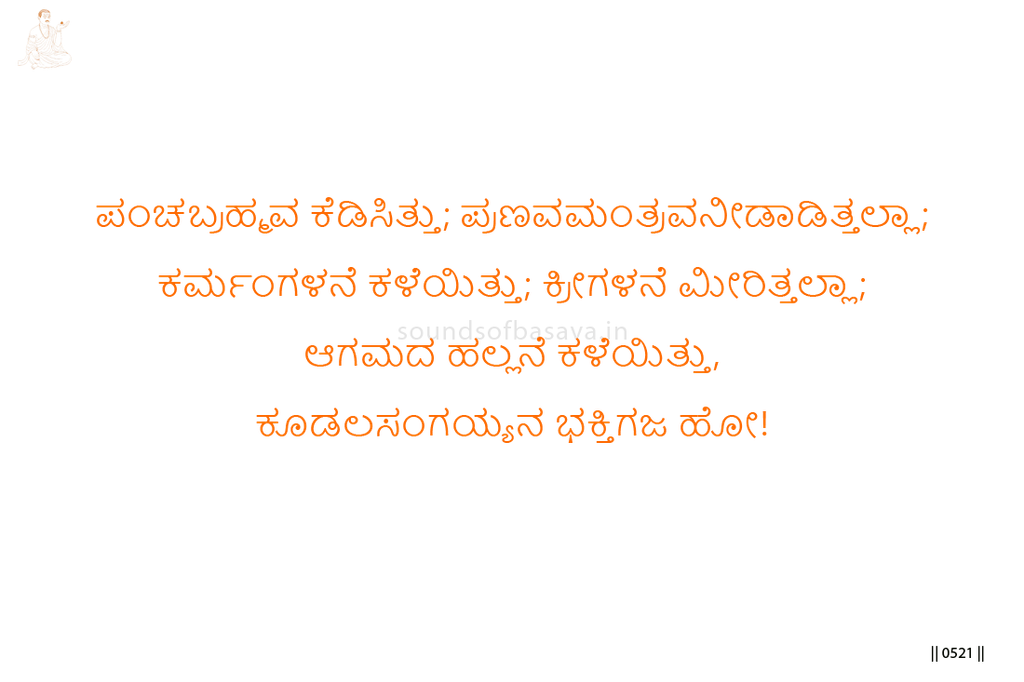
In this vachana, Basavanna presents Kudalasangayya’s Bhakti as a mighty elephant. This Bhakti-elephant overturns even sacred structures: Panchabrahma, the fivefold manifestation of Shiva traditionally understood as Sadyojata, Vamadeva, Aghora, Tatpurusha, and Ishana, is broken, and the Pranava Mantra, the primordial sacred syllable Om regarded as the fundamental sound and vibration underlying all existence, is made to resound.
The movement then passes beyond karma and kriya. Karma here refers to the accumulated effects of past actions and the binding cycle of cause and consequence that keeps the individual tied to worldly existence. Karmas are removed, and ritual acts are surpassed. The force of Bhakti does not remain confined within action, ceremony, or inherited religious procedure.
Basavanna then gives the sharpest image: the tooth of the Agama is removed. The Agama, as ritual and scriptural authority, loses its power to bite or dominate when Kudalasangayya’s Bhakti-elephant moves. The teaching is that living Bhakti grounded in Kudalasangama Deva surpasses even sacred formula, action, ritual, and Agamic authority.
Imagery & Symbolic Relevance
The first image is Panchabrahma. It refers here to a fivefold sacred formulation associated with religious knowing and worship. Basavanna says it is broken or undone. This shows that even respected sacred formulations cannot stand as final when living Bhakti has arisen.
The Pranava Mantra is the next image. Pranava is Om, the primal sacred syllable. In the vachana, it is not merely recited; it is made active and resonant in the movement of Bhakti. The word becomes alive through Kudalasangayya’s force.
Karma is then removed. Karma here is not only action, but the binding force of accumulated deeds and their consequences. The Bhakti-elephant does not merely decorate life; it cuts through bondage.
Kriya is surpassed. Kriya refers to ritual act, religious procedure, or prescribed action. Basavanna does not deny that such acts exist, but he places them below the transforming force of living Bhakti.
The tooth of the Agama is the strongest image. A tooth gives bite. When the tooth is removed, Agama no longer has the power to dominate the seeker as final authority. Ritual scripture loses its sharp hold before direct devotion to Kudalasangayya.
The final image is Bhakti-gaja, the elephant of devotion. The elephant suggests weight, strength, steadiness, and unstoppable movement. This is not fragile or decorative devotion. It is Bhakti strong enough to break structures, remove bondage, and move beyond ritual limitation.
Lingayoga
In Lingayoga, this vachana teaches that living Bhakti must become stronger than formal structure. Sacred formula, mantra, karma, kriya, and Agama have meaning only when they are carried into direct relation with Kudalasangama Deva.
For Pranalingi Sthala, the emphasis is inward force. Bhakti is no longer only outer worship or religious identity. It becomes a power that removes bondage and carries the seeker beyond dependence on ritual mechanism.
The practice-point is direct: do not stop at formula, mantra, action, or procedure. Let Bhakti become living force, like the elephant of Kudalasangayya, moving steadily beyond all that binds.
Editorial Commentary
“Panchabrahma” and “Pranava Mantra” shows that even sacred formulation and sacred sound must be taken up into living Bhakti.
The image of the Agama’s tooth should not be softened. Basavanna is saying that Agamic authority loses its bite when direct Bhakti to Kudalasangayya has become powerful.
The elephant image governs the whole vachana. Bhakti is not passive feeling here. It is mighty, grounded, and transformative.
Related Vachana
Supporting Vachana
Prasadi Sthala Vachana 509 — Through Your Anubhava
Prasadi Vachana 509 supports this vachana by showing that through Kudalasangama Deva’s Anubhava, body and mind are undone, karma is cut, and the Sharanas reveal Bhakti firmly. There, Bhakti becomes visible and established through lived experience.
Vachana 749 carries that same transformation into Pranalingi Sthala. Karmas are removed, kriyas are surpassed, the Agama loses its tooth, and Kudalasangayya’s Bhakti appears as an elephant. Thus Prasadi Vachana 509 supports the Pranalingi teaching that Bhakti must become realized force, not remain mere action, ritual, or doctrine.
Advancing Vachana
Sharana Sthala Vachana 953 — Beyond Veda, Shastra, and Argument: The Source Alone
Sharana Vachana 953 advances this teaching by showing the limitation of sacred systems when they reach what lies beyond them. Veda, Shastra, Tarka, and Agama each speak from their own boundary, but the Sharana does not remain in naming, ritual, thought, or doctrine.
In Vachana 749, Kudalasangayya’s Bhakti-elephant breaks sacred formulation, activates Pranava, removes karma, surpasses kriya, and removes the tooth of Agama. In Vachana 953, this advances into Sharana Sthala as the state where the seeker no longer stops at any system of word, ritual, reasoning, or Agamic approach. Thus the Pranalingi Bhakti-elephant matures into Sharana freedom before Kudalasangama Deva.
