

Summary
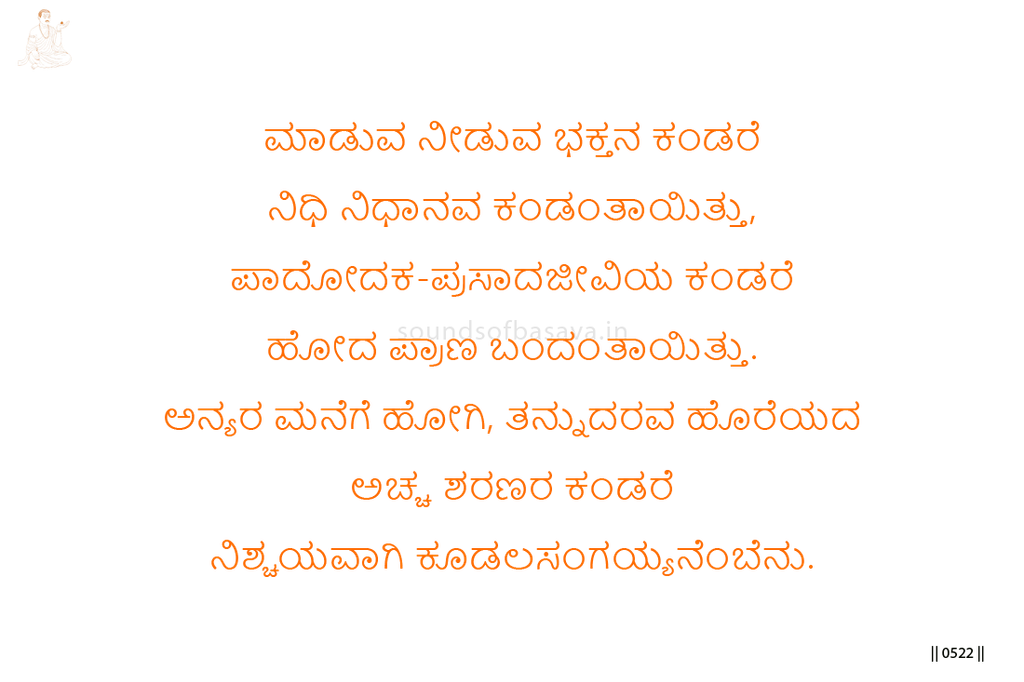
In this vachana, Basavanna says that when he sees the Bhakta who does and gives, it is like finding a hidden treasure. Action and giving are not treated as ordinary activity; they become spiritually precious when they arise from true devotion.
He then says that when he sees one who lives by Padodaka and Prasada, it is like life returning to a life that had gone away. Such a person does not merely receive sacred substances; his life itself is sustained by sacred receiving and offering.
Basavanna finally describes the pure Sharana who goes to another’s house without seeking to fill his own belly. Seeing such a Sharana, he says with certainty: this is Kudalasangayya. The teaching is that true Kayaka and Dasoha are recognized where doing, giving, receiving, and moving among others are free from self-seeking.
Imagery & Symbolic Relevance
The first image is the Bhakta who does and gives. Basavanna joins action and offering. Doing alone is not enough, and giving alone is not enough; both must arise from the true quality of devotion.
The hidden treasure is the next image. A treasure is rare, precious, and not found everywhere. Basavanna uses this image to show the rarity of one whose action and giving have become pure.
The Padodaka-Prasada-jivi is the central sacred figure. This is one whose life is sustained by Padodaka and Prasada. Such a person lives by what is sanctified, received, and offered, not by possession or self-claim.
The image of life returning to what had gone away shows revival. The sight of such a Prasada-living person restores life, meaning, and sacred confidence.
The pure Sharana going to another’s house is the final human image. He goes, but not for the hunger of his own belly. This distinguishes Sharana movement from self-seeking movement.
The final recognition is decisive. Basavanna does not merely call such a person devout; he says with certainty that this Sharana is Kudalasangayya. The realized Sharana becomes the living presence of the Lord’s way.
Lingayoga
In Lingayoga, this vachana teaches that Kayaka and Dasoha must become free from self-interest. Work is not rejected, and movement among households is not rejected; both are tested by motive.
For Pranalingi Sthala, the emphasis is living consecration. The seeker must act, give, receive Padodaka and Prasada, and move among others without making the belly, ego, or possession the center.
The practice-point is direct: let doing become offering, let giving become Dasoha, let Prasada sustain life, and let movement among others be free from self-feeding motive. Where this is present, Basavanna recognizes Kudalasangama Deva.
Editorial Commentary
The treasure image should be kept central. Basavanna is not praising any action or any giving; he is praising the rare Bhakta whose doing and giving carry true devotional worth.
The phrase “Padodaka-Prasada-jivi” shows a life sustained through sacred reception and offering, not private possession.
The final line, Basavanna’s certainty is strong: the pure Sharana who does not move for his own belly is recognized as Kudalasangayya.
Related Vachana
Supporting Vachana
Prasadi Sthala Vachana 936 — Dasoha at Every Stage
Prasadi Vachana 936 supports this vachana by teaching that Dasoha is required in every state. Bhakti must become Bhakti-Dasoha, Yukti must become Yukti-Dasoha, and even Mamakaara, the sense of “mine,” must become Dasoha.
Vachana 759 shows this principle embodied in the living Sharana. The Bhakta who does and gives is like hidden treasure; the Padodaka-Prasada-jivi restores life; and the pure Sharana moves without seeking his own belly. Thus Prasadi Vachana 936 supports the Pranalingi teaching that Prasada and action must not be held as private possession, but must move as Dasoha before Kudalasangama Deva.
Advancing Vachana
Sharana Sthala Vachana 1316 — If “I” Enter the Act, It Becomes Betrayal
Sharana Vachana 1316 advances this teaching by testing the inner purity of doing and giving. There, Basavanna says that if he thinks, “I have done it,” or “I have given it,” or if the mind relishes the taste of its own giving, it becomes betrayal before Kudalasangama Deva.
In Vachana 759, Basavanna recognizes the living Kayaka of the Bhakta who does and gives without self-seeking, and the pure Sharana who does not move for his own belly. In Vachana 1316, this advances into Sharana Sthala as the complete removal of “I” from action and giving. Thus the Pranalingi recognition of living Kayaka matures into Sharana purity, where even the claim “I did” or “I gave” must disappear before Kudalasangama Deva.
