

Summary
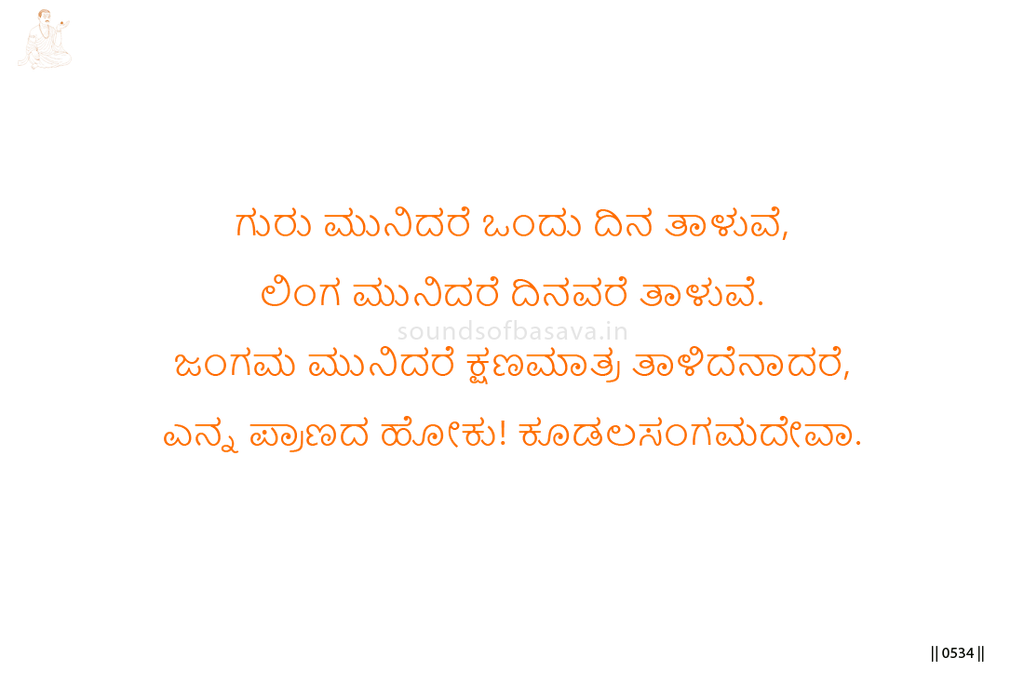
In this vachana, Basavanna measures the seeker’s relation to Guru, Linga, and Jangama by the time he can endure their displeasure. If Guru is displeased, he can bear it for a day. If Linga is displeased, he can bear it for a day. But if Jangama is displeased even for a moment, his prana departs.
The teaching gives special urgency to living sacred presence. Guru guides, Linga anchors inward awareness, and Jangama stands before the seeker as immediate realization. Damage in that relation cannot be postponed or treated lightly.
Before Kudalasangama Deva, Basavanna shows that Pranalingi life depends on vigilance toward Jangama. Speech, conduct, and inward attitude must remain careful where living presence is encountered.
Imagery & Symbolic Relevance
Guru’s displeasure shows the seriousness of failing in relation to guidance. Basavanna does not dismiss it, but says it may still be endured for a day.
Linga’s displeasure points to disturbance in inward sacred relation. This too is grave, yet the vachana allows a span of endurance.
Jangama’s displeasure is different. Even a moment is unbearable, because Jangama is the living presence through which realization confronts the seeker directly.
The departure of prana is the final image. Basavanna presents loss of right relation with Jangama not as social discomfort, but as loss of life-force itself.
Lingayoga
In Lingayoga, this vachana teaches that Guru, Linga, and Jangama must remain inseparable in practice. Guidance, inward worship, and living presence cannot be honored selectively.
For Pranalingi Sthala, prana is not treated as breath alone. It is life sustained in right relation with Kudalasangama Deva through Guru, Linga, and Jangama. When that relation is harmed, the seeker feels it as inner death.
The practice-point is direct: do not be careless before Jangama. Guard the relation immediately, because even a moment of rupture is spiritually dangerous.
Editorial Commentary
“Munidare” should be read as displeasure or anger, not mere absence. The vachana is therefore not about missing Jangama physically, but about damaging the living relation.
Guru and Linga are not diminished here. Basavanna’s emphasis is on immediacy: Jangama tests whether reverence has become living conduct.
Related Vachana
Supporting Vachana
Prasadi Sthala Vachana 422 — The Alchemy of Reverence
Prasadi Vachana 422 supports this vachana by teaching that the encounter with Jangama becomes nectar through reverence and poison through opposition. It also joins Sthavara and Jangama in one sacred recognition and places Kudalasangama Deva near in the Sharana.
Vachana 824 carries that teaching into Pranalingi urgency. What Prasadi presents as the need for reverent reception becomes here the impossibility of enduring even a moment of Jangama’s displeasure. Thus Prasadi reverence toward Jangama supports the Pranalingi demand for uninterrupted right relation with living sacred presence.
Advancing Vachana
Sharana Sthala Vachana 999 — Made Worthy Through the Grace of the Sharanas
Sharana Vachana 999 advances this teaching by showing the fruit of right relation with the Sharanas. There, the seeker does not claim independent purity or attainment. He is purified, corrected, and made worthy through the grace of Kudalasangama Deva’s Sharanas.
In Vachana 824, the seeker’s prana depends on preserving right relation with Jangama. In Vachana 999, this matures into Sharana Sthala as complete dependence on Sharana-grace. The Pranalingi urgency before Jangama thus advances into total belonging among Kudalasangama Deva’s Sharanas.
