

Summary
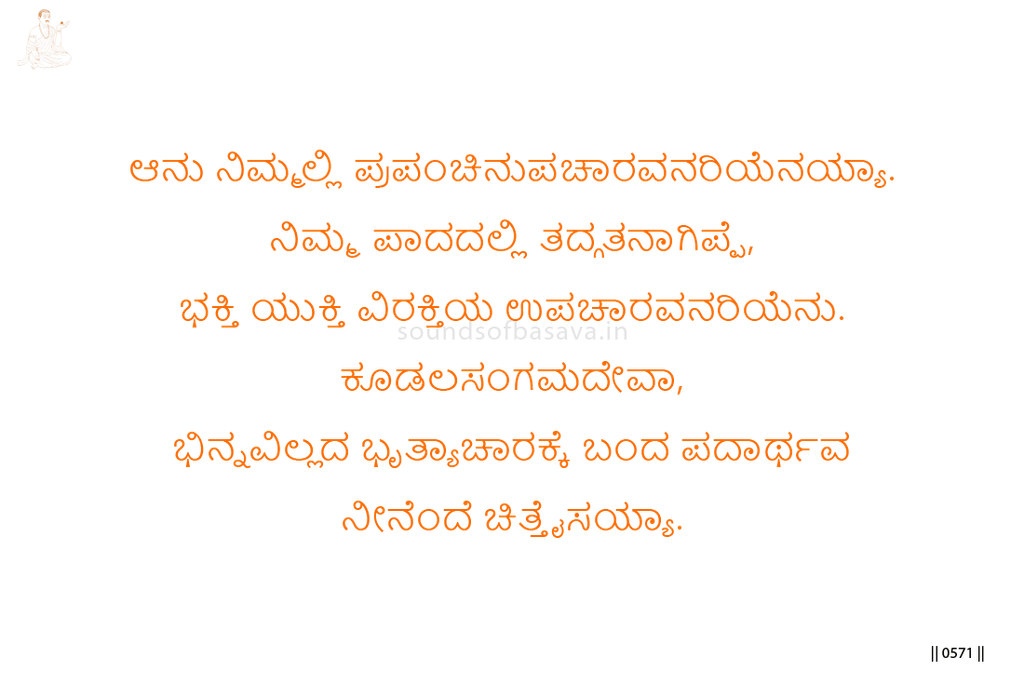
In this vachana, Basavanna says that he does not know the worldly forms of service or ceremonial upachāra before Kudalasangama Deva. He does not place value on elaborate external observance as his main path.
Instead, he says that he remains absorbed at the Lord’s feet. The service he knows is Bhakti, Yukti, and Virakti: devotion, right inward understanding, and detachment from worldly claim.
He then asks Kudalasangama Deva to make his heart understand that whatever comes before him in the conduct of undivided servitude is none other than the Lord Himself.
The spiritual concern is therefore transformed perception. Basavanna does not ask for ritual skill or public religious correctness. He asks for the heart to see everything received in undivided service as Kudalasangama Deva.
Imagery & Symbolic Relevance
The first image is worldly upachāra. Upachāra means service, attendance, or formal offering. Basavanna says he does not know the upachāra of prapañca, the worldly field. This points to outer convention, ceremonial correctness, and social forms of religious service.
The second image is remaining absorbed at the Lord’s feet. The feet of Kudalasangama Deva represent nearness, surrender, and steady devotion. Basavanna does not stand apart as one performing elaborate acts; he remains held at the feet.
The third image is Bhakti, Yukti, and Virakti as the true service. Bhakti is devotion. Yukti is right inward understanding and spiritual alignment. Virakti is detachment from possessiveness and worldly fascination. Together they form the service Basavanna accepts as real.
The fourth image is bhṛtyācāra. Bhṛtya means servant, and āchāra means conduct. Bhṛtyācāra is the conduct of one who belongs entirely to the Lord. Basavanna asks that this conduct remain without division.
The final image is whatever comes as the Lord Himself. Padārtha means that which comes before the seeker as object, circumstance, encounter, or received matter. Basavanna asks that his heart be made to see all such coming as Kudalasangama Deva.
Lingayoga
In Lingayoga, this vachana teaches that service must become inwardly undivided. External forms have their place, but they do not complete the path unless the heart remains absorbed and the seeker’s vision is purified.
For Pranalingi Sthala, the point is direct. The life of the seeker must become aligned through Bhakti, Yukti, and Virakti. Whatever comes in the field of service should not be treated as separate from Kudalasangama Deva.
The practice-point is clear: do not depend on worldly upachāra alone. Remain at the Lord’s feet. Let devotion, right understanding, and detachment shape the heart. In undivided bhṛtyācāra, receive whatever comes as Kudalasangama Deva Himself.
Editorial Commentary
The terms Bhakti, Yukti, and Virakti should be kept together. Basavanna is not rejecting service; he is distinguishing outer service from inwardly transformed service. Bhṛtyācāra is the conduct of one who serves without separation. The final prayer is the heart of the vachana: whatever comes before the seeker should be recognized as Kudalasangama Deva, not as a separate object of possession, preference, or rejection.
Related Vachana
Supporting Vachana
Prasadi Sthala Vachana 864 — When the Covering is Removed, the Fruit is Revealed
Prasadi Vachana 864 supports this teaching by showing that spiritual fruit appears when the covering is removed and conduct becomes true. When word, conduct, and inner truth become steady in Kudalasangama Deva, the person becomes the pure Sharana.
Vachana 1049 carries this into Pranalingi Sthala as undivided servant-conduct. Basavanna does not depend on worldly upachāra, but remains absorbed at the Lord’s feet through Bhakti, Yukti, and Virakti. What Prasadi 864 teaches as the alignment of word, conduct, and inner truth becomes, here, the prayer that whatever comes in bhṛtyācāra be recognized as Kudalasangama Deva Himself.
Advancing Vachana
Sharana Sthala Vachana 808 — The Measure of True Dasoha
Sharana Vachana 808 advances this teaching by showing Dasoha through body, life, bhava, and speech. Yet it says that the way of Prana-Linga is rare and is truly known only among the Sharanas of Kudalasangama Deva.
In Vachana 1049, Basavanna asks to remain in undivided bhṛtyācāra, seeing whatever comes in service as Kudalasangama Deva Himself. In Vachana 808, this matures into Sharana Sthala as complete Dasoha, where body, life, inner being, and speech are no longer separate acts of service but expressions of the rare way of Prana-Linga.
