

Summary
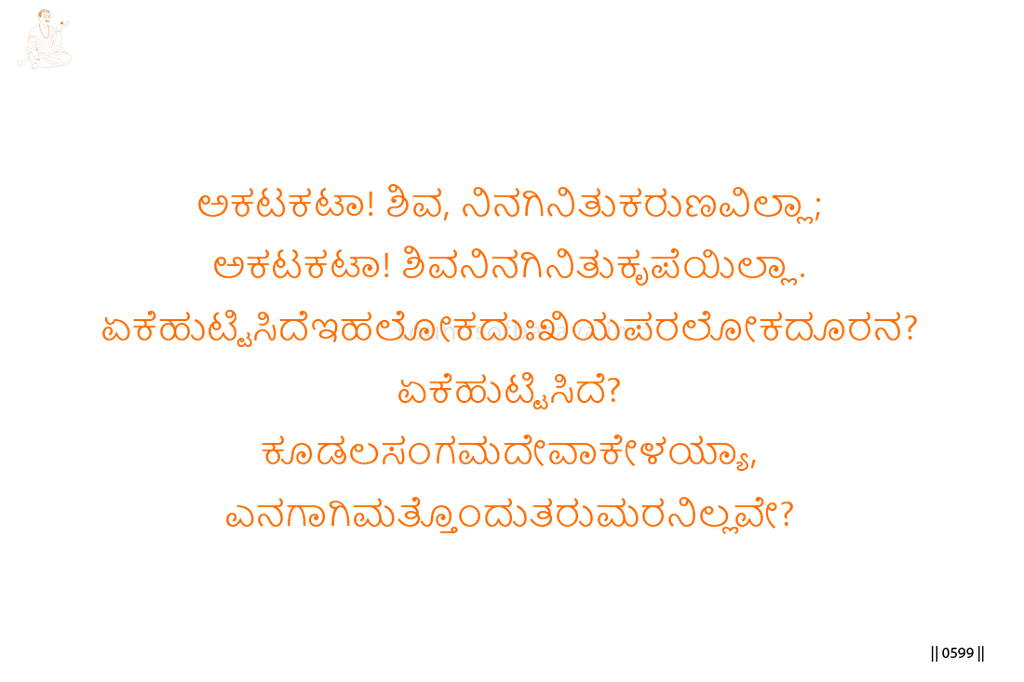
Basavanna cries out to Shiva, asking whether there is no compassion and no grace for him. He questions why he has been caused to be born into the sorrow of this world and kept far from the other world.
The lament then becomes sharper. Basavanna asks Kudalasangama Deva to hear him: could he not have been raised like a plant, without this awareness? The pain of the vachana lies in this contrast. A plant simply grows without such inner questioning, but the human being bears awareness, sorrow, distance, and the anguish of asking why.
Imagery & Symbolic Relevance
The repeated cry “Akatakata” gives the vachana its tone. It is an exclamation of anguish before Shiva.
The absence of compassion and grace is the first concern. Basavanna feels the lack of what he most needs and places that pain before the Lord.
Birth is the central question. He asks why he has been caused to be born. Birth here is not described as privilege, but as entry into the sorrow of this world.
The sorrow of this world and the distance from the other world form the divided condition of the vachana. The speaker feels caught in suffering here and yet far from release beyond it.
The image of the plant gives the final contrast. Basavanna asks whether Kudalasangama Deva could not have raised him like a plant, without this awareness. The plant stands as a form of life without the torment of reflective sorrow. The human condition is therefore shown as painful because it knows, questions, and suffers its own distance.
The final appeal to Kudalasangama Deva gathers the lament. Basavanna asks to be heard. The force of the vachana lies in the exposed question: why this birth, this sorrow, this distance, and this awareness?
Lingayoga
In Lingayoga, the relevance of this vachana lies in the movement given by the source: the seeker feels deprived of compassion and grace, questions the reason for birth, names the sorrow of this world, feels distance from the other world, and asks why he was not made like a plant without this painful awareness.
The practice-point is direct: when awareness itself becomes burdened by sorrow and questioning, the seeker must place that lament honestly before Kudalasangama Deva.
Editorial Commentary
This vachana should be read as a lament over conscious suffering. Basavanna does not merely ask why he was born; he asks why he was born with awareness that feels sorrow, distance, and abandonment. The reference to the plant must not be treated as decorative imagery. It is central to the vachana’s pain: unconscious growth would not carry this anguish, but human awareness does.
Related Vachana
Supporting Vachana
Prasadi Sthala Vachana 1002 — How Can I Claim to Have Conquered Māyā?
Prasadi Vachana 1002 supports this vachana by showing that the world, samsara, forgetfulness, sorrow, and release from darkness all stand within Kudalasangama Deva’s power. In Sharana Vachana 64, Basavanna asks why he has been born into worldly sorrow, why grace and compassion seem absent, and why he was not made like a plant without this awareness. Prasadi Vachana 1002 gives the supporting ground: the seeker cannot claim mastery over world, sorrow, or release. These remain before Kudalasangama Deva.
Advancing Vachana
Aikya Sthala Vachana 21 — The Womb of Becoming
Aikya Vachana 21 advances this teaching by carrying the question of birth into the deeper source of becoming. In Sharana Vachana 64, Basavanna asks why he has been born into the sorrow of this world and why he was not raised like a plant without this awareness. In Aikya Vachana 21, he turns to the womb of becoming itself and prays that no further such arising should occur. Thus the Sharana-stage lament over conscious birth and sorrow advances into Aikya as the prayer for the cessation of further becoming before Kudalasangama Deva.
