
Summary
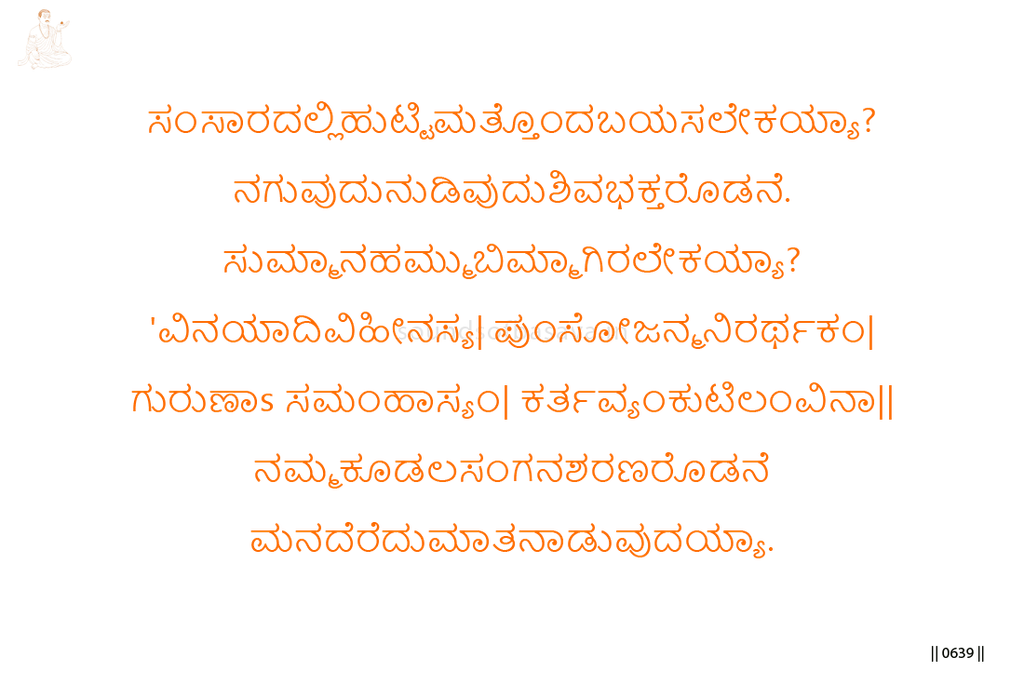
In this vachana, Basavanna asks why one should be born in samsara only to desire something else again. Human birth is not to be spent in further wanting, pride, or empty self-importance.
The better way is simple: laugh and speak with Shiva-bhaktas. Basavanna does not present spiritual life here as isolation, but as open-hearted companionship with those who live in devotion.
The final line gives the center of the teaching. With Kudalasangama’s Sharanas, one should open the mind and speak. Birth becomes meaningful when pride loosens and speech becomes sincere in the company of realized devotees.
Imagery & Symbolic Relevance
Birth in samsara is the first image. Basavanna begins with embodied life and asks what it is for. If birth only produces further wanting, its deeper purpose is missed.
Laughter and speech with Shiva-bhaktas form the next image. These are ordinary human acts, but in sacred company they become signs of ease, nearness, and shared truth.
Empty swelling or pride is the contrast. To remain closed, inflated, or self-important prevents the seeker from receiving what Sharana-sanga gives.
Opening the mind is the final image. It means speaking without concealment, superiority, or inner stiffness. Before Kudalasangama’s Sharanas, the seeker becomes simple enough to speak truthfully.
Together, the images show that sacred company is not external association alone. It becomes meaningful when the heart opens, speech softens, and pride gives way.
Lingayoga
In Lingayoga, this vachana places importance on Sharana-sanga. The seeker does not ripen only through private effort; the company of Shiva-bhaktas helps speech and mind become clear.
The practice-point is direct: do not spend life in further wanting or proud isolation. Seek the company of Sharanas and speak with an open mind.
For Sharana Sthala, this is living fellowship. The Sharana does not hide behind status or heaviness. The Sharana sits, laughs, speaks, and opens inwardly before Kudalasangama Deva’s devotees.
Editorial Commentary
The title should remain only as an identifier. The Kannada does not develop a full economic metaphor. Its actual movement is from birth in samsara, to companionship with Shiva-bhaktas, to open-hearted speech with Kudalasangama’s Sharanas. Laughter should not be treated as trivial entertainment; here it suggests natural ease in sacred company.
Related Vachana
Supporting Vachana
Pranalingi Sthala Vachana 979 — Without Experience, Nothing Ripens
Pranalingi Vachana 979 teaches that Sharana-sanga remains outward unless it awakens inward Anubhava and nearness.
This prepares Vachana 242, where pride and further wanting give way to natural fellowship, laughter, and open-hearted speech with Kudalasangama’s Sharanas. Thus external company becomes genuine inward participation.
Advancing Vachana
Aikya Sthala Vachana 1251 — The Awakening Through Direct Encounter
Aikya Vachana 1251 advances this teaching by carrying Sharana-sanga into direct realization through Jangama. In Vachana 242, the seeker opens the mind and speaks with Kudalasangama’s Sharanas. In Aikya Vachana 1251, Sangana Basavanna lives through the face of Jangama, and this is known by the three worlds. Thus the Sharana-stage fellowship of open speech advances into Aikya as realization lived through Jangama before Kudalasangama Deva.
