

Summary
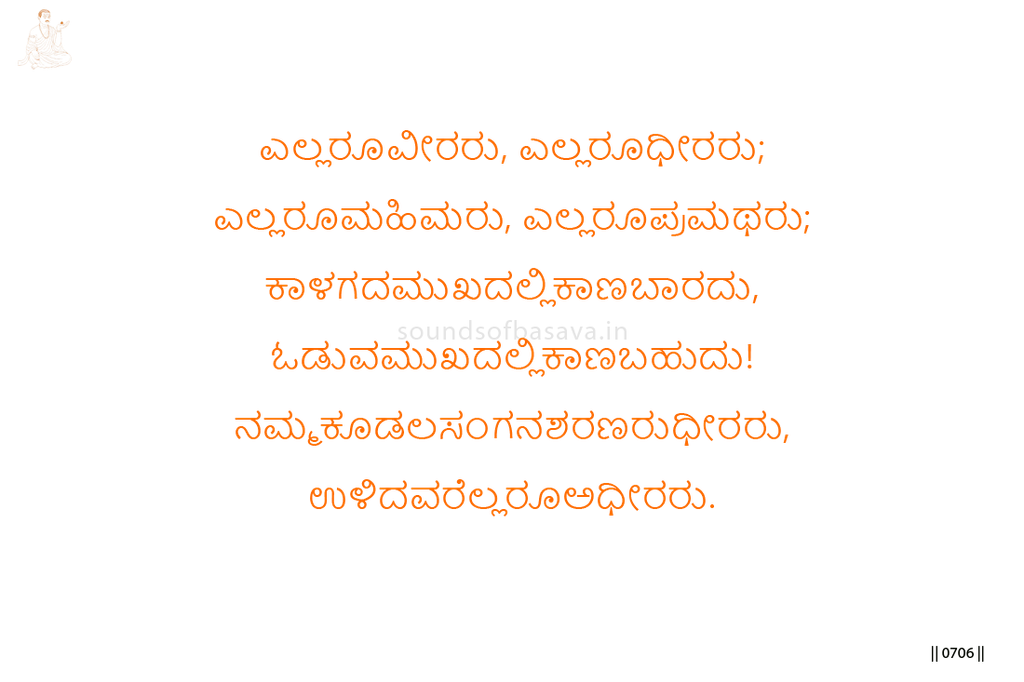
In this vachana, Basavanna says that everyone calls themselves warriors, steadfast ones, great ones, and Pramathas.
But such claims cannot be known at the face of battle. They are known when one sees the face that runs away. Courage is not proved by self-declaration, title, or appearance, but by what remains when the test comes.
Basavanna then gives the final distinction: the Sharanas of Kudalasangama are truly steadfast; all others are unsteady. The teaching is direct: true courage belongs to those who do not collapse when tested.
Imagery & Symbolic Relevance
The universal claim of courage is the first image. Everyone may call themselves brave, steady, great, or realized. Basavanna begins by exposing self-proclaimed stature.
The face of battle is the central testing image. Courage is not known before the test; it becomes visible when the field of danger or pressure appears.
The running face gives the contrast. One who flees reveals instability. The claim of courage is broken by the movement of retreat.
The Sharanas of Kudalasangama Deva are the final image of steadiness. They are called truly dhīra because their courage does not depend on outward claim.
All others are called adhīra. This does not require further ornament: those who do not stand in the test are not truly steadfast.
The imagery therefore moves from claim, to test, to flight, to true steadiness. Basavanna separates proclaimed courage from lived courage.
Lingayoga
In Lingayoga, this vachana teaches that courage must be lived, not announced.
The practice-point is direct: do not depend on title, speech, or self-image. Stand in the test without fleeing. Let devotion become steadiness before Kudalasangama Deva.
For Sharana Sthala, this is dhairya as spiritual firmness. The Sharana is not measured by proclamation, but by the ability to remain steady when the path tests him.
Editorial Commentary
The force of this vachana lies in its contrast between declared courage and tested courage. Basavanna does not accept the words “warrior,” “steadfast,” “great,” or “Pramatha” as proof. The proof appears when the test comes, and the one who runs is seen.
Related Vachana
Supporting Vachana
Pranalingi Sthala Vachana 857 — Not Time, but Becoming that Binds
Pranalingi Vachana 857 supports this teaching by showing that those who are not the Sharanas of Kudalasangama Deva are swallowed by Aham, the subtle self-claiming “I.” There, the danger is not merely outer time or visible threat, but the inward force that consumes through self-claim. Vachana 445 carries this into Sharana Sthala: those who merely claim courage are exposed when tested, while the Sharanas of Kudalasangama remain truly steadfast.
Advancing Vachana
Aikya Sthala Vachana 2 — The Ancient One
Aikya Vachana 2 advances this teaching by revealing Kudalasangama Deva as prior to all beginnings, before the waters, before Tripura, before Hari, Brahma, and Umā. Vachana 445 says that only the Sharanas of Kudalasangama are truly steadfast; Aikya Vachana 2 carries this into Aikya, where steadiness rests in the beginningless ground that does not arise or fall with time.
