

Summary
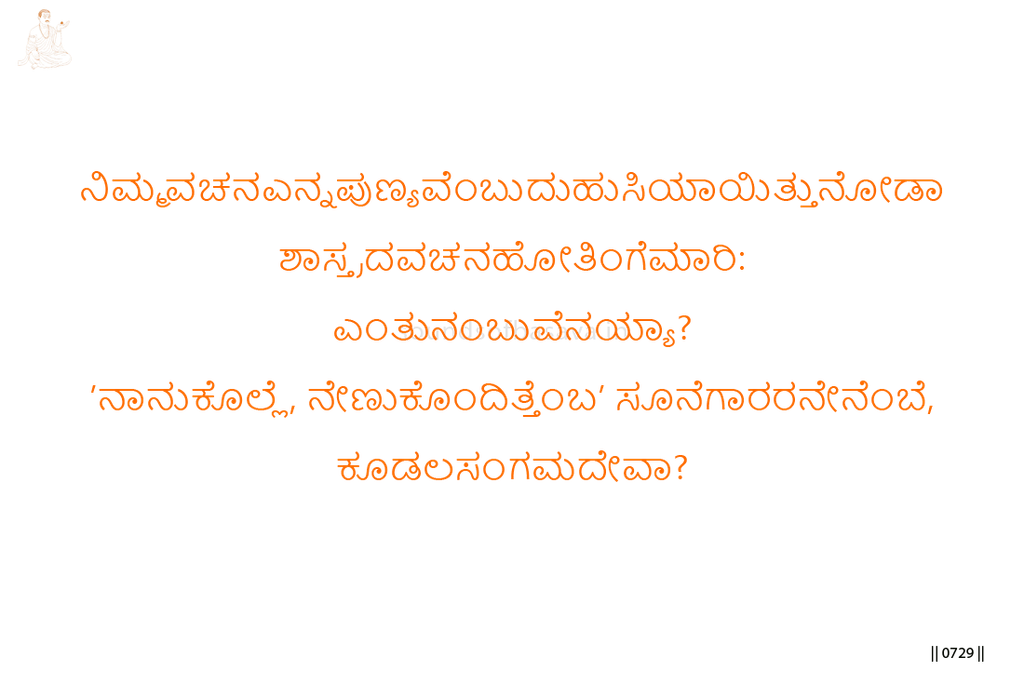
In this vachana, Basavanna distinguishes Kudalasangama Deva’s word from a scriptural word that hides violence.
He says that the Lord’s word alone is merit. For the reader, merit here means what is spiritually true, life-giving, and worthy before Kudalasangama Deva. But he then turns to the word of the Shastra, which permits the binding and offering of an animal. Basavanna asks how such a word can be trusted.
He exposes the evasion behind ritual violence: “I did not kill; the noose killed.” The person acts, but shifts responsibility to the instrument or the ritual.
The teaching is direct: sacred language cannot make harm pure. A word that hides responsibility is not the Lord’s word. True speech must reveal truth, not cover violence.
Imagery & Symbolic Relevance
The Lord’s word is the first image. It is not ordinary speech. It is the word aligned with Kudalasangama Deva, and therefore it becomes merit.
The word of the Shastra is the opposing image. Shastra means scriptural or religious authority. Basavanna is not rejecting all teaching. He is questioning a word that gives religious cover to harm.
The bound animal is the central ethical image. The animal is brought into a ritual frame, but the ritual name does not erase the reality of killing.
The noose is the sharp image of evasion. The one who acts says, “I did not kill; the noose killed.” Basavanna exposes this as false separation between the person, the instrument, and the deed.
The sacrificer or slaughterer is therefore not freed by language. Responsibility remains with the conscious agent.
The movement of the vachana is clear: the Lord’s word reveals truth; false scriptural use hides harm; the noose becomes an excuse; Basavanna refuses such speech before Kudalasangama Deva.
Lingayoga
In Lingayoga, this vachana teaches integrity of speech and action.
The practice-point is direct: do not use scripture, ritual, custom, or instrument to avoid responsibility for what is done. If an act harms, sacred wording cannot make it pure.
For Sharana Sthala, this is truthfulness before the Lord. The Sharana does not separate speech from conduct. The word, the hand, the act, and the inner intention must stand together before Kudalasangama Deva.
Editorial Commentary
This vachana should not be expanded into a general attack on learning. Basavanna’s concern is precise: when scriptural authority is used to justify harm and hide responsibility, it becomes false. The strongest line is the exposure of evasion: “I did not kill; the noose killed.” That is the word Basavanna refuses.
Related Vachana
Supporting Vachana
Pranalingi Sthala Vachana 566 — The Linga in the Palm
Pranalingi Vachana 566 supports this teaching by showing that the palm-held Linga demands truthful speech, right conduct, restraint, and reverence. There, Kudalasangama Deva’s word becomes the measure before which false speech and wrong action cannot stand.
This supports Vachana 572 directly. Basavanna says that the Lord’s word alone is merit, while the word that hides killing behind ritual or instrument cannot be trusted. Vachana 566 prepares this by teaching that speech, hand, and conduct must not be divided after the Linga has been received.
Advancing Vachana
Aikya Sthala Vachana 129 — The Altar of the Self
Aikya Vachana 129 advances this teaching by placing ritual sacrifice before the deeper test of non-harming. There, the lamb brought for festival sacrifice is shown as innocent life, and Basavanna asks whether one who takes life can know freedom.
Vachana 572 rejects the word that excuses killing by saying, “the noose killed.” Aikya Vachana 129 carries this into Aikya: where life is seen as one before Kudalasangama Deva, no offering that denies life can reveal truth. The false word is replaced by direct recognition of life’s indivisible sacredness.
