

Summary
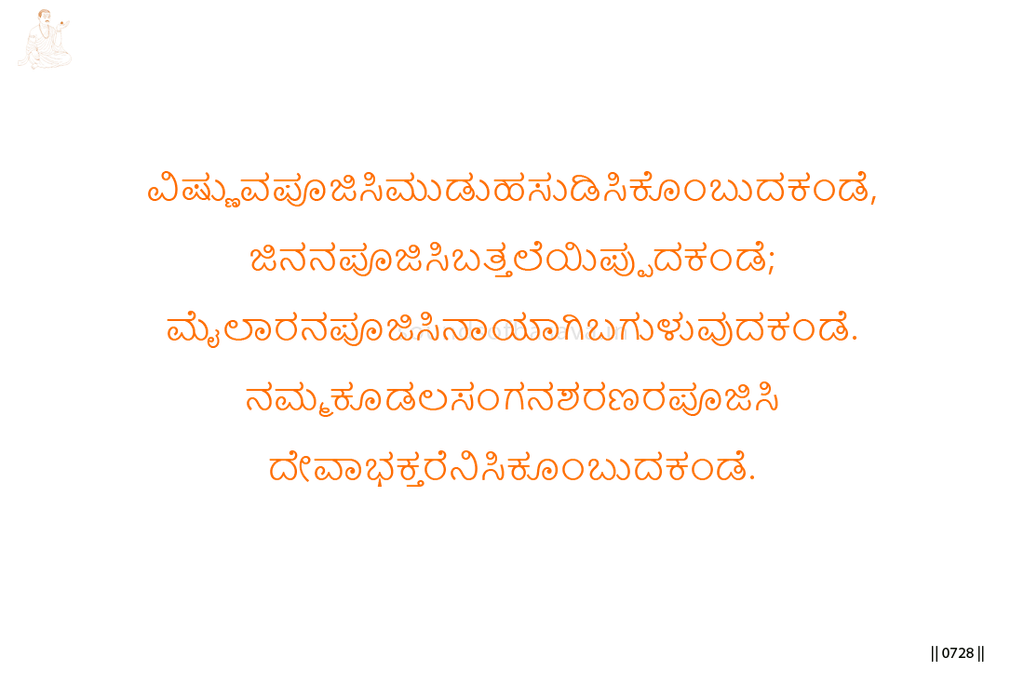
In this vachana, Basavanna distinguishes true Bhakti from outward religious extremity.
He says he has seen those who worship Vishnu and burn themselves, those who worship Jina and remain naked, and those who worship Mailara and bark like dogs. These are not casual observations. They are examples of visible religious intensity that may appear severe, disciplined, or ecstatic.
For the reader, Vishnu refers here to a deity worshipped through one religious path. Jina refers to the Jaina ideal associated here with bodily austerity. Mailara refers to a local or folk form of worship associated here with frenzied devotional expression.
Basavanna’s contrast is direct. Those who worship Kudalasangama Deva are the ones called Bhaktas. True devotion is not proved by burning the body, exposing the body, or imitating animal-like frenzy. It is proved by worship rightly centered in Kudalasangama Deva.
Imagery & Symbolic Relevance
Worshipping Vishnu and burning oneself is the first image. It points to religious practice that turns severe upon the body. Basavanna does not accept bodily burning as the measure of realization.
Worshipping Jina and remaining naked is the second image. It points to visible renunciation and bodily austerity. The body may be stripped, but that alone does not prove inner awakening.
Worshipping Mailara and barking like a dog is the third image. It points to ecstatic, uncontrolled, or frenzied expression. Sound, movement, and intensity may appear devotional, but they are not the same as Bhakti.
The worship of Kudalasangama Deva gives the correcting measure. Basavanna shifts the reader away from outer display and toward the true object of devotion.
The word Bhakta is the decisive mark. A Bhakta is not merely one who performs extreme acts in the name of religion. A Bhakta is one whose worship is rightly joined to Kudalasangama Deva.
The imagery therefore moves from bodily severity, to visible renunciation, to frenzied expression, and finally to the clear measure of true Bhakti.
Lingayoga
In Lingayoga, this vachana teaches discernment between performance and realization.
The practice-point is direct: do not mistake physical extremity, public austerity, or emotional display for Bhakti. Ask whether the practice is inwardly joined to Kudalasangama Deva and whether it brings steadiness, clarity, and transformation.
For Sharana Sthala, this is purification of the name Bhakta. Basavanna protects the word from being applied to every visible display of religion. True Bhakti is not spectacle; it is right worship centered in Kudalasangama Deva.
Editorial Commentary
This vachana should be read as a correction of religious display, not as a general rejection of discipline. Basavanna’s concern is that outward intensity can be mistaken for spiritual truth. Burning, nakedness, and frenzy are not final measures. The true measure is whether worship is directed to Kudalasangama Deva and ripens into genuine Bhakti.
Related Vachana
Supporting Vachana
Pranalingi Sthala Vachana 691 — The One-Pointed Alignment
Pranalingi Vachana 691 supports this teaching by saying that outer injury, bodily tearing, or loss of possessions is not the decisive measure. What matters is whether chitta, mind, and buddhi become one and do not separate again.
This supports Vachana 569 directly. Burning the body, exposing the body, or entering frenzy cannot by itself make one a Bhakta. True worship requires inward alignment before Kudalasangama Deva.
Advancing Vachana
Aikya Sthala Vachana 1166 — Kriya Is the Body, Jnana the Life-Breath
Aikya Vachana 1166 advances this teaching by showing the completed union of action and realization. There, Kriya is not separated from Jnana: action becomes the body, knowledge becomes the life-breath, the body is made Linga, and the life-breath is made Jangama.
Vachana 569 rejects religious action that remains only outwardly intense. Aikya Vachana 1166 carries this into fulfillment: action is no longer burning, display, austerity, or frenzy by itself. It becomes Kriya joined with Jnana, body joined with Linga, and life-breath joined with Jangama before Kudalasangama Deva.
