

Summary
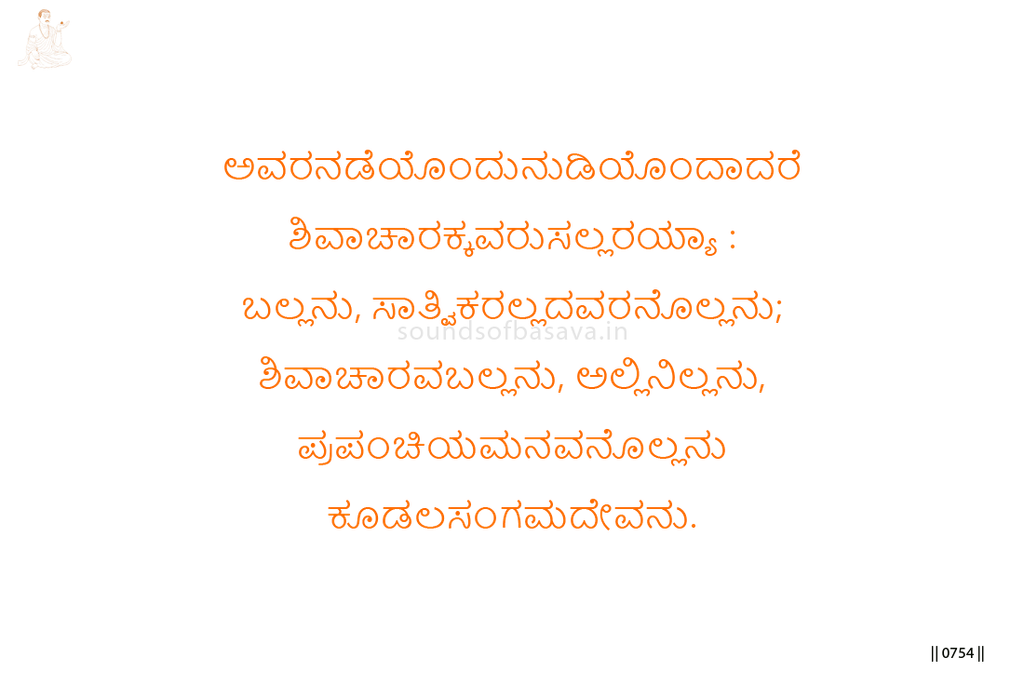
In this vachana, Basavanna tests Shivachara by one clear measure: whether one’s nudi and nade have become one.
Nudi means word or speech. Nade means walk, conduct, or the lived movement of a person. Shivachara means Shiva-centered conduct, the living way of Shiva.
If speech goes one way and conduct another, Basavanna says such a person is not fit for Shivachara. Religious language cannot replace lived integrity.
He then distinguishes knowing from standing. A person may know the language of Shivachara, but without inward steadiness, that knowing does not become abiding. The one who truly knows Shivachara stands there.
The final line rejects the worldly mind. A worldly mind is a mind still governed by division, inconsistency, display, and self-interest. Kudalasangama Deva does not accept that divided condition.
The teaching is direct: Shivachara is not a claim. It is the unity of speech and conduct, held steadily before Kudalasangama Deva.
Imagery & Symbolic Relevance
The first image is the joining of walk and word. Basavanna places speech and conduct side by side because both reveal the inner state. Speech declares what one values. Conduct shows what one has actually become.
When word and walk are separated, the person becomes spiritually divided. The mouth may speak of Shiva, but the life may still move according to another center. For Basavanna, such division cannot stand in Shivachara.
The next image is standing. To “stand there” does not mean physical stillness. It means remaining rooted in the conduct one knows to be true. Basavanna does not accept passing insight or verbal correctness as enough. The knower of Shivachara must remain in it.
The term sāttvika points to the steady, pure, inward quality needed for such abiding. Without this steadiness, knowledge remains unstable. It may appear in speech, but it does not govern life.
The worldly mind is the final contrast. It is not simply a mind living in the world. It is a mind shaped by worldly division: saying one thing, doing another, knowing without standing, and appearing spiritual without becoming inwardly steady.
Kudalasangama Deva is the measure at the end. The Lord does not accept outward Shivachara when the mind remains divided. What is accepted is undivided living.
Lingayoga
In Lingayoga, this vachana teaches integrity of speech and conduct.
The seeker must examine whether spoken devotion has entered action. Does the word “Shiva” govern the walk? Does declared knowledge become steadiness? Does conduct reveal what speech claims?
For Sharana Sthala, this is a strict test. The Sharana is not one who merely speaks correctly, knows terms, or appears religious. The Sharana’s walk and word must arise from one inward ground before Kudalasangama Deva.
Editorial Commentary
The entry should remain centered on nudi, nade, Shivachara, and standing. Basavanna’s concern is not eloquence, doctrine, or outer observance by itself. He asks whether speech and conduct have become one.
The strongest distinction in the vachana is between knowing and abiding. Knowledge that does not stand in conduct remains incomplete. Shivachara becomes real only when it is lived without inner division.
Related Vachana
Supporting Vachana
Pranalingi Sthala Vachana 797 — The Inseparable Abidance in the Linga
Pranalingi Vachana 797 supports this teaching by asking how one who has received Prana-Linga can walk, speak, experience the senses, or perform even the smallest act apart from the Linga. It rejects Linga-virahita living, meaning life separated from the Linga.
This directly supports Vachana 658. Vachana 658 says that word and walk must become one for Shivachara to be true. Vachana 797 gives the Pranalingi ground for that unity: after Prana-Linga is received, walking and speaking cannot remain outside Linga-awareness.
Together, they teach that spiritual life must enter ordinary movement. Speech, conduct, sensing, and action must not become separate from Kudalasangama Deva.
Advancing Vachana
Aikya Sthala Vachana 1235 — The Symphony of the Integrated Self
Aikya Vachana 1235 advances this teaching by saying that conduct must reveal its beauty through speech, and speech must reveal its beauty through conduct. It exposes the danger of hiding division beneath divine garb and sacred language. It then honors those who are complete without inner division.
Vachana 658 demands that word and walk become one in Shivachara. Aikya Vachana 1235 carries this into fuller realization: speech and conduct no longer merely avoid contradiction; they reveal one another.
Thus the Sharana test of Vachana 658 advances into Aikya as complete integration. The divided mind is left behind, and fellowship belongs to those whose living and speaking arise from one undivided state before Kudalasangama Deva.
