

Summary
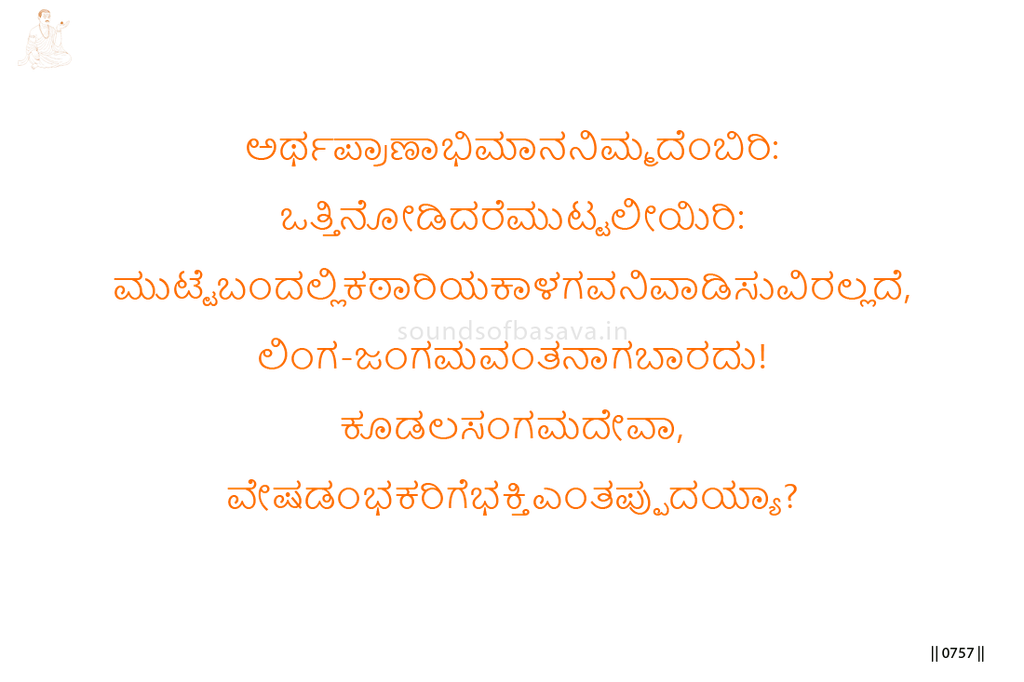
In this vachana, Basavanna exposes devotion that remains only a claim.
He addresses those who say, “wealth, life, and self-regard are Yours.” Artha means wealth, possession, or material interest. Prana means life or life-breath. Abhimana means self-regard, pride, or personal attachment. The speaker claims that all these belong to Kudalasangama Deva.
But when the claim is tested, the truth is revealed. What was said as surrender is not actually surrendered. The person does not allow wealth, life, or pride to be touched.
Basavanna then gives the warrior image. When the encounter comes, one must face the battle of the dagger. Without such testing, one cannot become Linga-Jangamavanta — one whose life is truly joined to Linga and Jangama.
The final question is sharp: what Bhakti can there be for vesha-dambhakas? Vesha means costume, outward appearance, or assumed form. Dambha means pretence, display, or boastful show. Basavanna is asking what devotion can exist in those who only wear the appearance of Bhakti.
The teaching is clear: surrender is not proved by saying “all is Yours.” It is proved when what one calls “Yours” is actually given up when tested.
Imagery & Symbolic Relevance
The first image is the verbal claim: “wealth, life, and self-regard are Yours.” These are not small offerings. Together they include possession, survival, and personal identity. Basavanna places the whole person under examination.
The test is the next image. A claim made in safety may sound complete, but pressure reveals what is still guarded. If the person refuses to let the claimed offering be touched, the surrender was only speech.
The dagger-battle gives the vachana its severity. Basavanna does not use a soft image. A dagger battle is close, dangerous, and direct. It represents the moment when devotion is no longer protected by words. The seeker must meet what threatens attachment, pride, and self-preservation.
The phrase Linga-Jangamavanta is central. Linga is the sacred presence of Shiva received and worshipped. Jangama is the living movement of that presence through the realized Sharana-field. To become Linga-Jangamavanta is not to speak about both, but to be inwardly tested by both.
The final phrase vesha-dambha completes the criticism. A person may wear the signs, carry the language, and appear ready. But if surrender fails under testing, the appearance becomes display.
The movement of the vachana is precise: claim is made, testing exposes refusal, the warrior image reveals the seriousness of the path, and outward show is rejected before Kudalasangama Deva.
Lingayoga
In Lingayoga, this vachana teaches that surrender must become real under testing.
The seeker should examine what is still being protected after saying “all is Yours.” Is wealth still guarded? Is life still clung to as personal possession? Is pride still defended? If so, the offering has not yet become complete.
For Sharana Sthala, this is a strict warning against devotional performance. The Sharana does not merely declare surrender. The Sharana allows the claim to be tested before Kudalasangama Deva.
Editorial Commentary
This vachana should not be softened into general advice about humility. Its force lies in the contrast between spoken surrender and tested surrender.
The key terms should remain clear: artha, prana, abhimana, Linga-Jangamavanta, and vesha-dambha. Basavanna is not rejecting devotional speech; he is rejecting speech that protects itself from consequence.
Related Vachana
Supporting Vachana
Pranalingi Sthala Vachana 798 — The Touchstone of Truth
Pranalingi Vachana 798 supports this teaching by asking what fruit comes from thousands of songs, meanings, vows, or observances if the mind has not touched the Linga. It also rejects the false claim, “I have seen the great Linga,” when inward contact has not occurred.
This supports Vachana 667 closely. Vachana 667 rejects those who say wealth, life, and pride are the Lord’s while refusing the test. Vachana 798 rejects sacred activity and proclamation when the mind has not truly reached Linga.
Together, they teach that claim, song, vow, and declaration are empty unless inward contact has become real.
Advancing Vachana
Aikya Sthala Vachana 679 — The One Witness
Aikya Vachana 679 advances this teaching by saying that battles of the brave may be described, but words do not fight the battle. The state of the ancient ones who offered body, mind, and wealth to Linga may be spoken of, but it cannot be attained through description. At the moment of testing, only lived Anubhava remains.
This is the direct continuation of Vachana 667. Vachana 667 exposes the person who speaks surrender but does not stand when tested. Aikya Vachana 679 shows the fulfilled opposite: those who have truly offered body, life, and breath to Guru, Linga, and Jangama do not merely speak of the path; they become it.
Thus Vachana 667’s warning against display advances into Aikya as lived realization. The pretender wears devotion; the realized one has passed through the test before Kudalasangama Deva.
