

Summary
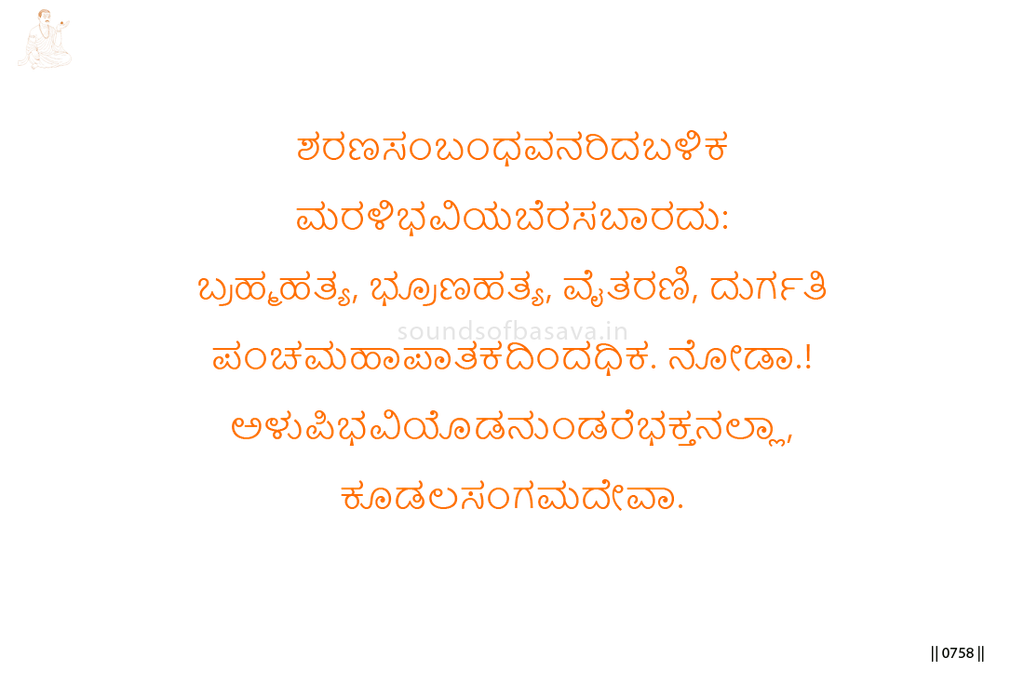
In this vachana, Basavanna teaches that once Sharana-sambandha is truly known, the Bhakta cannot return to the Bhavi field.
Sharana-sambandha means the living bond with Kudalasangama Deva’s Sharanas. It is not casual friendship, social contact, or religious affiliation. It is a recognized spiritual relation that changes one’s field of belonging.
Bhavi means one who remains in ordinary becoming, outside the awakened Linga-Sharana relation. Here it should not be read merely as a social label. It names an unawakened mode of life that has not entered the Sharana-bond.
Basavanna says that after knowing this Sharana-relation, one cannot again mix with the Bhavi way. He then names dreadful falls to show the seriousness of such return.
Brahm-hatya here should not be reduced to killing a Brahmin by birth. It should be understood as the killing of the knower of eternal truth. Bhruṇa-hatya means killing the unborn child. In a spiritual reading, it also points to obstructing or destroying the growth of one whose awareness has not yet come to birth. Vaitarani evokes the terrible hellish crossing. Durgati means ruinous fall, calling hell upon oneself. The pancha-mahapataka are the five great sins.
Basavanna says that returning to Bhavi-relation after knowing Sharana-sambandha is worse than these dreadful falls. The final test is concrete: if one eats with the Bhavi after knowing the Sharana-bond, one is not a Bhakta of Kudalasangama Deva.
The teaching is severe because the bond is severe. Once the Sharana-relation is known, receiving, eating, belonging, and fellowship cannot remain unchanged.
Imagery & Symbolic Relevance
The first image is the bond of the Sharana. A bond here means more than respect for holy people. It is a relation that enters the whole life. To know this bond is to recognize where one truly belongs.
The second image is the return to the Bhavi. Basavanna is not speaking of ordinary human contact. He is speaking of spiritual re-entry into an unawakened field after the Sharana-bond has been known. Such return makes the earlier recognition false.
The list of dreadful falls gives the vachana its intensity. Brahm-hatya, Bhruṇa-hatya, Vaitarani, Durgati, and the five great sins are not decorative terms. Basavanna deliberately invokes extreme images of moral and spiritual ruin in order to measure the gravity of returning after knowing.
The final image is eating with the Bhavi. Eating means receiving, sharing, dependence, and inward participation. Food enters the body; fellowship enters the life. Basavanna uses this image because the Sharana-bond must govern what one receives.
The movement of the vachana is precise: Sharana-sambandha is known, return to Bhavi-relation is forbidden, the gravity is measured against the most terrible falls, and the concrete test appears in eating or receiving.
Lingayoga
In Lingayoga, this vachana teaches vigilance after entering the Sharana-bond.
The seeker must ask: after knowing the Sharana-relation, what do I still receive from the old field? Where do I still eat, depend, identify, or belong in ways that weaken Linga-Sharana relation?
This is not a call to hatred or social contempt. It is a discipline of spiritual non-return. The Bhakta cannot live from two incompatible centers: Sharana-sambandha on one side and Bhavi-dependence on the other.
For Sharana Sthala, the teaching is decisive. The Sharana-bond must govern receiving, food, fellowship, loyalty, and conduct. If the old field still feeds the seeker, the new relation has not become complete.
Editorial Commentary
The corrected terms should remain clear. Brahm-hatya means killing the knower of eternal truth. Bhruṇa-hatya means killing the unborn child, and by extension obstructing the unborn spiritual growth of one not yet awakened. Vaitarani is the dreadful hellish crossing. Durgati is ruinous fall, the hellish consequence called upon oneself.
The severity of the vachana should not be softened. Basavanna is saying that after knowing Sharana-sambandha, returning to Bhavi-relation is spiritually worse than the most dreadful falls he names.
At the same time, this should not be written as social hatred. The issue is spiritual contradiction: once the Sharana-bond is known, the Bhakta cannot receive and belong as though nothing has changed.
Related Vachana
Supporting Vachana
Pranalingi Sthala Vachana 603 — Beyond Measure: The Exposure of False Purity
Pranalingi Vachana 603 supports this teaching more directly than the earlier selected support. It says that food seen by the Bhavi does not become Linga-offered. The issue is not outer handling alone, but inward fitness and the field from which the offering comes.
This directly supports Vachana 671. Vachana 671 warns that one who has known Sharana-sambandha must not eat with the Bhavi. Vachana 603 gives the Pranalingi ground for that warning: what belongs to Bhavi-seeing cannot simply be renamed as Linga-offered.
Together, the two vachanas teach that receiving must be purified by Linga-relation. Food, offering, and fellowship cannot be treated as neutral after the Sharana-bond is known.
Advancing Vachana
Aikya Sthala Vachana 1297 — No More Seeking, No More Wandering
Aikya Vachana 1297 advances this teaching by refusing Bhavi-sanga directly. Basavanna says he will not seek the company of the Bhavi, because before such company lie endless births and becoming. He also refuses worship that turns away from Kudalasangama Deva, and concludes by standing firm after leaving both delusions.
Vachana 671 says that after knowing Sharana-sambandha, one cannot return to Bhavi-relation or eat from that field. Aikya Vachana 1297 shows the fulfilled state: the seeker no longer seeks Bhavi-company or divided worship at all.
Thus Vachana 671’s warning becomes Aikya’s steadiness. What begins as a prohibition against return matures into firm standing before Kudalasangama Deva.
