

Summary
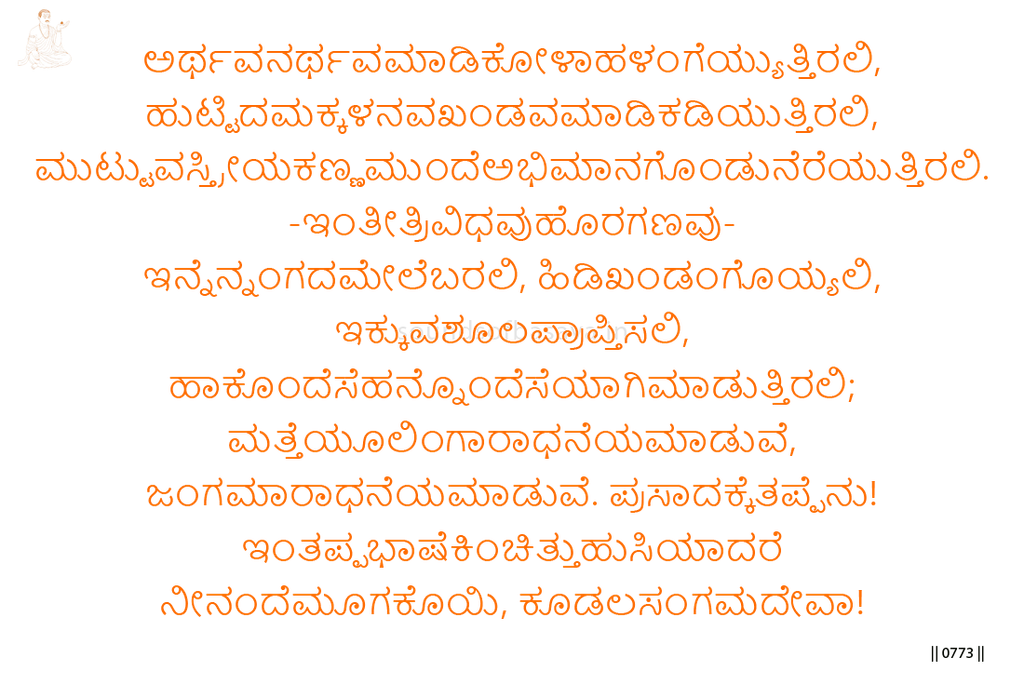
In this vachana, Basavanna separates outward disturbance from inward fidelity.
He first names three severe outward conditions. Truth may be twisted into falsehood and spread with noise. Children may be cut into pieces. A person may stand in pride before a woman’s dishonour or distress. Basavanna gathers these as three outward matters.
He then turns the force upon himself. Let such things come upon this body. Let the body be cut. Let the spear strike. Let every form of bodily ordeal arise. Even then, he says, he will continue Linga-ārādhane, Jangama-ārādhane, and will not fail in Prasada.
The vachana is not merely about physical endurance. It is about not allowing outward violence, disorder, shame, or fear to break the integrated path of Linga, Jangama, and Prasada.
The final line is severe. If this speech becomes even slightly false, Basavanna asks Kudalasangama Deva to cut his nose. This makes the vachana a vow, not a general statement.
The teaching is direct: the Sharana must not abandon Linga, Jangama, and Prasada even when outward conditions become violent, humiliating, or unbearable. If his vow is false, the disgrace belongs to him before Kudalasangama Deva.
Imagery & Symbolic Relevance
The twisting of truth into falsehood is the first image. Basavanna begins with speech and meaning corrupted in public. The issue is not simple error; it is the reversal of truth into its opposite.
Noise or public tumult gives the second layer of the same image. Falsehood does not remain hidden. It is made loud, spread, and socially sustained.
The cutting of children is the next severe image. It introduces bodily violence and unbearable grief. Basavanna does not soften the image; he places it among the outward matters that test the Sharana’s steadiness.
The woman before whose eyes pride is displayed gives another image of dishonour and moral failure. It shows how pride can stand shamelessly even where humility and restraint are required.
“These three are outward matters” is the turning point. Basavanna does not deny their seriousness. He says that they remain outside the center that must not break.
The body then becomes the field of testing. Let suffering come upon it. Let it be cut. Let the spear strike. Let bodily ordeal multiply. The body may be harmed, but the vow must not be abandoned.
Linga-ārādhane is the first inner commitment. Worship of the Linga must continue.
Jangama-ārādhane is the second. The living sacred relation must also continue; Basavanna does not allow worship to remain only inward or fixed.
Prasada is the third. He says he will not fail in Prasada. This completes the integrated field of practice: Linga, Jangama, and Prasada must remain unbroken.
The nose-cutting image gives the vow its severity. The nose is visible; its cutting is public disgrace. Basavanna binds his own speech to truth before Kudalasangama Deva.
The movement of the vachana is therefore from public falsehood and outward violence, to bodily trial, to unbroken Linga-Jangama-Prasada, and finally to severe accountability before Kudalasangama Deva.
Lingayoga
In Lingayoga, this vachana teaches that practice must not collapse under outward pressure.
The seeker should examine whether devotion remains steady only in favourable conditions. If truth is distorted, if disorder arises, if the body is threatened, if shame or fear appears, does the relation to Linga, Jangama, and Prasada remain whole?
For Sharana Sthala, the practice-point is clear: do not let outward turmoil sever the integrated path. Continue Linga-ārādhane. Continue Jangama-ārādhane. Do not fail in Prasada. Let speech before Kudalasangama Deva be true enough to bear its own consequence.
Editorial Commentary
The three outward examples should not be softened into vague “difficulty.” Basavanna gives harsh images and then says that even such outward conditions must not break the vow. The final nose-cutting line should also remain sharp. It shows that the vachana is not rhetorical courage, but accountable speech before Kudalasangama Deva.
Related Vachana
Supporting Vachana
Pranalingi Sthala Vachana 786 — Not a Blade of Grass Outside the Linga
Pranalingi Vachana 786 supports this teaching by giving another severe vow before Kudalasangama Deva. There, Basavanna says he will not take even a blade of grass unless it is Linga-arpita, and he repeats the head-penalty if the vow is not fulfilled. This supports Vachana 707 directly. Vachana 707 binds the speaker to continued Linga-ārādhane, Jangama-ārādhane, and fidelity to Prasada even under bodily ordeal; Vachana 786 gives the supporting discipline of vow-bound accountability, where even the smallest act must remain within the Linga.
Advancing Vachana
Aikya Sthala Vachana 1190 — The Prasada of Jangama and the Prasada of Linga Are One
Aikya Vachana 1190 advances this teaching by declaring that the true devotee knows Jangama as Prana-Linga, and that without Jangama-Prasada, Linga-Prasada cannot be received. It also says that one must not doubt that Jangama-Prasada belongs to Linga. This is the natural advancement from Vachana 707. Vachana 707 vows not to abandon Linga-ārādhane, Jangama-ārādhane, or Prasada under any outward trial. Aikya Vachana 1190 carries that vow into fulfilled unity, where Linga, Jangama, and Prasada are no longer separable before Kudalasangama Deva.
