

Summary
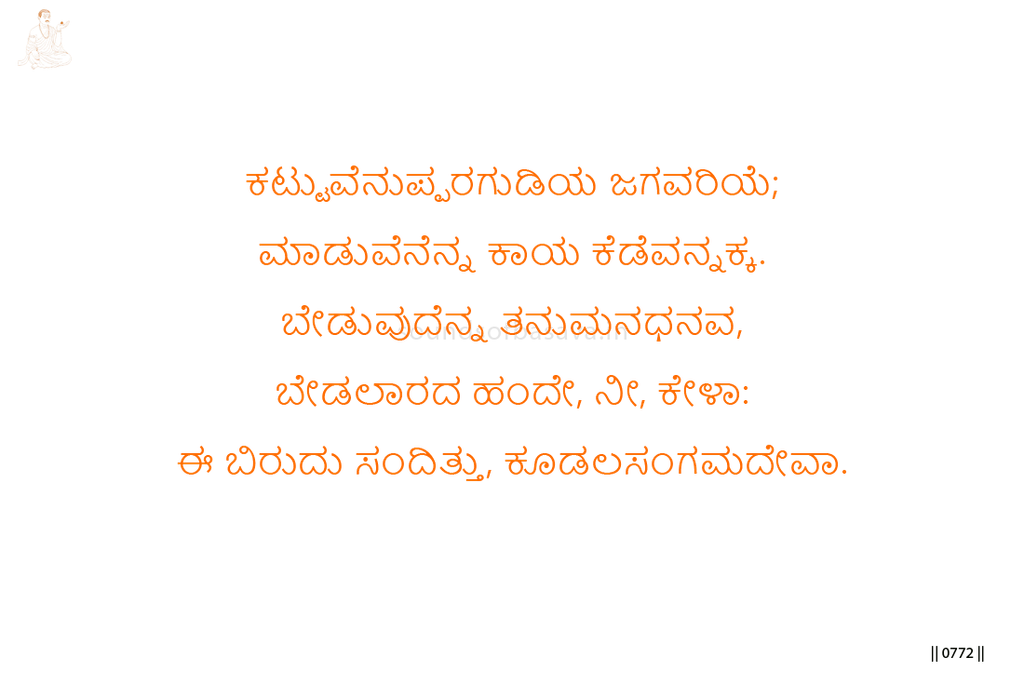
In this vachana, Basavanna refuses to turn devotion into asking, bargaining, or dependence.
He begins with the image of temples being built in the world. The point is not to condemn all temples, but to turn attention away from outward construction as the measure of devotion.
He then speaks of the body. He will not use the body as a means for gain, nor will he ask for body, mind, or wealth. The refusal is sharp: what cannot rightly be begged for should not be begged for.
The vachana therefore rejects the attitude that approaches Kudalasangama Deva in order to secure preservation, possession, advantage, or reward. The Sharana does not come before the Lord as a petitioner seeking worldly benefit.
The final line asks the Lord to hear this settled stance. Basavanna places his refusal of bargaining before Kudalasangama Deva Himself. The teaching is direct: the Sharana does not make the body, mind, wealth, temple, or devotion into a transaction. He stands before Kudalasangama Deva without begging for gain.
Imagery & Symbolic Relevance
The temple is the first image. Temples may be raised across the world, but Basavanna does not make outer construction the center of his relation to the Lord.
The world in which temples are built represents visible religious effort. Such effort can become impressive outwardly, but the vachana asks whether devotion has become inwardly free from bargaining.
The body is the second image. It is the place where life is lived, but it should not become a tool for negotiation. Basavanna refuses to make the body a means of spiritual trade.
Body, mind, and wealth form the threefold field of ordinary human attachment. The body seeks preservation, the mind seeks assurance, and wealth seeks security. Basavanna refuses to ask for these as the basis of devotion.
The phrase “what cannot be begged” gives the teaching its edge. Some things cannot be obtained by asking because asking itself keeps the seeker in the position of lack, dependence, and transaction.
The command “listen” makes the vachana a direct declaration. Basavanna is not merely thinking inwardly; he places this stance before Kudalasangama Deva.
The movement of the vachana is therefore from outward temple-building, to the body, to body-mind-wealth, to the refusal of begging, and finally to a settled declaration before Kudalasangama Deva.
Lingayoga
In Lingayoga, this vachana teaches freedom from transactional devotion.
The seeker should examine the subtle habit of asking: “Give me security,” “protect this body,” “increase my wealth,” “preserve what I possess,” “reward my devotion.” Basavanna cuts through this pattern.
For Sharana Sthala, the practice-point is clear: do not stand before Kudalasangama Deva as one bargaining for body, mind, wealth, or advantage. Let devotion become free from asking for gain.
Editorial Commentary
The temple image should be handled carefully. Basavanna is not merely arguing against buildings; he is rejecting devotion that depends on outer construction and inward transaction. The core of the vachana is the refusal to ask for body, mind, and wealth. Its force lies in the vow-like stance: what cannot rightly be begged for, the Sharana will not beg for.
Related Vachana
Supporting Vachana
Pranalingi Sthala Vachana 761 — Not for Wages
Pranalingi Vachana 761 supports this teaching by rejecting devotion performed for wages, treasure, gold, reward, or ritual gain. Basavanna says he is not like one who seeks payment, nor like the Chola who calls for a rain of gold; he asks Kudalasangama Deva only for true devotion. This supports Vachana 705 directly. Vachana 705 refuses to ask for body, mind, and wealth, and rejects bargaining before the Lord. Vachana 761 gives the supporting ground: sacred action must not become a means of reward-seeking, and devotion must be freed from transaction.
Advancing Vachana
Aikya Sthala Vachana 713 — Before the River
Aikya Vachana 713 advances this teaching by asking what stood before the river of time, before the Vedas, before the shastras, and before ritual forms. It turns the seeker away from dependence on what is constructed, spoken, written, or arranged, and toward the source that precedes them. This is the natural advancement from Vachana 705. Vachana 705 refuses bargaining through body, mind, wealth, and outward religious construction; Aikya Vachana 713 carries that refusal into completion, where even scripture, ritual, and institutional form are not held as final before Kudalasangama Deva.
