

Summary
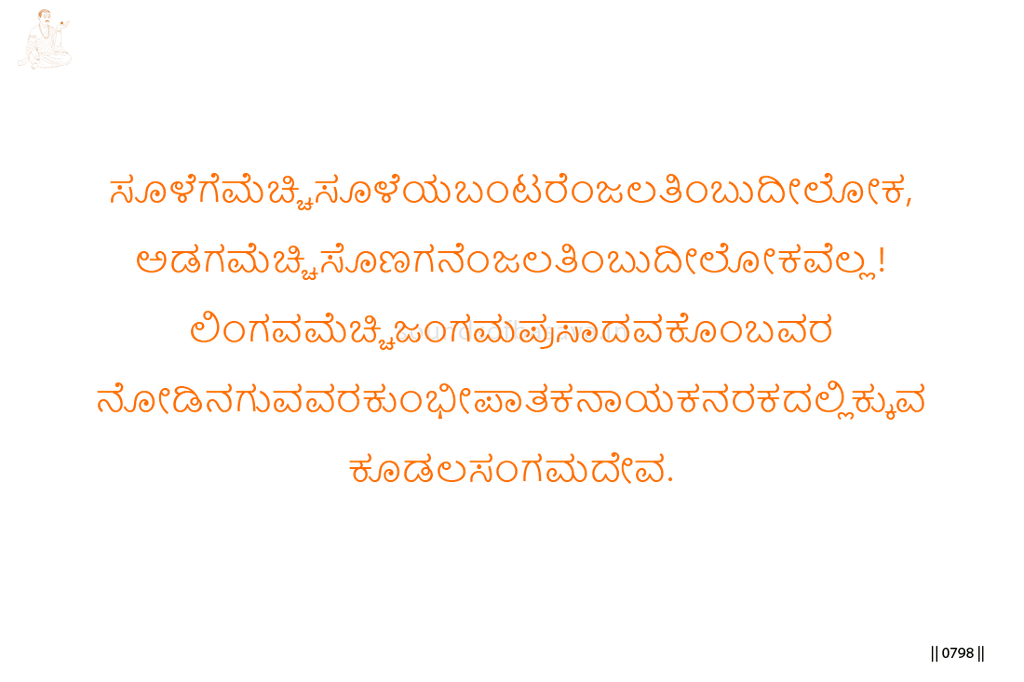
In this vachana, Basavanna exposes the world’s inverted sense of participation.
He says that the courtesan hides, yet the world eats the courtesan’s feast. He then says that the thief hides, yet the world eats the thief’s feast. In both images, something concealed and morally compromised still attracts participation.
Basavanna then gives the reversal. Those who embrace the Linga and receive Jangama-Prasada are seen and laughed at. The world accepts hidden indulgence and hidden theft, but mocks the sacred relation of Linga, Jangama, and Prasada.
The final warning is severe. Those who laugh at such receiving fall into Kumbhipātaka-naraka, the hell of grave sin, before Kudalasangama Deva. The laughter is not harmless ridicule. It reveals contempt for the living path.
The teaching is direct: the Sharana must discern what kind of participation nourishes bondage and what kind of receiving belongs to grace. To mock Linga joined with Jangama-Prasada is to reject the very movement that completes Bhakti before Kudalasangama Deva.
Imagery & Symbolic Relevance
The courtesan is the first image. Basavanna says she hides, yet the world eats her feast. The image points to concealed desire and the willingness of people to partake in what is morally compromised.
The feast is important. To eat is to participate. Basavanna is not speaking only of watching from a distance. Those who eat share in the condition of what they accept.
The thief is the second image. He too hides, yet the world eats the thief’s feast. This points to concealed taking, wrongful gain, and the willingness to benefit from what is not cleanly obtained.
The two feasts together reveal contradiction. Hidden desire and hidden theft do not prevent the world from joining. Concealment does not disturb them when gain or pleasure is available.
Linga is the third and sacred image. To embrace or hold the Linga is to stand in visible relation to Kudalasangama Deva. This is not hidden corruption, but open devotion.
Jangama-Prasada gives the decisive correction. Prasada received through Jangama belongs to the living relation between Linga and Jangama. It is not ordinary eating. It is sacred receiving within the Sharana path.
The laughter of others is the turning point. What should be honored is mocked. Basavanna shows the depth of spiritual blindness: people partake in hidden corruption but laugh at sacred receiving.
Kumbhipātaka-naraka completes the warning. The hell-image should retain its severity. It is the consequence of mocking the living relation of Linga, Jangama, and Prasada while accepting what degrades the path.
The movement of the vachana is therefore from hidden desire, to hidden theft, to worldly participation in both, then to the ridicule of Linga and Jangama-Prasada, and finally to the fall that follows contempt for Kudalasangama Deva’s living grace.
Lingayoga
In Lingayoga, this vachana teaches discernment in participation and receiving.
The seeker should ask: what do I join? What do I eat from? Do I participate in what is hidden and compromised while laughing at what is sacred? Do I understand Jangama-Prasada as part of the living fulfilment of Linga, or do I reduce it to something laughable?
For Sharana Sthala, the practice-point is clear: do not follow the world’s inverted measure. Do not partake in the feasts of hidden desire and theft. Receive Jangama-Prasada with reverence, as part of the living relation of Linga and Jangama before Kudalasangama Deva.
Editorial Commentary
The two-feast contrast should remain central. The vachana does not require a broad moral theory of secrecy, nor should it be softened into a general statement about hypocrisy. Basavanna’s image is sharper: the world eats from the hidden feasts of the courtesan and the thief, but laughs at those who embrace Linga and receive Jangama-Prasada.
The phrase Jangama-Prasada must remain central. The issue is not food alone. It is sacred receiving through the living presence of Jangama in relation to Linga. The final hell-image should also remain strong, because Basavanna treats contempt for this sacred receiving as grave spiritual downfall.
Related Vachana
Supporting Vachana
Pranalingi Sthala Vachana 961 — The Descent of Linga into Prana
Pranalingi Vachana 961 supports this teaching by showing that Linga placed upon the body and worshipped outwardly does not by itself end bhava. Linga must become inwardly joined with prana, and the realization must pass through Dasoha and Jangama as Mukhalinga. This supports Vachana 769 directly. Vachana 769 shows the world laughing at those who embrace Linga and receive Jangama-Prasada; Vachana 961 gives the supporting ground: Linga must not remain a mere outward mark, but must move through life, offering, and the living face of Jangama before Kudalasangama Deva.
Advancing Vachana
Aikya Sthala Vachana 1190 — The Prasada of Jangama and the Prasada of Linga Are One
Aikya Vachana 1190 advances this teaching by declaring that the true devotee knows Jangama as Prana-Linga, and that without Jangama-Prasada, Linga-Prasada cannot be received. It also says that the Prasada of Jangama cannot be doubted as belonging to Linga. This is the natural advancement from Vachana 769. Vachana 769 condemns those who mock the receiving of Jangama-Prasada in relation to Linga; Aikya Vachana 1190 carries that teaching into completion, where Linga-Prasada and Jangama-Prasada are known as one indivisible grace before Kudalasangama Deva.
