

Summary
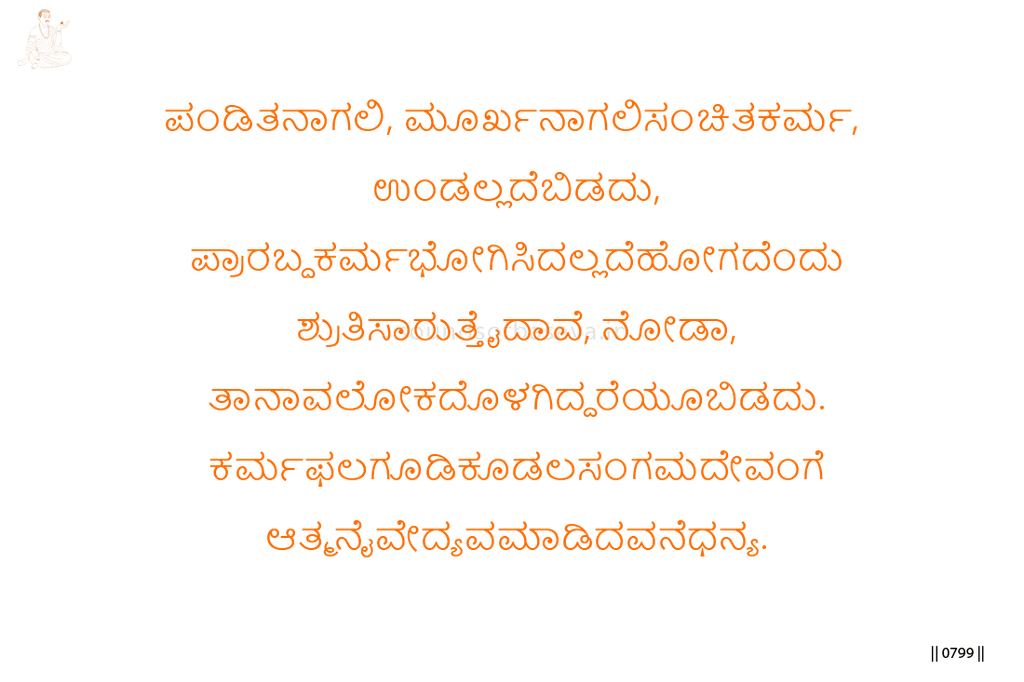
In this vachana, Basavanna teaches that karma does not lose its force because of learning or ignorance.
He says that whether one is a scholar or a fool, accumulated karma does not disappear without being exhausted. He then adds that prārabdha-karma does not pass away without being experienced. This is the teaching declared by Shruti.
The next line widens the measure. In whatever world one may be, karma-fruit does not leave. A change of place, status, learning, or condition does not by itself end consequence.
The final line gives the blessed condition. The one who, together with the fruit of karma, offers the self as Naivedya to Kudalasangama Deva is dhanya — blessed. The answer is not denial of karma, nor pride in knowledge, but total offering.
The teaching is direct: karma must be faced; prārabdha must be lived through; karma-fruit follows wherever one goes. Blessed is the one who offers the self itself, together with the karmic fruit, as Naivedya to Kudalasangama Deva.
Imagery & Symbolic Relevance
The scholar is the first image. Learning may give clarity, language, and discrimination, but Basavanna refuses to treat learning as exemption from karma.
The fool is the second image. Ignorance also does not stand outside karma. Scholar and fool are placed under the same law of consequence.
Accumulated karma is the first karmic term. It refers to what has been gathered. Basavanna says it must be exhausted; it does not vanish merely because one wishes to be free of it.
Prārabdha-karma is the second karmic term. It is what has already begun to bear fruit. Basavanna says it does not pass away without being experienced.
Shruti gives authority to this law. The statement is not presented as personal opinion, but as a truth already declared by sacred hearing.
The worlds form the next image. Basavanna says that whatever world one may be in, karma-fruit does not leave. The movement across worlds does not break the thread of consequence.
Karma-phala, the fruit of action, is the decisive burden. It is not merely action in the past, but the ripened result that follows and must be faced.
Ātma-Naivedya is the final transforming image. Naivedya is offering placed before the Lord. Here the object offered is not food, wealth, or ritual substance, but the self itself, together with karma-fruit.
The blessed one is therefore not the one who avoids karma, nor the one who explains it, but the one who offers the whole self before Kudalasangama Deva.
The movement of the vachana is therefore from scholar and fool, to accumulated karma, to prārabdha, to karma-fruit across worlds, and finally to the self offered as Naivedya before Kudalasangama Deva.
Lingayoga
In Lingayoga, this vachana teaches responsibility joined to offering.
The seeker should ask: do I imagine that knowledge frees me from consequence? Do I try to avoid what has already begun to bear fruit? Do I seek another condition, place, or state instead of offering the whole self to Kudalasangama Deva?
For Sharana Sthala, the practice-point is clear: do not deny karma and do not be crushed by it. See what has been gathered, live through what has begun, and offer the self itself as Naivedya to Kudalasangama Deva.
Editorial Commentary
The karmic terms should remain precise. Sanchita-karma is what has been accumulated; prārabdha-karma is what has begun to bear fruit; karma-phala is the fruit that follows. Basavanna does not say that these are unreal or irrelevant. He says they do not leave without being exhausted or experienced.
The final movement should not be reduced to fatalism. The vachana does not end with bondage to karma. It ends with Ātma-Naivedya. The blessed one is the one who offers the self, together with karma-fruit, to Kudalasangama Deva.
The teaching: the karmic fruit is acknowledged, and the self is offered. The power of the vachana lies in holding both together — unavoidable consequence and total offering.
Related Vachana
Supporting Vachana
Pranalingi Sthala Vachana 964 — What Is Offered in the Body—Does It Truly Merge in the Linga?
Pranalingi Vachana 964 supports this teaching by distinguishing prāṇa from the karma-born body. It asks how the body born of karma can merge in the same way as prāṇa, and how Kudalasangama Deva’s Sharanas remain embodied while becoming nirmāya. This supports Vachana 774 directly. Vachana 774 says that accumulated karma and prārabdha do not disappear without being exhausted or experienced; Vachana 964 gives the supporting discernment: realization does not require denying the karma-born body, but understanding how the Sharana remains embodied without being bound by māyic identification.
Advancing Vachana
Aikya Sthala Vachana 1183 — Behold the One Ripened in the Dense Reality
Aikya Vachana 1183 advances this teaching by showing the ripened one who has known the Dense Reality, installed the Great Guru within, offered body, mind, and wealth into Guru, Linga, and Jangama, and become established in Kaya-Prasada. This is the natural advancement from Vachana 774. Vachana 774 blesses the one who offers the self itself, together with karma-fruit, as Naivedya to Kudalasangama Deva; Aikya Vachana 1183 shows that offering fully ripened, where body, mind, and wealth are no longer held separately, but are established in the fulfilled life of Kudalasangama Deva.
