

Summary
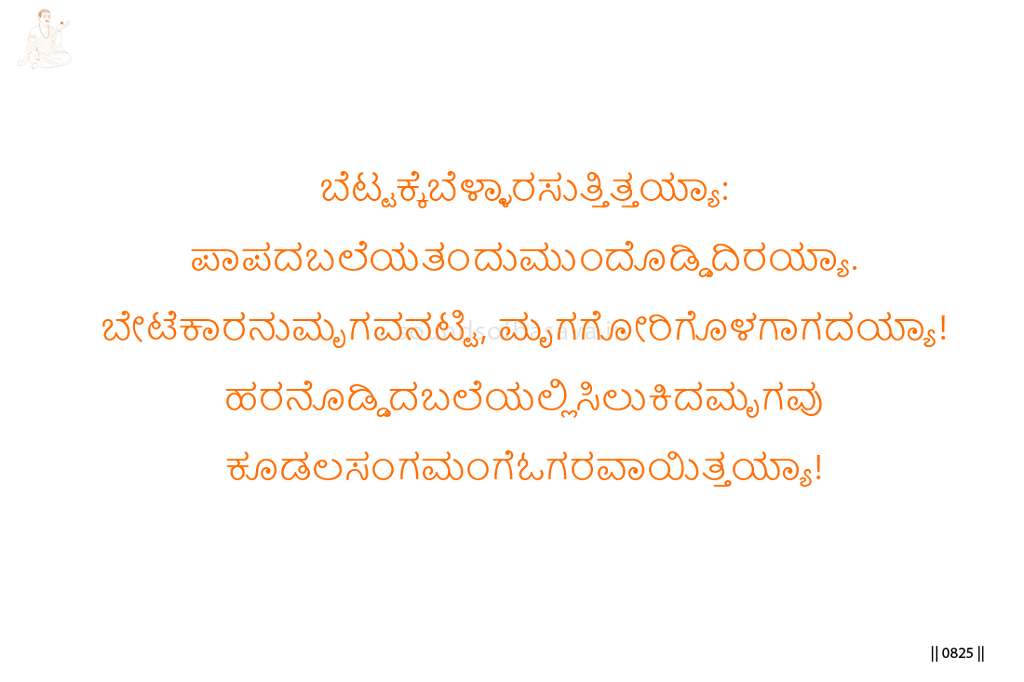
Basavanna begins with the weight of accumulated action, piled like a mountain. Before him stands the net of sin or bondage, already spread. The seeker is not shown as free-moving; he is placed within a field where past action and present entanglement have force.
The deer and hunter image gives the vachana its sharpness. When the hunter comes driving the deer, the deer cannot escape into safety. The trapped condition is unavoidable once it has entered the net.
Yet the final line reverses the meaning of capture. The deer caught in Hara’s net becomes fit for Kudalasangama Deva. What first appears only as bondage becomes, through the Lord’s act, the place where the creature is made worthy. The Sharana-stage teaching is therefore not escape by denial, but transformation within the very field of entanglement.
Imagery & Symbolic Relevance
The mountain is the first image. It indicates the accumulated weight of action. Basavanna does not treat past action lightly; it stands before the seeker with the heaviness of something gathered over time.
The net is the second image. It is not a loose or harmless surrounding. It is spread before the creature as a binding field. The phrase points to the condition in which sin, action, and bondage have already enclosed the seeker.
The hunter is the active image. The deer is not simply standing still; it is driven. The hunter’s coming makes escape impossible. Basavanna’s concern here is the decisive moment when wandering can no longer continue as before.
The deer is the vulnerable image. It represents the one caught in movement, fear, and flight. Once driven into the net, its former freedom is no longer available.
The final reversal is central. The deer caught in Hara’s net becomes worthy for Kudalasangama Deva. The same net that appears as capture becomes the condition through which the creature is brought into Divine fitness.
The movement of the vachana is therefore exact: accumulated action stands like a mountain; the net of bondage is spread; the hunter drives the deer; the deer cannot escape; yet in Hara’s net, the caught creature becomes acceptable before Kudalasangama Deva.
Lingayoga
In Lingayoga, this vachana teaches that bondage must be seen truthfully. The practitioner should not deny accumulated action or the force of entanglement. The mountain and net must be acknowledged.
For Sharana Sthala, the practice-point is surrender at the point where escape by self-movement fails. The deer cannot free itself by further running. When caught in Hara’s net, its condition is transformed by Kudalasangama Deva.
This guards against despair as well as self-confidence. The net is real, but it is not final in itself. When the Lord’s act takes hold of the bound creature, the very place of bondage becomes the place of being made worthy.
Editorial Commentary
The hunter, deer, and net should not be softened into a general moral image. Basavanna’s teaching depends on the reversal: the creature caught in the net becomes worthy before Kudalasangama Deva. The vachana therefore holds both truths together — the seriousness of karmic entanglement and the transforming power of Divine capture.
Related Vachana
Supporting Vachana
Pranalingi Sthala Vachana 964 — What Is Offered in the Body—Does It Truly Merge in the Linga?
Pranalingi Vachana 964 supports this teaching by distinguishing prana from the karma-born body and by asking how Kudalasangama Deva’s Sharanas hold the body while becoming nirmāya, free from the binding condition of māyā. This prepares Vachana 836 directly. In Vachana 964, the karma-born body continues, yet the Sharana is not finally governed by māyic bondage; in Vachana 836, accumulated action and the net of bondage are acknowledged, yet the deer caught in Hara’s net becomes worthy before Kudalasangama Deva.
Advancing Vachana
Aikya Sthala Vachana 1325 — When All Three Become One
Aikya Vachana 1325 advances this teaching by showing the full dissolution of bondage in Linga-Aikya. There, the divisions of Yoga, Bhoga, and Jnana are forgotten; Guru, Linga, and Jangama are realized as one movement; seer, seeing, and seen become one; and bondage is cut away as the devotee becomes the Vast Open Expanse. This is the Aikya-stage fulfillment of Vachana 836. In Sharana Vachana 836, the deer caught in the net is made worthy before Kudalasangama Deva; in Aikya Vachana 1325, the bondage itself is severed, and the devotee stands in the boundless openness of Linga-Aikya.
