

Summary
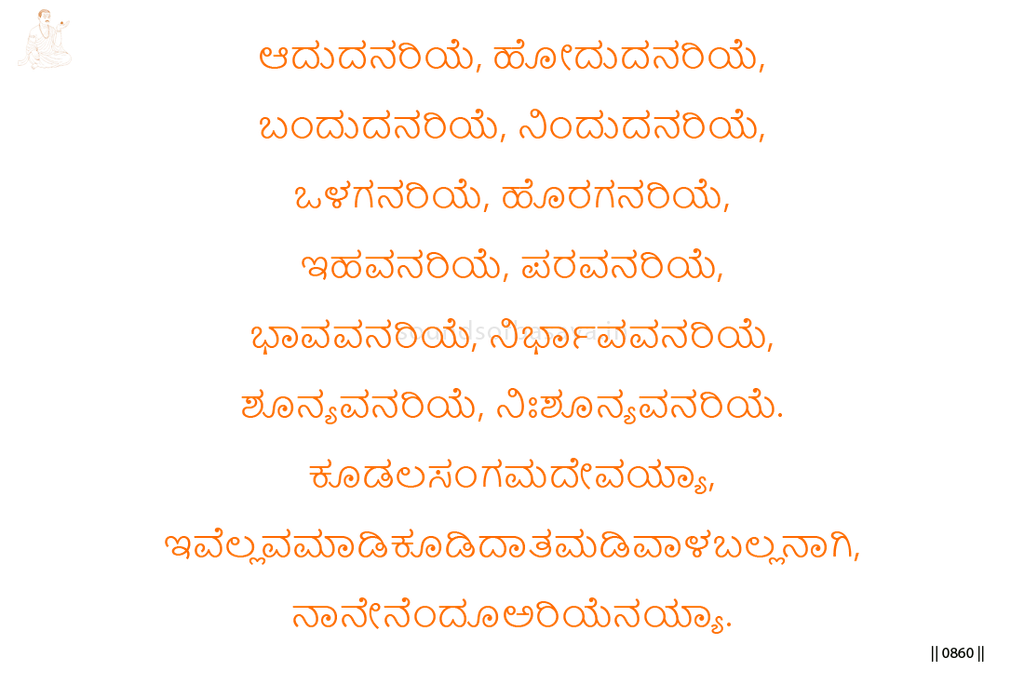
Basavanna honours Maḍivāḷa Machayya as one who knows the full range of states that ordinary seekers experience as divided. What has happened, what has passed, what has come, and what remains are known to him. Inner and outer, this world and the beyond, bhāva and nirbhāva, śūnya and niḥśūnya are all gathered into one knowing.
The vachana is not merely a catalogue of spiritual categories. Its force lies in the contrast between Machayya’s complete knowing and Basavanna’s own humility. The great Sharana knows the states that appear separate to others. Basavanna, standing before such realization, refuses to claim even self-knowledge.
The final confession, “I do not know what I myself am,” is therefore not ordinary ignorance. It is humility before realized wholeness. The ego wants to know itself and announce its state. Basavanna does not do this. He lets Maḍivāḷa Machayya stand as the knower and places himself in reverent not-knowing before Kudalasangama Deva.
Thus the vachana reveals Sharana humility at a high level. The seeker does not compete with realized beings, nor claim their measure. He honours the one who knows and remains without self-assertion.
Imagery & Symbolic Relevance
Basavanna honours Maḍivāḷa Machayya as one who knows the full range of states that ordinary seekers experience as divided. What has happened, what has passed, what has come, and what remains are known to him. Inner and outer, this world and the beyond, bhāva and nirbhāva, śūnya and niḥśūnya are all gathered into one knowing.
The vachana is not merely a catalogue of spiritual categories. Its force lies in the contrast between Machayya’s complete knowing and Basavanna’s own humility. The great Sharana knows the states that appear separate to others. Basavanna, standing before such realization, refuses to claim even self-knowledge.
The final confession, “I do not know what I myself am,” is therefore not ordinary ignorance. It is humility before realized wholeness. The ego wants to know itself and announce its state. Basavanna does not do this. He lets Maḍivāḷa Machayya stand as the knower and places himself in reverent not-knowing before Kudalasangama Deva.
Thus the vachana reveals Sharana humility at a high level. The seeker does not compete with realized beings, nor claim their measure. He honours the one who knows and remains without self-assertion.
Lingayoga
In Lingayoga, this vachana teaches reverence before integrated realization. The practitioner may pass through many states: inner and outer, worldly and transcendent, devotional movement and stillness, emptiness and what lies beyond emptiness. Yet the point is not to collect states or claim mastery over them.
For Sharana Sthala, the practice-point is humility before the realized Sharana. Maḍivāḷa Machayya represents the one in whom divisions have been gathered into knowing. Basavanna’s response is not comparison, but surrender of self-claim.
Arivu here is disciplined by humility. It does not become self-certification. Achara becomes reverence toward one who truly knows. Kayaka and Dasoha are protected from pride because the seeker no longer uses spiritual experience to declare himself complete.
Editorial Commentary
The paired terms should be preserved without excessive explanation. The vachana’s strength lies in the repeated “he knows” and the final “I do not know.” Maḍivāḷa Machayya’s realized knowing and Basavanna’s humble not-knowing must be held together. Reducing the final line to mere ignorance would weaken the vachana; inflating it into self-declared realization would also misread it.
Related Vachana
Supporting Vachana
Pranalingi Sthala Vachana 994 — The Incomprehensible State of the Sharana
Pranalingi Vachana 994 supports this teaching by saying that the state of Kudalasangama Deva’s Sharanas cannot be measured within heaven, the mortal world, or the nether world. They are beyond ordinary category, of undivided greatness, and established in a true unstained condition. This prepares Vachana 1047 directly. In Vachana 994, Basavanna says that if he does not know the state of the Lord’s Sharanas, what else can he truly know; in Vachana 1047, Maḍivāḷa Machayya is shown as one who has gathered and known the full range of states, while Basavanna remains humble before that greatness.
Advancing Vachana
Aikya Sthala Vachana 1013 — Worshipping the Knower Until Only Truth Remained
Aikya Vachana 1013 advances this teaching by moving from the reverence for one who knows all states into the dissolution of knowing itself. There, Basavanna worships the Knower, and then knowledge fades, memory disappears, bhāva becomes nirbhāva, and he enters Truth itself, dwelling everywhere in Kudalasangamayya. This is the natural Aikya fulfillment of Vachana 1047. In Sharana Vachana 1047, Maḍivāḷa Machayya knows the gathered totality of states, while Basavanna says he does not know himself; in Aikya Vachana 1013, the very structure of knowing and self-reference dissolves until only Truth remains in Kudalasangama Deva.
