

Summary
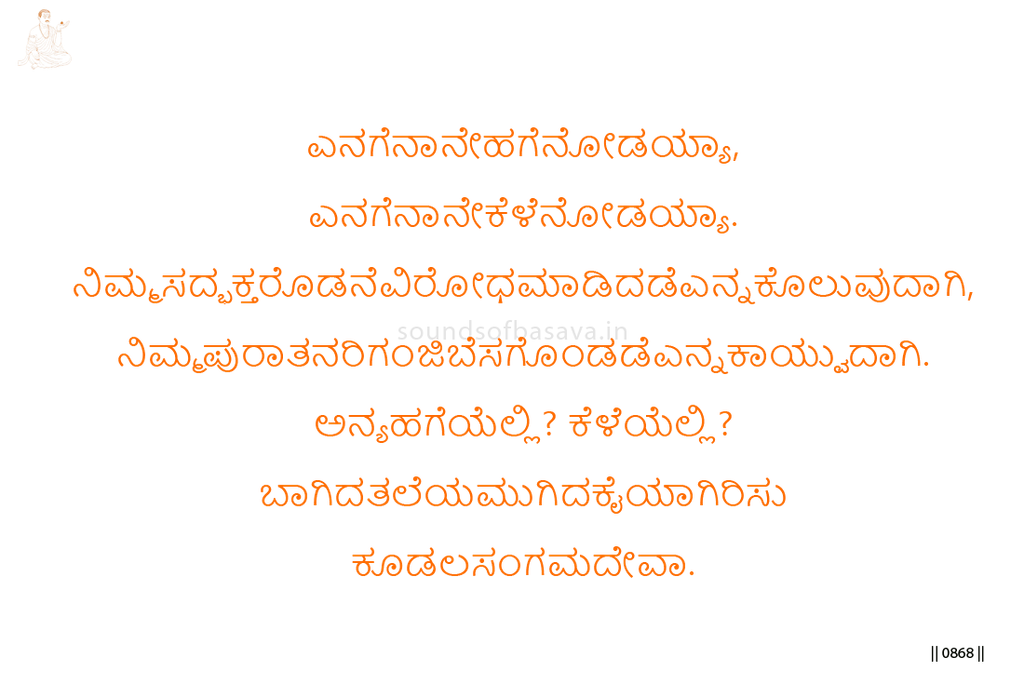
Basavanna turns the question of enemy and friend inward. He says that he himself is his own enemy, and he himself is his own friend. The source of destruction or preservation is not finally outside him; it lies in his own orientation toward Kudalasangama Deva’s Sharanas.
If he opposes the Lord’s true Sharanas, that opposition becomes self-destruction. If he holds fast to the ancient devotees, that nearness becomes preservation. The Sharanas do not become ordinary allies or opponents. They reveal the seeker’s inward condition.
The rhetorical question, “Where is another enemy? Where is another friend?” completes the inward turn. Basavanna no longer searches outside for blame or rescue. The decisive matter is whether the self stands opposed to the Sharanas or bows into their company.
The final prayer is simple: keep my head bowed and my hands folded. Basavanna does not ask to defeat enemies or secure allies. He asks to remain in the posture that prevents opposition and preserves reverence before Kudalasangama Deva.
Imagery & Symbolic Relevance
The first image is the self as enemy. Basavanna does not say that another person is the enemy, nor does he place blame upon circumstance. The “I myself” becomes enemy when it turns against the Lord’s true Sharanas.
The second image is the self as friend. The same self becomes friend when it holds fast to the ancient devotees. The inner condition is not fixed. It is shaped by orientation: opposition destroys; clinging to realized company preserves.
The true Sharanas form the test of the vachana. One’s relation to them reveals whether the self is moving toward destruction or preservation. To oppose them is not merely to disagree outwardly; it is to resist the field of truth they embody.
The ancient devotees represent the sustaining lineage of realized devotion. To cling to them is to remain attached to the path that protects. This is not ordinary dependence; it is rightful nearness to those established before Kudalasangama Deva.
The questions about enemy and friend remove external projection. Once the inner orientation is seen, the search for another enemy or another friend loses force.
The bowed head and folded hands are the closing images. The bowed head refuses pride. The folded hands refuse opposition. Together they form the posture of surrender, reverence, and right relation.
Lingayoga
In Lingayoga, this vachana teaches vigilance over orientation. The seeker must ask whether the inner movement is opposing the Sharanas or holding to them.
For Sharana Sthala, the practice-point is direct: stop looking outside for the real enemy or the real friend. The enemy is the self when it resists realized company. The friend is the self when it remains joined to the ancient devotees.
The posture of practice is humility. Keep the head bowed and the hands folded. This bodily image carries the inward discipline: do not stand in pride before the Sharanas; remain in reverence before Kudalasangama Deva.
Editorial Commentary
The words “enemy” and “friend” should be read through the vachana’s own conditions. Basavanna is not denying that people may help or harm in ordinary life. He is identifying the deeper spiritual measure: opposition to the Sharanas destroys, and nearness to the ancient devotees preserves.
Related Vachana
Supporting Vachana
Pranalingi Sthala Vachana 824 — The Moment That Cannot Be Lost
Pranalingi Vachana 824 teaches that even a moment of broken relationship with the living Jangama is spiritually unbearable.
This prepares Vachana 1076, where opposition to the true Sharanas becomes self-destruction, while holding firmly to the ancient devotees preserves life and establishes humble reverence.
Advancing Vachana
Aikya Sthala Vachana 473 — Lifted into the Embrace
Aikya Vachana 473 advances this teaching by carrying humble nearness to the Sharanas into fulfilled belonging. There, Basavanna becomes one among the servants in the house of the Sharanas, receives and holds what they have lived, and the bonds of becoming fall away before Kudalasangama Deva lifts him into His embrace. This is the natural Aikya fulfillment of Vachana 1076. In Sharana Vachana 1076, the seeker asks to remain with head bowed and hands folded, preserved by holding to the ancient devotees; in Aikya Vachana 473, that humble nearness ripens into complete reception, purification, and Divine acceptance.
