

Summary
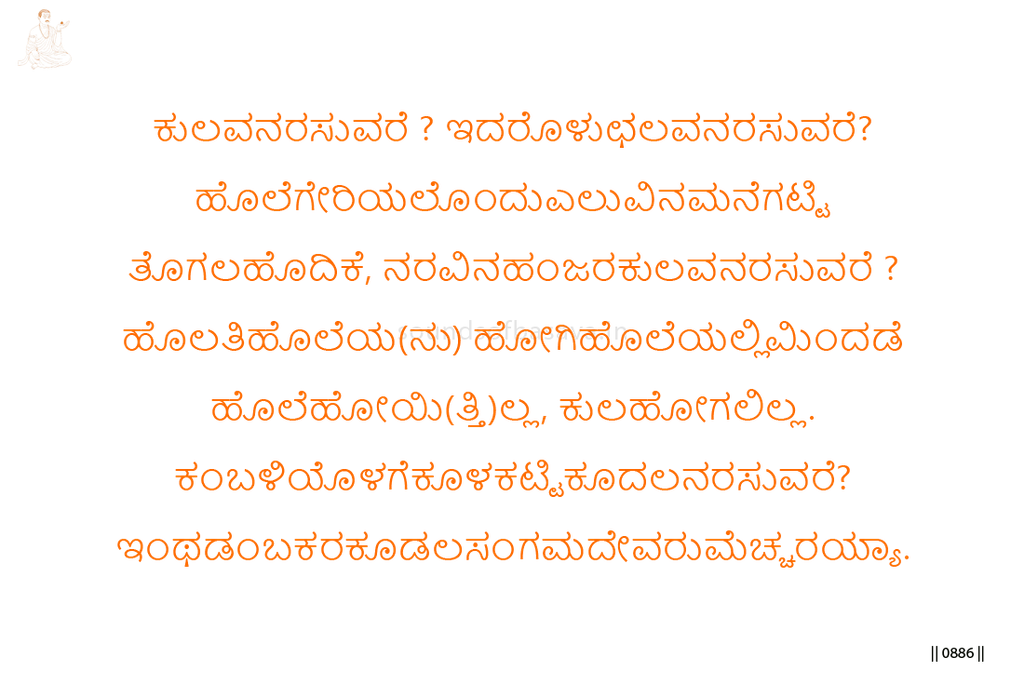
Basavanna dismantles caste-pride by turning attention to the body itself. Do they search for caste? Do they search for lineage? In this body made of bones, covered with skin, and held together by nerves, where is caste to be found?
The vachana exposes the emptiness of inherited superiority. The human body offers no inner proof of caste or lineage. Social distinction is imposed upon a common bodily condition; it is not written into bone, skin, or nerve.
Basavanna then turns to external purification. Bathing may remove dirt, but it does not remove caste-consciousness. Wrapping oneself in a blanket or adopting an outward religious appearance does not create purity.
The final judgment is severe: such pretenders do not please Kudalasangama Deva. The Lord is not pleased by caste-searching, lineage-pride, bodily purity claims, or religious disguise. What matters is truth, humility, and the end of false distinction.
Imagery & Symbolic Relevance
The first image is the search for caste. Basavanna begins with a question, not a declaration. The question itself exposes the absurdity of the search. If one looks closely, caste cannot be found as a spiritual reality.
The second image is lineage within caste. Basavanna does not stop with caste as a broad identity; he also questions the subtler pride of family, ancestry, and inherited standing.
The third image is the body as a hut of bones. The body is reduced to its basic structure. Once seen in this way, the claims of superiority attached to birth become hollow.
The fourth image is skin as covering. Skin hides the common structure beneath, but it also becomes the surface upon which social distinctions are imposed. Basavanna strips away that surface claim.
The fifth image is the cage of nerves. This intensifies the bodily realism of the vachana. The body is not a vessel marked by caste; it is a living structure common to all.
The river-bath image distinguishes physical cleansing from inner release. Water can remove dirt from the body. It cannot remove the pride that clings to caste.
The blanket image exposes religious appearance. A person may sit wrapped in marks of austerity or purity, but if the inner search is still for caste and superiority, the covering only conceals pretension.
The final word, “pretenders,” gives the vachana its moral force. Basavanna is not merely making a social observation. He is exposing a spiritual falsehood that cannot please Kudalasangama Deva.
Lingayoga
In Lingayoga, this vachana teaches the rejection of birth-based measurement. The seeker must not look for spiritual worth in caste, lineage, bodily identity, ritual bathing, or outward appearance.
For Sharana Sthala, the practice-point is direct: do not search for caste in the body, and do not search for purity in coverings. The body is common; the Lord’s truth is not inherited through social rank.
This vachana also disciplines perception. The seeker must learn to see without caste-pride and without external purity-claims. What pleases Kudalasangama Deva is not social distinction, but the truthfulness that refuses deception.
Editorial Commentary
The body imagery should remain stark. Basavanna deliberately names bones, skin, and nerves to remove the glamour of caste and lineage. The criticism is not aimed at the body itself, but at the false spiritual claims imposed upon it. The word “pretenders” should also remain strong, because the vachana judges caste-pride and religious display as deception before Kudalasangama Deva.
Related Vachana
Supporting Vachana
Pranalingi Sthala Vachana 715 — The Master of the House
Pranalingi Vachana 715 supports this teaching by overturning birth-based judgment through the presence of Kudalasangama Deva. There, Basavanna says he will not enter the house where the Lord is absent, but even one called Shvapacha is truly Kulaja if Kudalasangama Deva dwells within. This prepares Vachana 1152 directly. In Vachana 715, true nobility is determined by Divine indwelling, not social designation; in Vachana 1152, Basavanna asks where caste can be found in bones, skin, nerves, bathing, or blankets, and rejects such pretension before Kudalasangama Deva.
Advancing Vachana
Aikya Sthala Vachana 1153 — Beyond Distinctions, Into Grace
Aikya Vachana 1153 advances this teaching by dissolving caste and all related distinctions into equal vision. There, Basavanna says that once caste, status, pretension, and position are not looked at, and once seekers are joined in the Divine path, the question of greater and lesser no longer arises. This is the natural Aikya fulfillment of Vachana 1152. In Sharana Vachana 1152, caste-pride is exposed as empty before the common body and rejected as deception; in Aikya Vachana 1153, the whole structure of higher and lower is dissolved, and the devotee is instructed to receive all in equal measure before Kudalasangama Deva.
