

Summary
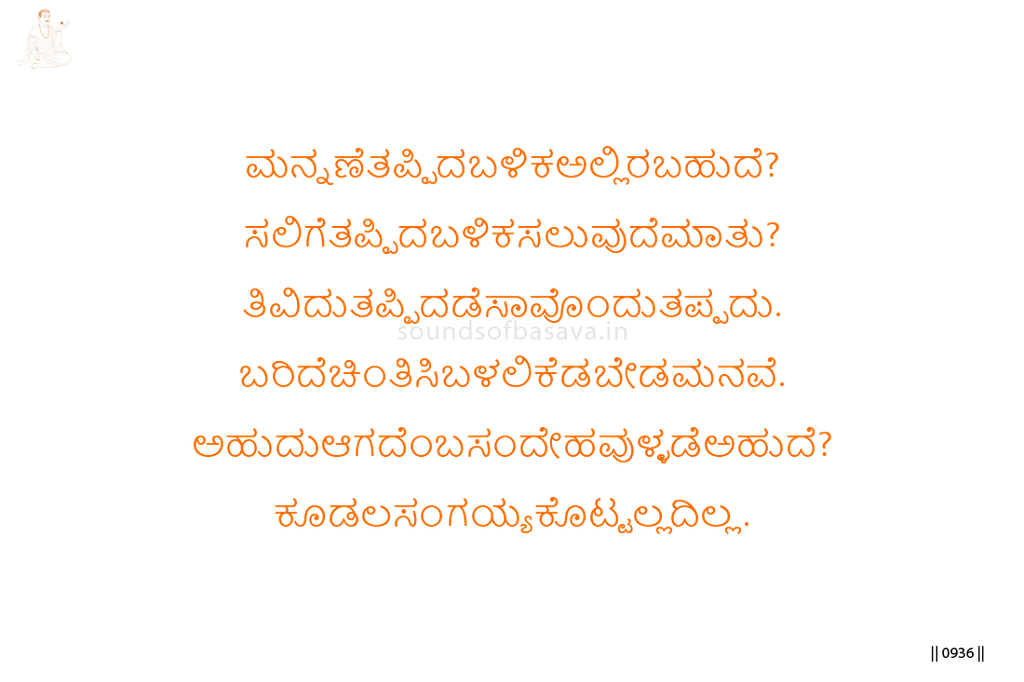
Basavanna addresses the wavering mind and warns it against exhausting itself in fruitless worry. Once honour is lost, once harmony is broken, and once a mortal wound is given, mere anxiety cannot undo what has happened. The mind must not keep circling around loss and regret.
The deeper obstacle is doubt. So long as the mind remains divided, asking, “Will it happen, or will it not happen?” fulfilment cannot take place. Basavanna ends with a firm assurance: Kudala Sangayya has withheld nothing. The barrier is not the Lord’s refusal, but the mind’s hesitation to trust what has already been given.
Imagery & Symbolic Relevance
The first image is honour lost. Basavanna asks what remains after honour has slipped away. The point is not to deepen shame, but to show that worry cannot restore what has already fallen.
The second image is harmony lost. When the bond of agreement or right relation is broken, words alone cannot make it whole. Speech becomes weak when the living foundation beneath it has failed.
The third image is being pierced through. Once a fatal wound has been made, death does not fail to follow. Basavanna uses this severe image to show that some consequences must be faced directly; they cannot be undone by endless mental agitation.
The fourth image is the mind wearing itself out. Basavanna turns inward and speaks to the mind itself. He tells it not to grow exhausted by thinking, grieving, and circling around what cannot be repaired by anxiety.
The fifth image is doubt asking, “Will it happen, or will it not happen?” This is the heart of the vachana. Doubt here is not sincere inquiry; it is inner wavering. When the mind remains split between trust and distrust, the very happening it longs for is obstructed.
The final image is Kudala Sangayya withholding nothing. Basavanna places the responsibility clearly. The Lord has not kept back what is needed. Grace is not lacking. What must cease is the mind’s exhausting hesitation before what has already been bestowed.
Lingayoga
In Lingayoga, this vachana teaches that the mind must stop wasting its strength in regret and doubt. The path cannot mature while the seeker remains divided by the question, “Will it happen or not?”
For Sharana Sthala, the practice-point is direct: do not wear out the mind with fruitless sorrow. Trust that Kudala Sangayya has withheld nothing. Stand firmly in what has been given, and let doubt fall away.
Editorial Commentary
This vachana should not be read as indifference toward failure or loss. Basavanna is not dismissing the seriousness of honour lost, harmony broken, or harm done. He is warning that worry alone cannot heal them. The true remedy begins when doubt ends and trust in Kudala Sangayya becomes steady.
Related Vachana
Supporting Vachana
Pranalingi Sthala Vachana 979 — Without Experience, Nothing Ripens
Pranalingi Vachana 979 supports this teaching by showing that spiritual life must ripen into lived experience, not remain as outer association or untested thought. This prepares Vachana 1307, where Basavanna warns the mind not to remain trapped in doubt and anxious circling. In Vachana 979, experience is necessary for ripening; in Vachana 1307, doubt is shown as the obstruction that prevents such ripening.
Advancing Vachana
Aikya Sthala Vachana 1415 — One Moment of Living Experience
Aikya Vachana 1415 advances this teaching by showing the fulfilment that comes when doubt gives way to direct experience. In Sharana Vachana 1307, Basavanna tells the mind not to exhaust itself with “Will it happen or will it not happen?” because Kudala Sangayya has withheld nothing. In Aikya Vachana 1415, even one moment of living experience of the Sharanas becomes greater than accumulated practice. The movement advances from the abandonment of doubt to the certainty of direct Anubhava.
