

Summary
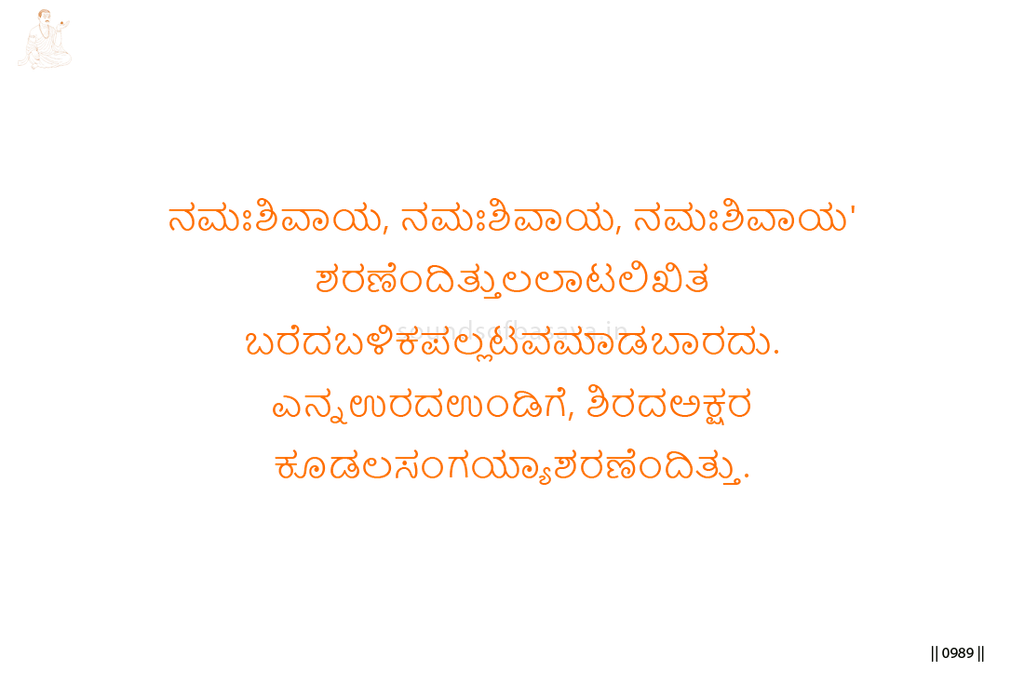
Basavanna repeats “Namah Shivaya” three times and says that it is written as surrender upon the forehead. This is not mere repetition of a sacred sound; it is the fixing of refuge into awareness. What has been written in this way cannot be erased or reversed.
The chest bears the seal, and the head bears the sacred letters. The realization is therefore not only inward feeling, nor only mental understanding. It is both lived and known. The Name has entered the body, awareness, and identity.
Before Kudalasangama Deva, surrender is no longer an occasional act. It has become an irreversible state. What was once uttered now stands inscribed; what was once taken as refuge now cannot be withdrawn.
Imagery & Symbolic Relevance
The threefold utterance of “Namah Shivaya” forms the opening movement of the vachana. Basavanna does not repeat the Name for ornament. The repetition shows fullness of surrender. The Name is not held lightly; it is allowed to enter again and again until no separate standpoint remains.
The word “sharane” gives the mood of the vachana. The Name is not merely recited; it is taken as refuge. “Namah” carries the bowing of the separate self, and “Shivaya” turns that bowing toward Shiva, the auspicious Whole. In this way the Name becomes surrender itself.
The inscription upon the forehead is the first strong image. The forehead is the place of recognition and inward orientation. When “Namah Shivaya” is written there, awareness has been marked by the Name. The seeker no longer stands before the Name from outside; the Name has entered the very field of seeing.
The statement that what is written should not be erased gives the vachana its force. Basavanna is not speaking of a temporary religious mood. True recognition cannot be casually reversed. Once surrender has become inward inscription, the old separateness cannot reclaim its former authority.
The seal upon the chest is the second bodily image. The chest is the region of living devotion and inner holding. The seal suggests that the Linga-presence has become established in the heart of life. It is not merely remembered at the level of speech; it is borne inwardly.
The letters upon the head complete the alignment. The head carries understanding; the chest carries living presence. Together they show that surrender must be both known and embodied. The Name must not remain only on the tongue, nor only in feeling, nor only in thought. It must become a complete inscription.
The final address to Kudalasangayya gathers all these images into refuge. The forehead, chest, and head do not become separate symbols of attainment. They are all surrendered before Kudalasangama Deva. The body is marked, awareness is marked, and understanding is marked by the same irreversible turning.
Together, the imagery shows the Name becoming destiny—not fate imposed from outside, but identity recognized within. What is written cannot be erased because it is no longer an external mark; it has become the truth by which the seeker now lives.
Lingayoga
The threefold utterance of “Namah Shivaya” forms the opening movement of the vachana. Basavanna does not repeat the Name for ornament. The repetition shows fullness of surrender. The Name is not held lightly; it is allowed to enter again and again until no separate standpoint remains.
The word “sharane” gives the mood of the vachana. The Name is not merely recited; it is taken as refuge. “Namah” carries the bowing of the separate self, and “Shivaya” turns that bowing toward Shiva, the auspicious Whole. In this way the Name becomes surrender itself.
The inscription upon the forehead is the first strong image. The forehead is the place of recognition and inward orientation. When “Namah Shivaya” is written there, awareness has been marked by the Name. The seeker no longer stands before the Name from outside; the Name has entered the very field of seeing.
The statement that what is written should not be erased gives the vachana its force. Basavanna is not speaking of a temporary religious mood. True recognition cannot be casually reversed. Once surrender has become inward inscription, the old separateness cannot reclaim its former authority.
The seal upon the chest is the second bodily image. The chest is the region of living devotion and inner holding. The seal suggests that the Linga-presence has become established in the heart of life. It is not merely remembered at the level of speech; it is borne inwardly.
The letters upon the head complete the alignment. The head carries understanding; the chest carries living presence. Together they show that surrender must be both known and embodied. The Name must not remain only on the tongue, nor only in feeling, nor only in thought. It must become a complete inscription.
The final address to Kudalasangayya gathers all these images into refuge. The forehead, chest, and head do not become separate symbols of attainment. They are all surrendered before Kudalasangama Deva. The body is marked, awareness is marked, and understanding is marked by the same irreversible turning.
Together, the imagery shows the Name becoming destiny—not fate imposed from outside, but identity recognized within. What is written cannot be erased because it is no longer an external mark; it has become the truth by which the seeker now lives.
Editorial Commentary
This vachana should be read as a teaching on irreversible recognition. The phrase “what is written cannot be erased” should not be softened into ordinary piety. Basavanna is describing a state where surrender has become established.
The chest seal and head letters should remain close to the source image. They show embodied presence and awakened understanding, not a decorative religious mark alone. The Name is not outside the seeker; it has become the seeker’s own inward inscription before Kudalasangama Deva.
Related Vachana
Supporting Vachana
Sharana Sthala Vachana 697 — Death Is No Threat to the One Who Walks With the Lord
Sharana Vachana 697 supports this teaching by showing that what Kudalasangama Deva has written cannot be altered. There, even Hari and Brahma cannot overturn the Lord’s writing, and the seeker is taught steadiness before death, certainty, and the Lord’s decree.
Aikya Vachana 86 carries that certainty into the field of surrender. In Vachana 697, what the Lord writes must be accepted and cannot be avoided. In Vachana 86, that writing becomes the inscription of “Namah Shivaya” itself. What was first accepted as divine certainty now becomes sealed refuge: the Name is written, and it cannot be erased.
Advancing Vachana
Aikya Sthala Vachana 1344 — When Linga Is Anga and Anga Is Linga
Aikya Vachana 1344 advances this teaching by carrying inscription into complete non-division. In Vachana 86, “Namah Shivaya” is written upon the forehead, sealed upon the chest, and borne as letters upon the head. Surrender has become irreversible.
In Vachana 1344, this irreversible surrender ripens further: Linga is known as Anga, Anga as Linga; Linga as Prana, Prana as Linga. Nothing needs to be shown as existing, and nothing needs to be sought as absent. The written seal of Vachana 86 advances into uninterrupted Linga itself. What was inscribed as refuge becomes unbroken Aikya-presence before Kudalasangama Deva.
