

Summary
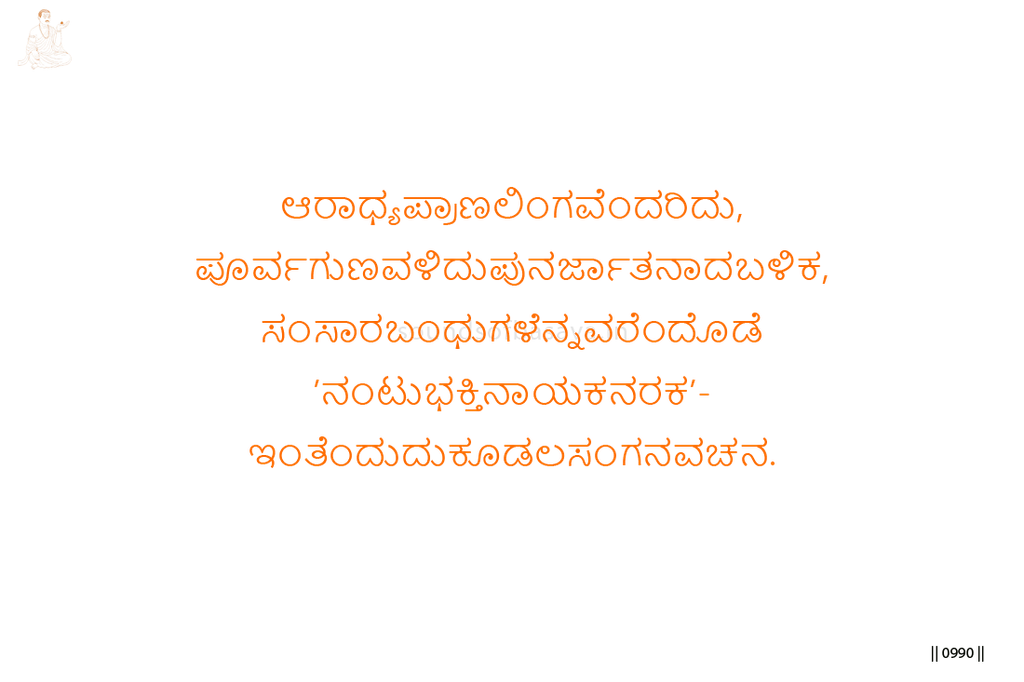
Basavanna speaks of a decisive recognition: the worshipful one is known as Pranalinga. Linga is no longer treated as distant or external; it is recognized as living presence.
After this recognition, former qualities fall away and the seeker is “reborn.” This rebirth is not ordinary birth, but a changed state of awareness in which inherited identity and old separations lose their authority.
The warning comes in the final movement. If, after such recognition, one still clings to worldly bonds as “mine,” that divided devotion becomes the path to fall. The Aikya source states that the contradiction itself is the fall: knowing unity but living division becomes the real hell before Kudalasangama Deva.
Imagery & Symbolic Relevance
The phrase “knowing the worshipful as Pranalinga” gives the first movement of the vachana. The Linga is not approached only as an outer object of reverence. It is known as Pranalinga, the living Linga, the presence joined to life itself. The source explains Pranalinga as the Linga realized as living presence, the awareness within breath and continuity within beings.
The phrase “former qualities falling away” gives the second movement. Basavanna points to the dropping of old identity-marks. The source clarifies that this refers to the dissolution of inherited constructs such as caste, status, and ego-based distinctions.
The phrase “being reborn” gives the third movement. This is not biological rebirth. It is rebirth after recognition: the seeker no longer lives by the old basis of division. The source explains this as awakening into equality, where all beings are seen within the same field of presence.
The phrase “if one calls worldly bonds one’s own” gives the warning. Basavanna does not reject relationship itself. He rejects the return to possessive attachment after Pranalinga has been known. When the old “mine” returns, the earlier realization becomes divided in conduct.
The phrase “divided devotion” names the inner split. Devotion remains outwardly present, but its ground has become fractured. One part turns toward Pranalinga; another part clings to inherited separation, social attachment, or possessive identity.
The word “hell” gives the consequence. Basavanna is not describing a remote place here. The source states that hell is the condition of knowing unity yet living division. The fall is therefore inward: realization has been seen, but conduct returns to separation.
The closing statement, “this is Kudalasangama’s vachana,” seals the teaching as a direct warning. After Pranalinga is known, divided living cannot be treated as harmless. Kudalasangama Deva’s word makes the measure clear.
Together, the lines move from living recognition, to shedding old qualities, to rebirth, and then to warning. What has been realized must not be contradicted by possessive bonds.
Lingayoga
In Lingayoga, this vachana teaches that recognition must change belonging. To know Pranalinga and yet continue to live by old bonds is divided practice.
The practice-point is direct: after Linga is known as living presence, the seeker must watch where the word “mine” still governs conduct. Family, relation, caste, status, and worldly nearness cannot be allowed to reintroduce separation as spiritual truth.
The source states that true devotion cannot coexist with inequality once the Linga is realized as all-pervading. Therefore the relevance of this vachana lies in consistency: what is known inwardly must be lived without division.
Editorial Commentary
This vachana should be read as a strict warning against contradiction after realization. Basavanna is not condemning ordinary relationships by themselves. He is warning against possessive and divisive attachment after Pranalinga has been known.
The danger is subtle. Before realization, bondage appears as ignorance. After recognition, returning to division becomes a deeper fall because it goes against what has already been seen.
Related Vachana
Supporting Vachana
Sharana Sthala Vachana 451 — Breaking of Bonds
In that vachana, Basavanna exposes the bonds that remain even after one calls oneself a bhakta: caste-pride, old dependence, gain, fear, and inherited identity. The source states that devotion must not be added onto an unchanged self, and that the seeker must examine what still binds after calling oneself a bhakta.
Aikya Vachana 89 carries this into the Pranalinga stage of recognition. In Sharana Vachana 451, false bonds must be broken so that the seeker belongs rightly to Kudalasangama Deva’s Sharanas. In Aikya Vachana 89, after Pranalinga is known and former qualities fall away, to return to worldly bonds as “mine” becomes divided devotion itself.
Advancing Vachana
Aikya Sthala Vachana 1084 — The Revelation Within the Karasthala
Aikya Vachana 1084 advances this teaching within Aikya Sthala. In Vachana 89, Basavanna warns that after Pranalinga is known, returning to division becomes the fall. In Vachana 1084, the distinction between inner and outer disappears in the experience of the Karasthala-Linga, and the Sharanas are revealed within that field of realization.
Thus Vachana 89 warns against divided devotion, while Vachana 1084 shows the deeper state in which division itself no longer governs perception. What Vachana 89 protects from contradiction, Vachana 1084 fulfills as vision purified through Kudalasangama Deva’s Sharanas.
